49 works in this view — arrow keys or swipe to move between them.
Dance in Art
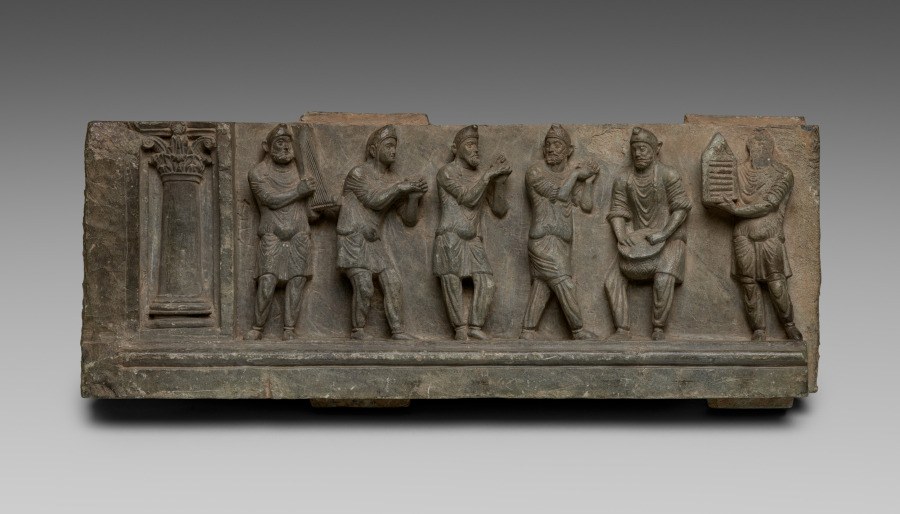
Dancers and Musicians from Phrygia
Unknown artist
- Source:
- Cleveland Museum of Art
- Rights:
- Public domain — free to use, share and adapt.
- Recorded as:
- CC0 (Public Domain)
Ancient sources for the movement practices of non-Greek Mediterranean cultures are scarce; this carving is direct visual evidence of Phrygian ritual or celebratory movement. The work demonstrates that dance was important enough to commemorate in a public or sacred architectural context, suggesting it played a significant role in religious or civic life.
What you are looking at
A limestone relief carving depicts seven figures in a shallow rectangular field, arranged in a processional line across the composition. On the far left stands a fluted column or architectural element. The six remaining figures move or stand in varied poses, each wearing what appears to be a short draped garment. Several raise their arms in expressive gestures—some with hands brought together near the chest or raised outward. The rightmost figure wears a distinctive ribbed or scaled garment, possibly armor or ceremonial dress, and carries what may be an object of regalia. The carving is weathered but legible, with the figures shown in shallow relief against a flat ground line. No setting beyond the architectural fragment is indicated; the focus is entirely on the human bodies and their gestures.
The dancing
The bodies display a variety of arm and torso positions suggesting movement or ritual action rather than static stance. Three of the central figures have their arms raised or bent across their bodies in nearly symmetrical poses; two others hold their arms at their sides or lower. The figures appear to progress from left to right, and their varied postures—some upright, some with weight shifted—suggest either sequential movement or a moment of coordinated action. No clear partnering or paired holds are visible; this appears to be either individual dancers or participants in a group ritual aligned in a line.
The dance depicted
The relief is catalogued as depicting dancers and musicians from Phrygia, a region of ancient Anatolia (modern Turkey). The varied arm gestures, raised hands, and forward movement are consistent with ecstatic or celebratory ritual movement, but the work offers no certain evidence of a specific named dance form. The presence of what may be a musician or ceremonial official at the far right, and the formal processional arrangement, suggest this depicts a religious festival, rite, or ceremonial gathering rather than secular social dance. Without inscription or additional context, the specific movement vocabulary and cultural function remain open to interpretation.
How it was made
This is a carved limestone relief, a technique that allowed for public display and was common in Anatolia and the broader Mediterranean world. The shallow carving and repetitive figural arrangement suggest this was part of a larger architectural program—possibly a temple frieze, tomb monument, or public building—rather than a standalone object. The weathering visible in the image indicates significant age and exposure. Relief carving as a medium prioritizes silhouette and profile, which may have simplified or stylised the actual movement vocabulary of the dancers depicted.
About this work
This ancient relief carving documents a moment of collective movement or ritual action from Phrygian culture. The raised arms, varied body positions, and processional arrangement suggest either an ecstatic religious dance, a ceremonial procession, or a festival gathering. As a visual record of non-written dance practice from the ancient Mediterranean world, it offers rare evidence of how movement was valued and commemorated in Anatolian society. The work belongs in a dance history collection because it represents one of the few surviving visual documents of pre-classical Anatolian movement culture and demonstrates that dance held sufficient cultural importance to warrant permanent representation in stone.
How to look at it
Observe the variety of arm positions and how each figure's body differs from its neighbors—this suggests the carver was documenting actual movement vocabulary rather than repeating a formula. Notice the raised or outward-facing hands on multiple figures; these are marks of ecstatic or celebratory gesture in ancient Mediterranean imagery. The presence of the architectural element (column) on the left and the figure with regalia on the right frames the dancers and suggests this was part of a narrative or ceremonial context. The shallow depth of the carving means that movement is read primarily through arm and torso position rather than spatial depth.
The period
Phrygia was a major kingdom in central Anatolia from the 8th century BCE onward, with significant cultural influence in the classical world. Phrygian religious practice, particularly the ecstatic worship of the goddess Cybele (Kybele), was known to the Greeks and Romans for its dramatic music and movement. This relief likely dates to the Phrygian period (8th–6th century BCE) or reflects Phrygian practices as represented in later Greco-Roman art. The style of relief carving and the figural treatment are consistent with Anatolian artistic traditions of the archaic and classical periods.
Where it lives
The work is held in the Cleveland Museum of Art and is identified as coming from Phrygia. The catalogue record provides minimal additional information about accession, date, or original context.
Dance in this work
Questions about this work
Is this a specific named dance form?
The relief does not preserve enough information to identify a named dance tradition. The raised arms and varied postures are consistent with ecstatic ritual movement associated with Phrygian religious practice, particularly worship of Cybele, but the image alone cannot confirm this or identify the specific movement vocabulary.
How do we know these are dancers and not just standing figures?
The varied arm positions, some raised or extended outward, and the forward-facing stance suggest active movement or ritual action rather than static position. The asymmetry of gesture across the figures supports interpretation as coordinated movement rather than formal procession in repose.
What does the column on the left represent?
The fluted column likely indicates an architectural or sacred setting—possibly a temple or public building where the ceremony took place. It may also serve to frame the narrative or establish the formal and public nature of the event depicted.
More dance artwork