49 works in this view — arrow keys or swipe to move between them.
Dance in Art
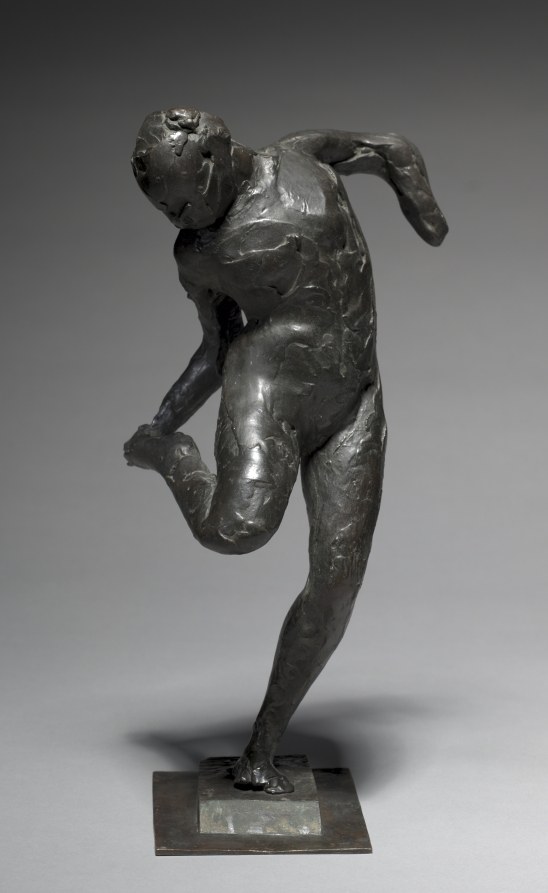
Dancer Looking at the Sole of her Right Foot
Edgar Degas (French, 1834–1917)
- Source:
- Cleveland Museum of Art
- Rights:
- Public domain — free to use, share and adapt.
- Recorded as:
- CC0 (Public Domain)
This work challenges the assumption that dance art must depict motion. By freezing the body in a moment of private self-examination, the artist reveals something essential about the dancer's relationship to her own form: the awareness, study, and proprioceptive knowledge that underpins all movement. The sculpture also preserves a modernist moment when artists moved away from narrative or spectacle toward the study of bodily form itself—a shift that would profoundly influence both sculpture and dance practice in the 20th century.
What you are looking at
A nude male figure stands in contrapposto on a small rectangular plinth, his weight shifted onto his left leg while his right leg bends slightly at the knee. His torso twists gracefully, with his head turned to gaze downward toward his right foot, which he appears to be examining or admiring. His right arm extends behind him along his body, while his left arm hangs naturally at his side. The figure is rendered in dark patinated bronze or similar metal, with visible tooling marks and surface texture suggesting hand-modeling and casting. The musculature is anatomically precise but idealized, with particular attention to the definition of the chest, abdomen, and limbs. The pose suggests a moment of introspection or self-regard rather than active movement—the dancer is pausing to look at her own body.
The dancing
A single female figure (the title specifies) stands in a contemplative contrapposto stance. The weight distribution reveals sophisticated understanding of balance: the standing leg is engaged and vertical, while the free leg—the right—is relaxed and slightly bent, positioned so the foot can be observed. The twist of the torso and downward gaze of the head create a vertical S-curve from shoulders to hips. The arms are positioned naturally, neither raised nor clasped, allowing the torso's line to be the primary focus. This is not a figure in motion but a figure pausing—a common subject in both academic sculpture and modernist studies of the body.
The dance depicted
This work does not depict an active dance moment. Rather, it represents a dancer at rest—a study of the body outside performance. The pose recalls academic life-drawing and neoclassical sculpture traditions in which the human form is studied in poses that reveal musculature and proportion. The title's emphasis on "looking at the sole of her foot" suggests an anatomical or proprioceptive interest: the awareness a dancer has of her own body, its capabilities and structure. This kind of introspective pose became common in modernist sculpture of the late 19th and early 20th centuries, where artists moved away from narrative action toward studies of form and bodily awareness. Without date or attribution, it is difficult to place precisely, but the style suggests early-to-mid 20th-century modernism.
How it was made
This is a bronze or dark-patinated metal sculpture, hand-modeled and cast. The surface retains visible marks of the artist's tool—subtle faceting and texture that suggest the work was carved or modeled rather than smoothed to a high polish. The casting process, whether lost-wax or sand-cast, has preserved fine anatomical detail while maintaining a sense of immediacy and directness. The patina—a dark greenish or blackish oxidation on the metal surface—indicates age and outdoor or museum display. The small scale and mounting on a discrete plinth suggest this is a gallery object, likely produced as an edition or a single cast for display rather than a monumental public work.
About this work
This is a modernist bronze sculpture of a single standing female figure examining her own foot in a moment of quiet self-regard. The work belongs to the early-to-mid 20th-century tradition of figure sculpture that prioritized anatomical study and formal composition over narrative action. The dancer is not performing but pausing—a moment of proprioceptive awareness translated into permanent form. The artist demonstrates a sophisticated understanding of the human body's proportions and the subtle dynamics of weight and balance, even in stillness. The work sits at the intersection of academic sculpture traditions (life drawing, neoclassical form) and modernist innovation (the reduction of the figure to essential form, the emphasis on the artist's hand and process). It belongs in a gallery about dance not because it depicts movement, but because it treats the dancer's body—at rest and self-aware—as a subject worthy of sustained aesthetic attention.
How to look at it
Attend to the precise moment the artist has chosen: not a leap, a turn, or an extended line, but a pause. The weight distribution in the contrapposto stance is subtle but crucial—it is the foundation of the pose's stability and grace. Notice how the artist has used the twist of the torso and the downward gaze to create a sense of inward focus, almost meditative. The hand-tooled surface of the bronze, visible in the subtle faceting and texture, reminds us that this is not a photographic capture but a constructed, deliberately composed statement about the body. The small scale of the figure and the intimate nature of the action—looking at one's own foot—invite close viewing and a kind of empathetic awareness of the dancer's private moment.
The period
The early-to-mid 20th century saw a dramatic shift in how sculptors approached the human figure. The academic traditions of the 19th century—which emphasized idealized form and narrative action—gave way to modernist investigation of form, material, and process. In dance, this same period witnessed a parallel move away from classical ballet toward new forms that emphasized the body as a site of expression and experimentation. Artists like Rodin, Brancusi, and others were producing studies of the human form that emphasized musculature, balance, and the artist's hand—exactly what we see here. The subject of a dancer examining her own foot resonates with this broader modernist interest in the body as both object of study and instrument of consciousness.
Where it lives
The work is held in the Cleveland Museum of Art collection and is documented in their dance-related art holdings. The record identifies it as coming from the CMA but does not provide accession number, date of acquisition, or prior provenance.
Questions about this work
Is this figure actually dancing?
No—the artist has chosen to depict a moment of stillness and self-regard rather than active movement. This is a common approach in modernist sculpture, which often prioritized studies of form and the body's capabilities over narrative action. The figure is pausing, aware of her own body, which is itself a kind of dance knowledge.
Why would someone make a sculpture of someone just standing there?
Modernist artists were fascinated by the human body as a formal problem and as a site of consciousness. By removing the figure from narrative context and focusing on a private moment of self-awareness, the artist invites us to consider the body itself—its proportions, balance, musculature, and the subtle dynamics of pose—as worthy of sustained attention. This approach influenced both visual art and modern dance, which similarly moved toward abstraction and formal investigation.
Could this be a specific dancer or role?
Without attribution or date information, it is not possible to say. The title describes only the pose and action, not a named dancer or character. It may be a study from life, an idealized figure, or a deliberate invention. The lack of specific identifying detail suggests the artist was more interested in the universal subject—a dancer's moment of self-examination—than in portraiture.
More dance artwork