49 works in this view — arrow keys or swipe to move between them.
Dance in Art
Dance of Death Death the Strangler
Alfred Rethel (German, 1816–1859)
- Source:
- Cleveland Museum of Art
- Rights:
- Public domain — free to use, share and adapt.
- Recorded as:
- CC0 (Public Domain)
The Danse Macabre is foundational to how Western culture has used dance imagery to express existential fear and the limits of human agency. For dancers and choreographers, this engraving is a crucial historical document showing how dance was understood not only as entertainment or courtship but as a metaphor for fate itself—a tradition that resurfaces in Romantic ballet and modern dance. Historians need this image because it shows the circulation of complex allegorical ideas through prints, reaching audiences far beyond the learned elite.
What you are looking at
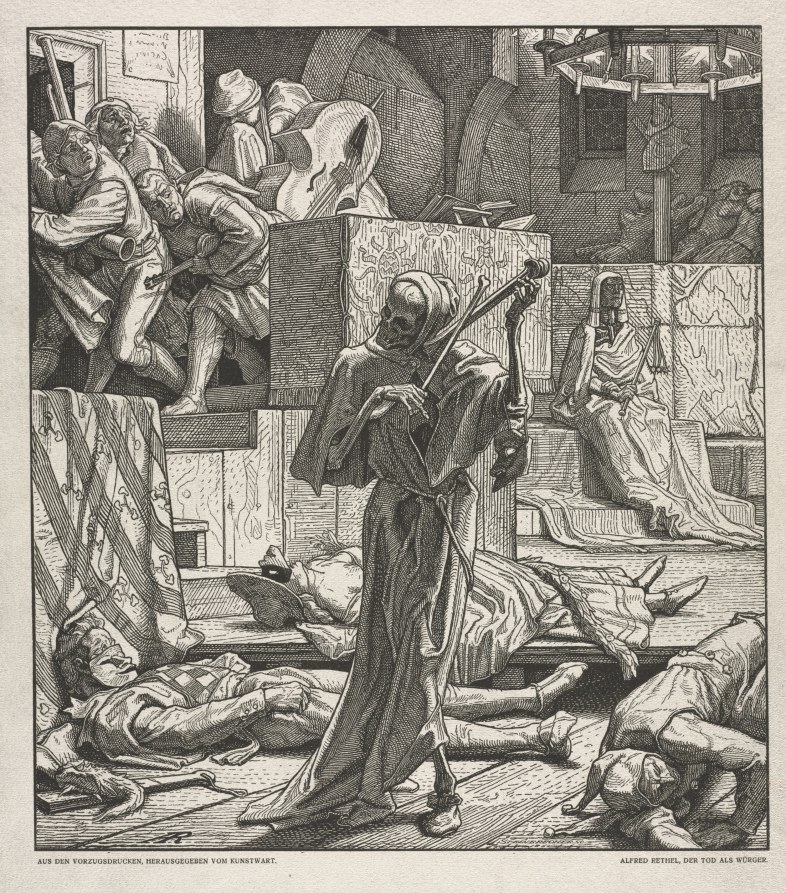
This is an engraving depicting the Danse Macabre or Dance of Death, a medieval allegory in which Death personified claims victims across all social stations. The composition is divided into multiple scenes across a single plate. In the foreground, a skeletal figure robed in a hooded cloak—Death itself—stands centrally with one arm raised, wielding what appears to be a scythe or similar implement. Around this figure lie the bodies of the dead or dying, their limbs arranged in attitudes of collapse and surrender. In the background, visible through architectural openings and at different spatial planes, other scenes unfold: the living seem to flee or dance, some appearing to waltz or embrace, while others gesture in despair. The setting combines interior and exterior spaces—there are architectural elements suggesting a town or village, with buildings, doorways, and what may be a bridge or fortification. The engraving technique creates strong contrasts between light and dark, with dense cross-hatching used to render shadow and volume. The overall mood is one of inevitability and terror: Death is omnipresent and inescapable, and the living cannot outrun it.
The dancing
The bodies throughout the composition are rendered in various states of collapse and distortion. Some figures appear to be dancing in pairs—one couple visible in the upper left shows two figures in what might be an embrace or waltz position—while others writhe or fall. Death's own posture is commanding: the skeletal figure stands upright with raised arm, dominating the smaller human figures around it. The limbs of the fallen are splayed and twisted, lacking the control or grace of living movement; the bodies appear weightless or inert. The living who still stand or move show agitation in their gestures—raised arms, turned heads, forward lunges. There is no unified formation or ballroom decorum; instead, chaos and disarray dominate, with figures at different scales and orientations across the plate.
The dance depicted
This is a visualization of the Danse Macabre, a cultural and artistic motif that emerged in medieval and early Renaissance Europe, particularly during and after periods of plague and mass mortality. The Dance of Death was not a dance in the modern sense but an allegorical warning: a procession or dance in which Death leads people of all ranks (peasants, nobles, clergy, merchants) to the grave. In art, it typically shows the living and the dead engaged in a grotesque parody of social dancing and courtship. This engraving captures the moment of Death's dominion: some figures still waltz or embrace, unaware or defiant, while others collapse around Death's feet. The work conflates social dance (the waltz or embrace visible in the upper portion) with literal death, suggesting that all human gaiety is futile in the face of mortality. The engraving does not depict a specific choreographed dance but rather uses the vocabulary of dance—coupling, movement, gesture—as metaphor for the inevitability of death.
How it was made
This is an engraving, a print made by incising lines into a metal plate (likely copper) and then inking and pressing the plate onto paper. The technique is evident from the fine parallel lines (hatching and cross-hatching) that model form and create tonal variation, characteristic of Northern European engraving of the 16th century onward. Engravings were among the most widely distributed and affordable artworks of the early modern period, allowing a single design to reach thousands of viewers across Europe. The inscription at the foot of the image—partially legible as a German or Dutch text—suggests this was created for a broad, vernacular audience rather than an elite collector. The technique's precision and capacity for fine detail made it ideal for complex narrative compositions with multiple figures and scenes, as seen here. The print would have circulated as a broadsheet or as part of an album or book on the theme of mortality.
About this work
This is an early modern engraving illustrating the Danse Macabre, one of the most powerful memento mori tropes of European art and culture. The work uses the visual language of social dancing—couples embracing, bodies in motion—to convey an allegory of death's claim on all humanity regardless of rank or virtue. The engraving technique allowed the artist to pack multiple narrative moments and social types into a single composition, creating a comprehensive vision of death's dominion. As a print, it would have been affordable and mobile, circulating widely among educated and popular audiences alike. It belongs in a gallery of dance in art not because it depicts a real dance but because it weaponizes the aesthetics of dance—its grace, its coupling, its pleasure—to create meaning about mortality and the futility of human joy. The work is a profound meditation on how dance itself can be inverted or perverted as a symbol of surrender.
How to look at it
Attend first to the central skeleton figure and its commanding posture: this is the organizing force of the entire composition, yet it is not the largest figure on the plate. Notice how the engraver has scattered human bodies and living figures across multiple spatial planes and depths, creating a sense of panic and inescapability—there is no place to hide from Death. Look at the couples who are still dancing or embracing in the background and middle distance: their grace and intimacy are rendered in the same careful cross-hatching as the corpses, suggesting that there is no real difference between social pleasure and death. Finally, observe how the engraver used light and dark to create drama: Death is often silhouetted or cast in shadow, making it loom larger than its actual size, while the living are caught in patches of light where they are still visible and hopeful.
The artist
The artist is not recorded in the catalogue, but the style, technique, and inscription suggest this is a Northern European engraving from the 16th or possibly early 17th century. The Danse Macabre was a popular subject across the German-speaking lands, the Low Countries, and France during this period, with numerous versions by different printmakers and in different media. The inscription at the foot appears to be in German or Dutch, supporting attribution to the North. Without signature or clear provenance, the work likely represents the output of a workshop tradition rather than a single identifiable master.
The period
The Danse Macabre emerged as a visual and textual motif in the late 14th century, gaining particular intensity after the Black Death (1347–1353), which killed one-third of Europe's population. The trope remained vivid through the Renaissance and into the baroque period, especially in Protestant regions where religious art became more focused on themes of sin, mortality, and divine judgment. In the 16th century, when this engraving likely dates, the Dance of Death appeared in prints, woodcuts, frescoes, and manuscripts across Northern Europe. Socially and artistically, the period saw an intensifying interest in macabre subjects and in the grotesque as a category of art. At the same time, formal ballroom dances like the pavan and galliard were becoming codified and fashionable among the nobility, making the contrast between the ordered, pleasurable social dance and the chaotic dance with Death all the sharper.
Where it lives
The work is held in the Cleveland Museum of Art. It is catalogued as a print artwork related to dance, though the catalogue record itself is sparse. The museum's collection includes northern European prints and engravings from this period, and this object fits within a tradition of morality and allegorical prints that circulated widely in the early modern period.
Questions about this work
Is this actually a dance?
Not in the literal sense. The Danse Macabre is an allegory in which Death leads people to the grave, using the imagery and metaphors of social dance to convey the inevitability of mortality. Some figures in the engraving do appear to be waltzing or embracing, but the overall composition inverts the pleasure of dance into a memento mori—a reminder of death.
When was this made?
The catalogue record does not provide a date, but the style and technique suggest a Northern European engraving from the 16th or early 17th century, when the Danse Macabre theme was extremely popular in prints. The German or Dutch inscription supports a North European origin.
Who is the skeleton figure?
That is Death personified. In Danse Macabre tradition, Death is depicted as a skeleton, often robed and sometimes carrying a scythe or hourglass. Death's role is to lead the living—nobles, peasants, clergy, merchants—to the grave, illustrating that mortality is universal and inescapable.
Why did artists make so many of these images?
The Danse Macabre was a powerful response to plague, war, and religious anxiety in medieval and early modern Europe. Prints and engravings made these morality lessons widely available and affordable, reaching popular audiences. The theme also appealed to artists because it allowed them to depict people of many social ranks in a single composition and to explore the grotesque and dramatic.
More dance artwork