49 works in this view — arrow keys or swipe to move between them.
Dance in Art
Dance of Death The Abbot
Hans Holbein the Younger (German, active England and Switzerland, 1497/98–1543)
- Source:
- Cleveland Museum of Art
- Rights:
- Public domain — free to use, share and adapt.
- Recorded as:
- CC0 (Public Domain)
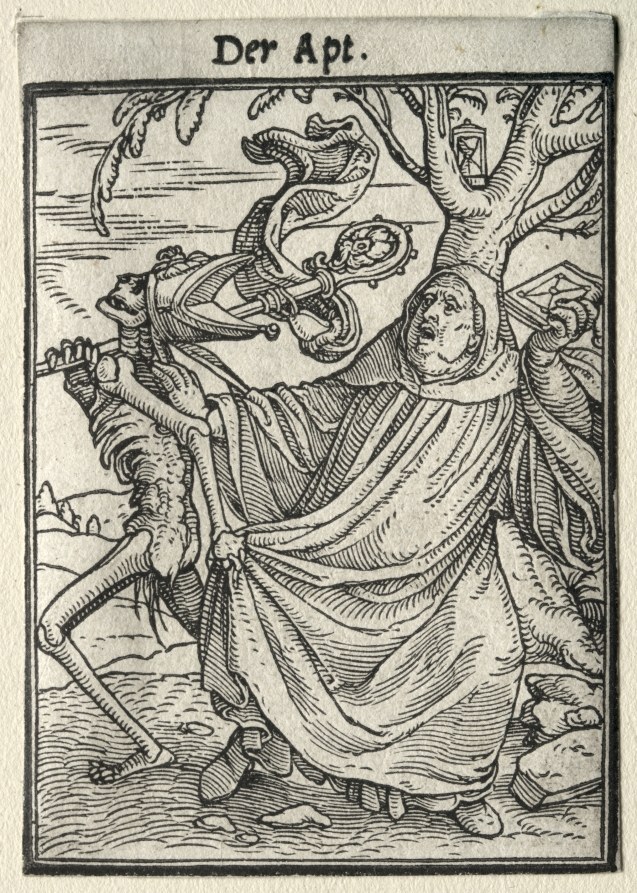
The *Totentanz* was the dominant visual language for depicting figures in motion during the 15th–17th centuries, and skeletal anatomy was often rendered with far greater anatomical precision and dynamism than the clothed living. This image shows how death was visualized as animated, musical, and performative—not static—a powerful reversal of the usual associations of skeletons with stillness. For historians of dance iconography, it demonstrates how non-narrative movement (the skeleton's gesturing) could carry more visual and symbolic weight than any representation of actual social dancing.
What you are looking at
A skeletal figure—Death personified—dominates the composition, its articulated bones rendered in meticulous hatching and line work. The skeleton wears flowing robes that billow around its frame, and holds a pipe or flute in one hand while gesturing with the other in a pose of command or invitation. Before it stands a living figure in ecclesiastical dress: an abbot or high-ranking cleric, identifiable by his voluminous robes and the round head-covering typical of monastic habit. The abbot's face registers alarm or resignation as he confronts the skeletal musician. The background suggests a landscape or garden setting with trees and foliage rendered in the same fine linear technique. The entire scene is compressed into a vertical rectangular frame with a border line, characteristic of a woodcut or engraving meant for print circulation.
The dancing
The skeleton is positioned as the active agent: its body is upright and animated, with limbs extended in a posture of performance or summoning. The abbot's stance is more constrained and reactive—his weight appears to sink, his robes heavy, his gaze fixed on the apparition. There is no physical contact or embrace between them; instead, the skeleton's gesture creates distance, as if playing music to enchant or compel. The two figures occupy different registers of the composition: Death is central and commanding, the abbot displaced to one side, smaller and subordinate.
The dance depicted
This is a 'Dance of Death' or *Totentanz* composition, a genre depicting the medieval and Renaissance motif of Death claiming figures from all stations of life. The skeleton here functions as a musician-guide rather than a dancer per se, playing an instrument to summon the living. The abbot, a figure of spiritual authority, is shown as powerless before this force. The 'dance' is not a choreographed movement but a symbolic confrontation—the skeleton's animation and gesture contrast with the living figure's passivity. This visual trope circulated widely in Northern European prints from the 15th to 17th centuries as memento mori, often with darkly comic intent.
How it was made
This is an engraving or woodcut, identifiable from the bold, regular hatching lines that model form and the crisp black-and-white contrast. The fine linear detail in the robes and the careful articulation of the skeleton's joints suggest the precision of engraved or etched line work rather than the broader strokes of woodcut. The title 'Der Apt.' (The Abbot) is printed at the top in period typeface, confirming this is a numbered or titled series print. This format—a small, portable, reproducible image with text—indicates it was made for mass circulation among a lettered or merchant audience, likely in the 16th or early 17th century.
About this work
This is one sheet from a multi-figure *Totentanz* series, a visual sermon in print form addressing the medieval obsession with mortality and the equality of death before all social hierarchies. The skeleton musician and the terrified abbot embody the genre's central tension: no rank, piety, or learning can exempt the living from death's call. The work belongs in a dance history collection not because it depicts social dancing, but because the *Totentanz* was a major vehicle for visualizing movement, gesture, and the body's relationship to music and animation in Renaissance and early modern culture. The skeleton's pose—active, musical, and gesturally commanding—established visual conventions for representing Death as a performer or choreographer of the final transformation.
How to look at it
Attend to the skeleton's posture and gesture: it is not threatening with a weapon but performing—playing music, gesturing openly. The abbot's heavy robes and downcast or frozen demeanor emphasize passivity. The artist has chosen the moment of summons or confrontation, not the act of dancing itself. Notice the contrast in line weight and detail: the skeleton's articulated joints are rendered as clearly as any anatomical study, while the abbot's face is smaller and less individually rendered, reinforcing the skeleton's dominance as the subject of depiction.
The artist
The artist is not recorded in the catalogue. The style and technique are consistent with Northern European (likely German or Swiss) engraving workshops of the 16th or early 17th century. The title in German and the subject matter suggest either a work produced in or copied from such a tradition. Many *Totentanz* series were produced anonymously or as workshop products, and individual sheets often circulated without clear attribution.
The period
The *Totentanz* motif exploded in popularity after the Black Death (1347–53) and remained central to Northern European religious and secular art through the 17th century. Hans Burgkmair, Hans Schäufelein, and other Augsburg and Nuremberg engravers produced the most celebrated versions. The genre reflected both genuine anxiety about plague and mortality and the period's fascination with the grotesque and the morally instructive. In dance history, the *Totentanz* represented one of the few contexts in which skeletal or grotesque bodies were depicted in motion; it thus established a visual vocabulary for representing the body deformed or animated by forces beyond individual control.
Where it lives
The work is held in the Cleveland Museum of Art collection and catalogued as part of its dance-related art holdings. It appears to be a single print or impression from a series, likely assembled into a bound volume or collected sheet by sheet.
Questions about this work
Is this actually a dance?
Not in the modern sense. The *Totentanz* is a symbolic confrontation set to music and gesture rather than choreographed movement. But the skeleton is depicted as animated and gesturing—performing, in effect—and the genre was one of the most powerful visual languages for representing the body in motion during this period. For dance historians, it matters because it shows how the moving body was imagined and visualized outside the ballroom or theater.
What is the abbot supposed to represent?
The abbot represents the church hierarchy and spiritual authority. One of the *Totentanz* genre's central messages was that death spares no one—not the pope, not the king, not the scholar, not the beggar. By showing a figure of high ecclesiastical rank confronted by a skeleton musician, the artist undercuts any claim that piety or learning can ward off mortality.
Why is Death playing music?
In the *Totentanz* tradition, music is Death's instrument of summoning and animation. The skeleton-musician plays a pipe or fiddle to call the living to dance, or to animate them in their final transition. This conflates the idea of death as a performance, a musical event, and an irresistible summons all at once.
More dance artwork