49 works in this view — arrow keys or swipe to move between them.
Dance in Art
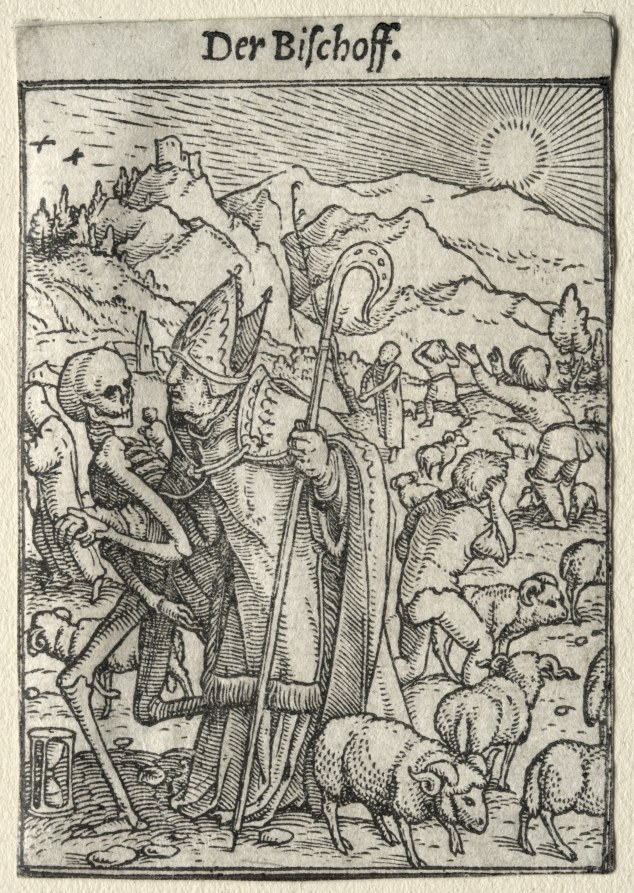
Dance of Death The Bishop
Hans Holbein the Younger (German, active England and Switzerland, 1497/98–1543)
- Source:
- Cleveland Museum of Art
- Rights:
- Public domain — free to use, share and adapt.
- Recorded as:
- CC0 (Public Domain)
Danse Macabre prints are foundational to understanding how dance functioned in medieval and Renaissance art not as entertainment or technique, but as metaphor and moral instruction. For historians of dance, this work reveals how the language and imagery of procession and synchronized movement were deployed to convey ideas about death, equality, and fate—showing that 'dance' in historical art encompasses far more than ballrooms and stages.
What you are looking at
This engraving depicts a procession or ceremonial gathering centered on a richly dressed ecclesiastical figure—a bishop identifiable by his distinctive vestments, tall mitre, and the crosier (episcopal staff) he carries. He stands among a diverse crowd of figures including skeletal death personifications, living people in period dress, and various social classes. The setting is a mountainous or hilly landscape with a fortified castle visible on a distant peak, a sun with radiating lines in the upper right, and scattered evergreen trees. The composition is dense and crowded, with figures arranged in loose ranks around the central bishop, creating a narrative procession that moves through the landscape. The engraving technique is fine-lined and detailed, with careful hatching to create depth and shadow.
The dancing
The bishop stands upright and formal in the center, wearing full liturgical regalia and holding his crosier vertically. Around him move figures in various postures—some skeletal (death figures), others in animated poses suggesting movement or dancing, others standing passively or gesturing. The crowds do not maintain any unified formation or partner hold; instead they mill and process in a loose gathering. Several figures appear to be in dynamic motion with limbs extended, though the precise choreography is obscured by the density of the composition. The scale and positioning suggest this is not a paired or structured dance but rather a processional gathering or parade.
The dance depicted
This is a Danse Macabre or Dance of Death—a medieval allegorical genre depicting death claiming figures from all social stations. The bishop, as a figure of religious authority and high social rank, is shown being drawn into death's procession alongside commoners, the living, and skeletal death figures. These works emerged in northern Europe during the late medieval period, particularly after plague outbreaks, and functioned as memento mori (reminders of mortality). While titled 'Dance of Death,' the movement depicted is more processional and ceremonial than choreographed dance, though the lively postures of some figures and the title itself invoke the metaphor of dancing with death. The bishop's formal, upright posture contrasts with the more animated, contorted poses around him, emphasizing death's leveling power.
How it was made
This is a woodcut or engraving—the fine parallel hatching, careful line work, and the characteristic appearance suggest engraving on wood or metal. The technique allowed for mass reproduction and wide circulation in the 16th century, making this the kind of popular moral and religious instruction accessible to literate and semi-literate audiences alike. The detail possible in engraving enabled the artist to differentiate the bishop's elaborate vestments from common dress and to render the skeletal forms of death with anatomical precision. Such prints were inexpensive and portable, circulating as loose sheets and in bound collections, reaching audiences far beyond wealthy patrons.
About this work
This is a Danse Macabre engraving, a medieval and Renaissance allegorical genre in which Death personified leads figures of all social ranks—here epitomized by a bishop—in a procession toward mortality. The work operates as both a visual narrative and a moral lesson: the bishop's high station and rich vestments offer him no protection from death's equal claim. The engraving technique and its surviving circulation as a loose sheet indicate it was popular devotional and instructional art, addressing universal human anxieties about plague, rank, and the afterlife. Within the gallery, it represents an entirely different kind of 'dance'—not choreographed movement but allegory, procession, and the metaphorical dance that is human mortality.
How to look at it
Attend to the positioning and gesture of the bishop: despite his central placement and formal posture, he is not exempt from the procession of skeletal figures and common people surrounding him. Note the artist's choice to render death figures as skeletons in motion, some apparently dancing or playing instruments, while the living display more restrained and dignified poses—a visual inversion that emphasizes death's transgressive animation. The mountainous landscape and distant castle frame this as a universal scene transcending any particular place, reinforcing the moral universality of the message. The sun's radiating lines suggest divine oversight of this procession.
The period
The Danse Macabre tradition flourished in northern Europe in the 15th and 16th centuries, emerging in the aftermath of repeated plague outbreaks (particularly the Black Death of 1347–1353) and persisting through the early modern period. The genre appeared in mural paintings, woodcut cycles, printed books, and loose engravings, reaching a wide audience. In the 16th century, when this engraving was likely made, such works continued to serve as both devotional objects and moral commentary on the leveling power of death and the vanity of earthly rank. The Protestant Reformation and Catholic Counter-Reformation both deployed such imagery, though for different purposes. Engraving as a medium was relatively new and increasingly accessible, enabling the mass production and circulation of such moralizing imagery.
Where it lives
The work is held in the Cleveland Museum of Art as part of its dance-related art collection. It survives as a loose engraving or woodcut print, typical of the medium's circulation as affordable, reproducible moral instruction in the 16th century.
Questions about this work
Is this really a dance?
Yes and no. The Danse Macabre is titled 'dance' and deploys the visual language and metaphor of procession and synchronized movement, but it depicts allegory and moral instruction rather than choreographed steps. It shows how the concept of 'dance' was used in medieval and Renaissance art to convey ideas about mortality and social equality. For art historians and dance historians alike, it represents an essential genre in which dance-like movement carries theological and philosophical meaning.
Why is the bishop the focal point?
The bishop represents the highest social and spiritual rank, making him an ideal subject for a memento mori work: if even the church's authority cannot exempt one from death, neither can anyone else. The Danse Macabre tradition deliberately selected figures of power and prestige—popes, kings, emperors, nobles—to hammer home the message that death is universal and indiscriminate.
When was this made?
The catalogue record does not provide a date, but the style, engraving technique, and subject matter suggest the 16th century. The Danse Macabre tradition was most active in the 15th and 16th centuries, though such works continued to be produced and reprinted well beyond.
More dance artwork