49 works in this view — arrow keys or swipe to move between them.
Dance in Art
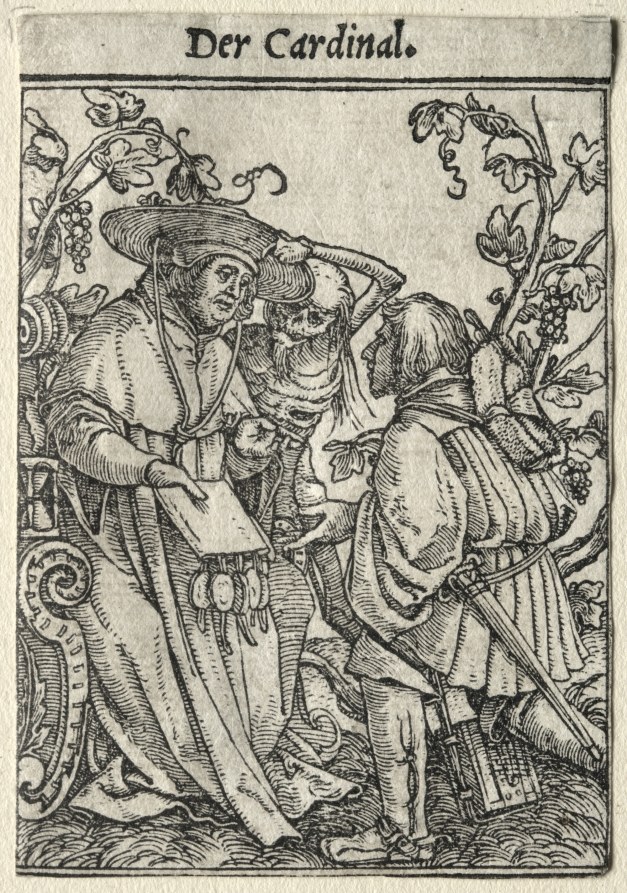
Dance of Death The Cardinal
Hans Holbein the Younger (German, active England and Switzerland, 1497/98–1543)
- Source:
- Cleveland Museum of Art
- Rights:
- Public domain — free to use, share and adapt.
- Recorded as:
- CC0 (Public Domain)
This image is essential for understanding how Renaissance and medieval artists used dance as a vehicle for moral and satirical commentary. The *Danse Macabre* represents an entire genre of allegorical movement separate from the codified ballroom and court dances being documented elsewhere; it shows dance functioning as theology, theatre, and social critique. For historians of dance, this work demonstrates that not all early modern movement imagery depicts technique or social practice—much of it is symbolic, didactic, and deeply embedded in religious and philosophical discourse.
What you are looking at
A woodcut or engraving titled *Dance of Death: The Cardinal* depicts a cardinal in full ecclesiastical regalia dancing with a skeleton amid abundant vines bearing grapes. The cardinal, identifiable by his broad-brimmed hat and voluminous red robes, is caught mid-movement in a figure-eight or turning pattern. The skeleton opposite him is rendered with anatomical precision, its hollow eye sockets and grinning skull turned toward the cardinal in a grotesque mirror of the dance. The composition is crowded with decorative Renaissance foliage—grapevines with heavy fruit spiral around the frame on both sides, and smaller figures or faces emerge from the vegetation, creating a sense of a natural world teeming with life and decay simultaneously. The print is framed by a simple rectangular border. The scene exemplifies the *Danse Macabre* tradition: a medieval and Renaissance motif in which Death dances with the living, regardless of rank or station.
The dancing
The cardinal's posture shows an animated, almost sprightly movement—his body is angled, one leg extended in a walking or stepping motion, his arms positioned in a manner suggesting active engagement rather than formal restraint. The skeleton moves in mimicry, suggesting the two are locked in a grotesque conversation through movement. The cardinal's broad robes billow around him, creating volume and emphasizing the dynamism of the step. There is no formal dance hold; instead, the two figures face each other across a small space, their bodies angled in a kind of asymmetrical, episodic movement typical of the *Danse Macabre* genre rather than any codified ballroom or court dance.
The dance depicted
This is not a representation of a specific historical dance form, but rather an allegorical or morality image using the convention of the *Danse Macabre*—a recurring motif from the 14th through 17th centuries in which Death (usually a skeleton or corpse) dances with living figures of all social ranks as a memento mori. The cardinal here dances not by choice but by compulsion, a teaching device about the inevitability of death and the futility of earthly rank. The 'dance' is a procession or symbolic shuffle rather than a ballroom movement; the cardinal's animated step and the skeleton's mirror posture create a grotesque parody of courtship or social dancing. No actual dance technique is depicted—the image is theological and satirical rather than documentary.
How it was made
This is a woodcut or engraving (likely a woodcut given the bold linear style and sharp contrasts), a medium that allowed for mass reproduction and circulation throughout 16th-century Europe. The technique is characterized by bold outlines, precise hatching for shadow and texture, and a densely packed composition with minimal empty space. The decorative vines and intricate foliate border are typical of Renaissance print design and suggest this was intended for a book or series of prints, not a single luxury object. The clarity and detail achievable in engraving allowed the artist to render both the cardinal's vestments and the skeleton's anatomy with equal precision—a visual equivalence that reinforces the moral message.
About this work
This *Danse Macabre* print represents a cardinal dancing with Death, rendered in the allegorical tradition of memento mori imagery. The work belongs to a vast body of Renaissance and medieval visual satire using dance as a metaphor for the leveling force of mortality. It is a work of moral instruction and social commentary disguised as a dance scene—the cardinal's rank offers him no protection against the skeleton's embrace.
The *Danse Macabre* tradition was at its height in the 16th century, appearing in prints, woodcuts, murals, and manuscripts across Europe. This image participates in a visual conversation about death, social hierarchy, and the body—themes that animate both Renaissance art and dance. The cardinal's animated step and the skeleton's mimicry create a grotesque inversion of courtly movement, using the conventions of dance to articulate a memento mori lesson.
How to look at it
Observe the cardinal's posture carefully: despite the solemnity of the skeleton opposite him, his body is animated and stepping, suggesting movement captured mid-stride rather than a static pose. The repetition of bilateral forms—cardinal and skeleton, facing each other—creates a rhythm across the composition that mirrors the call-and-response structure of many early dances. Note how the elaborate vines and grapes frame the scene: they are not mere decoration but a memento mori in themselves, a visual reminder of the cycle of growth and decay. The print invites you to read the scene as narrative—not a single frozen moment but a dance unfolding, with the cardinal drawn inexorably forward.
The period
The *Danse Macabre* emerged in the late medieval period, gaining enormous popularity in the 15th and 16th centuries in response to repeated plague, war, and religious upheaval. The motif appears in frescoes (notably in the Cemetery of the Innocents in Paris), illuminated manuscripts, and—from the invention of the printing press onward—in woodcuts and engravings. This print likely dates to the 16th century, when the *Danse Macabre* was widely circulated in Protestant and Catholic territories alike. The specific pairing of a cardinal with Death carries anti-clerical satire typical of Reformation-era prints, whether produced by Protestant satirists or Catholic artists offering their own social critique.
Contemnporaneously, court and ballroom dances were becoming increasingly codified and theorized in manuals and treatises. The contrast between the elegant, rule-bound pavane and the chaotic, compulsory movement of the *Danse Macabre* made the latter a powerful counter-image: a dance without choice, without grace, without the human agency celebrated in courtly movement.
Where it lives
The work is held by the Cleveland Museum of Art and is identified as part of the museum's dance-related art collection. It is catalogued as a historical print but lacks comprehensive documentation of date, medium, or artist. The title in the record suggests it may be part of a larger series of *Danse Macabre* prints.
Questions about this work
Is this a real dance or an invented one?
The *Danse Macabre* is not a codified social or ballroom dance, but rather a visual and literary motif expressing mortality and the futility of earthly rank. Death compels the living to dance whether they wish to or not, so the 'dance' is allegorical rather than technical. Real people did not perform *Danse Macabre* steps in ballrooms, though the motif appeared in religious processions, mystery plays, and theatrical performances. This is an image of a metaphorical dance, not a practical one.
Why is the cardinal dancing with a skeleton?
The *Danse Macabre* was a memento mori tradition—a reminder that death comes for all, regardless of status, wealth, or power. A cardinal, as a high ecclesiastical official, represents worldly authority and spiritual rank. By pairing him with a skeleton, the image teaches that rank offers no exemption from mortality. The dance itself becomes a metaphor for being led inevitably toward death, without choice or resistance.
When was this made?
The catalogue record does not provide a precise date, but the style, technique, and subject matter suggest a 16th-century origin. The *Danse Macabre* motif was especially popular in prints and woodcuts from roughly the 1480s through the 1600s, and this image's formal qualities align with that period.
What is the technique?
This is a woodcut or engraving (the precise medium is not recorded), a reproductive print technique that allowed images to be circulated widely and affordably. The bold outlines, hatching, and decorative border are characteristic of Renaissance printmaking, suggesting the work was intended for a book, broadsheet, or series rather than as a single unique object.
More dance artwork