49 works in this view — arrow keys or swipe to move between them.
Dance in Art
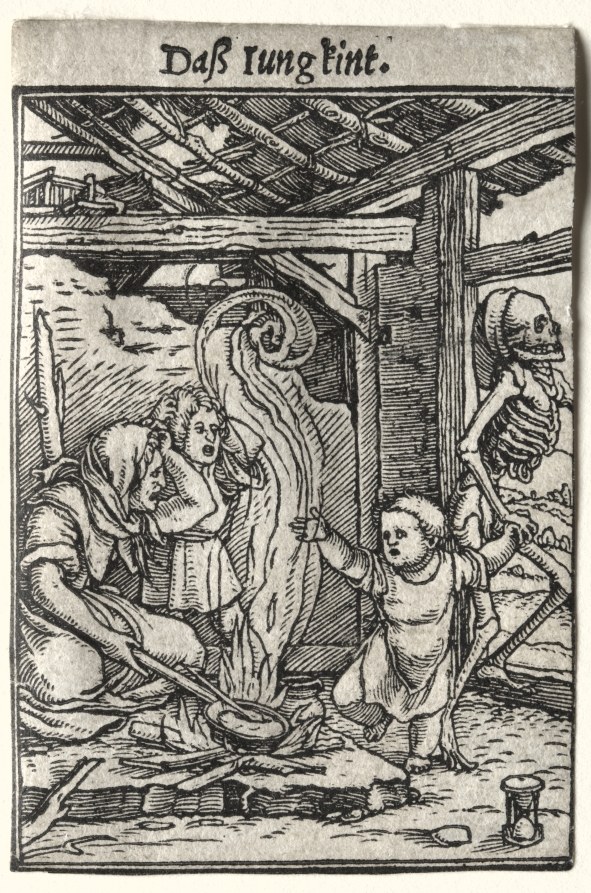
Dance of Death The Child
Hans Holbein the Younger (German, active England and Switzerland, 1497/98–1543)
- Source:
- Cleveland Museum of Art
- Rights:
- Public domain — free to use, share and adapt.
- Recorded as:
- CC0 (Public Domain)
The *danse macabre* tradition shaped early modern ideas about what dance could mean: not only entertainment or courtship, but a confrontation with death itself. This image shows how a single figure—Death—could stand in for an entire allegorical performance, and how the language of the body (collapse, recoil, supplication) communicated meaning without formal steps or partners.
What you are looking at
A woodcut or engraving titled *Das Jung kind* (The Young Child) depicts a domestic interior, probably a barn or workshop, with heavy timber framing visible above. A woman kneels or crouches at left, her body bent forward in a posture of distress or supplication, wearing a long dress with a white headdress. A skeletal figure—Death, rendered as a wrapped or robed skeleton—stands at center, reaching or gesturing toward the woman. A small child stands nearby, also gesturing or recoiling. At right, a second skeleton or death figure appears in profile. The floor is scattered with tools and domestic objects. The composition is crowded and urgent, with strong contrasts between light areas (the figures) and the dark hatching of the architectural frame.
The dancing
The woman's body is folded forward in a posture of grief, fear, or prayer rather than dance; her weight is on her knees. The child's stance is unstable, weight shifted as if startled or pulled away. Death is upright and active, one arm extended in a claiming or summoning gesture. The spatial relationship is one of threat and separation rather than partnership—the figures do not face each other in mutual engagement, but in a dynamic of capture and resistance. No formal dance hold or frame is present.
The dance depicted
This is not a dance scene. The title refers to a *danse macabre*—a medieval and early modern artistic tradition in which Death dances with the living—but this particular image represents Death claiming or threatening the child and mother, not a choreographed dance. The woman's posture and the child's gesture may echo the vocabulary of fear or pleading familiar from other dances of death, but there is no formal dance structure, no musicians, and no reciprocal movement. The work illustrates a narrative of mortality rather than depicting an actual dance.
How it was made
This is a woodcut or engraving, identified as such by the strong black line work, the careful hatching to suggest shadow and texture, and the composition designed for printing and broad distribution. The technique allowed for rapid reproduction and circulation as a moral or devotional image. The bold, thick outlines and the economy of detail are characteristic of northern European prints of the 16th century, suited to both popular and learned audiences.
About this work
This is a German woodcut or engraving from the tradition of *danse macabre* imagery, a visual language in which Death appeared to claim figures from all walks of life. The composition shows Death as an active, predatory force confronting a woman and child in a domestic space. While labeled as dance in the historical record, the image represents not a choreographed dance but a narrative confrontation—the woman's collapsed posture and the child's alarm are gestures of fear and resistance, not movement within a formal dance tradition. It belongs in a dance gallery because the *danse macabre* tradition profoundly influenced how dance was represented in European art, and because the skeletal Death figure in dance contexts became a powerful emblem of mortality's threat.
How to look at it
Attend first to the posture of the woman: her spine is curved, her center of gravity collapsed toward the ground. This is the opposite of the upright frame of formal dance. The child's body is angular and unstable, caught mid-flinch. Death, by contrast, is stable and forward-moving, the arm extended in a gesture of claim or summons. The artist has frozen not a step or a figure within a choreography, but a moment of capture—the instant before the living are taken. The heavy frame of the building, with its dark beams, closes in on the scene; there is no space for the free movement of a dance floor.
The artist
Unknown. The print is attributed to no hand in the record and is catalogued as part of a broader tradition of northern European moralizing prints and woodcuts, likely from the 16th century. The style and subject are consistent with German printmaking of that period.
The period
The *danse macabre* tradition reached its visual and literary height in the 15th and 16th centuries, especially in German-speaking lands and France. It emerged from plague mortality and apocalyptic theology, and it represented death not as peaceful rest but as an active, seductive, or predatory force that could claim anyone—peasant, noble, child, elder. In art, Death was typically rendered as a skeleton or cadaver, sometimes dancing with the living, sometimes simply taking them. The tradition influenced both moral instruction and popular entertainment; *danse macabre* cycles were painted on church walls, printed as broadsides, and performed as theatrical pieces. By the 16th century, the image of Death as a dancer or a figure who danced with the living had become a standard emblem of mortality in northern Europe.
Where it lives
Held in the Cleveland Museum of Art. Catalogued as part of the museum's collection of dance-related art, though the work's status as 'dance' derives from the historical *danse macabre* tradition rather than from the depiction of an actual dance performance.
Questions about this work
Is this actually a dance?
Not in the formal sense. It is part of a visual and literary tradition called the *danse macabre*, in which Death was personified as a figure who danced with or claimed the living. This print shows Death as a predatory force confronting a mother and child; the woman's posture is one of collapse and fear, not dance steps. The 'dance' is metaphorical—a way of representing the inevitability and terror of death.
What was the *danse macabre* tradition?
A medieval and early modern artistic and literary tradition, especially popular in 15th–16th century northern Europe, in which Death appeared to dance with or claim figures from all ranks of society—the pope, the king, the peasant, the child. It emerged from plague mortality and served both as moral instruction (death comes for everyone) and as a kind of dark entertainment. Death was typically rendered as a skeleton or cadaver, often depicted as the active agent in the encounter.
Why is this in a dance gallery?
Because the *danse macabre* tradition fundamentally shaped how dance was represented and understood in early modern Europe. It demonstrated that dance could be a vehicle for meaning beyond courtship or celebration—that it could embody fear, mortality, and the violation of the living body. The skeletal Death figure became an iconic symbol in dance imagery, and the tradition influenced both high art and popular performance.
More dance artwork