49 works in this view — arrow keys or swipe to move between them.
Dance in Art
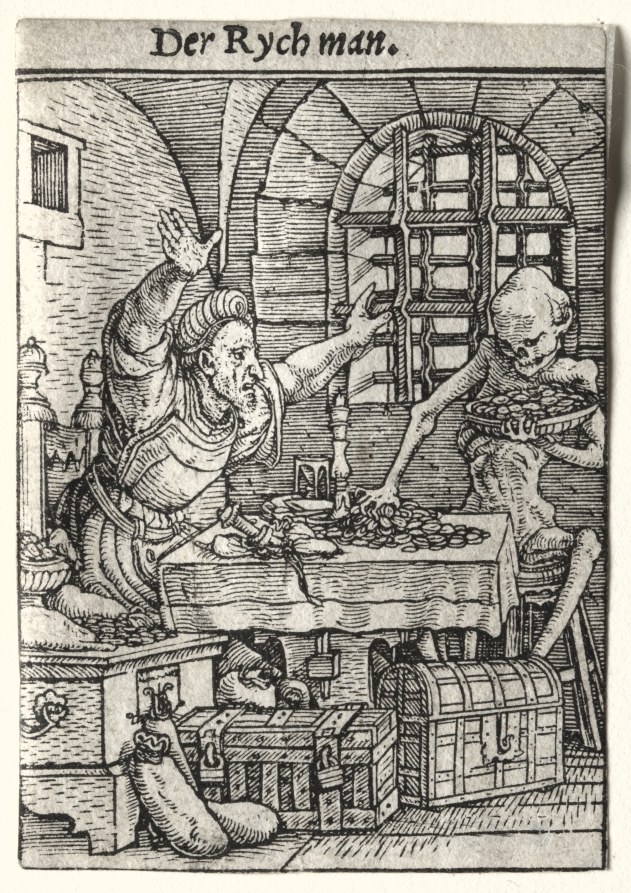
Dance of Death The Miser
Hans Holbein the Younger (German, active England and Switzerland, 1497/98–1543)
- Source:
- Cleveland Museum of Art
- Rights:
- Public domain — free to use, share and adapt.
- Recorded as:
- CC0 (Public Domain)
The work demonstrates how gesture and bodily pose functioned as a moral and didactic language in Renaissance art and popular culture, a convention that shaped how dancers and performers understood the expression of emotion and virtue through the body. It also illustrates the close overlap between moralizing art, performance, and dance spectacle in the period, showing how allegorical tableaux vivants and printed moral narratives drew on similar symbolic vocabularies of pose and movement.
What you are looking at
A figure in late medieval or Renaissance dress stands in a stone-vaulted interior, raising both arms in an exuberant gesture toward a barred window. His clothing—a tunic with elaborate pleating, hose, and a feathered hat—marks him as a man of some wealth or courtly status. A second, younger male figure sits at a table laden with coins and treasure, gesturing proprietorially over the hoard. The inscription "Der Rych man" (The Rich Man) appears at the top. The engraving's composition suggests a morality play or allegorical scene: the standing figure's raised arms and animated posture contrast sharply with the seated man's possessive stance. The architectural setting—austere stone walls, a heavy wooden door, a high window admitting light through cross-hatched lines—creates a prison-like atmosphere. Various vessels and objects scatter the floor, suggesting disorder or excess.
The dancing
The standing figure displays an open, expansive upper-body position with both arms raised to roughly shoulder height or slightly higher, palms partly open—a gesture suggesting exultation, prayer, or desperation. His weight appears to be on both feet, his torso upright and engaged. The seated figure adopts a more constrained posture, bent forward slightly over his wealth, with one arm extended proprietorially across or toward the coins. Neither figure is engaged in ballroom or theatrical dance in the conventional sense; the gestures are more gestural-dramatic and emblematic.
The dance depicted
This is not a depiction of ballroom, folk, or theatrical dance. The work illustrates a moral or allegorical narrative—likely from a Danse Macabre tradition or a similar memento mori cycle—in which figures enact vice and virtue. The raised-arms gesture of the standing man reads as a spiritual or emotional state rather than learned choreography. The composition and inscription suggest a didactic purpose: to contrast the vanity of wealth (the seated miser) with some other state (possibly repentance, prayer, or the inevitable judgment of death). The 'dance' here is rhetorical and emblematic rather than kinetic.
How it was made
This is a woodcut or engraving on paper, executed in the Northern European tradition of the 15th or 16th century. The technique employs close hatching and parallel lines to create shadow and volume, particularly visible in the drapery folds, the stone vault, and the floor. The clarity and linearity of the medium—its suitability for mass reproduction—suggests this was part of a series or broadsheet intended for wide circulation, likely with a didactic or moral purpose. The crisp, legible composition and symbolic iconography are characteristic of Northern Renaissance printmaking.
About this work
This engraving depicts a scene from a moral or allegorical cycle, most likely a Danse Macabre or memento mori series, showing a richly dressed man with raised arms in an attitude of exultation or supplication, confronted by or contrasted with a seated miser counting his hoard. The work is not a dance image in the technical sense but uses gesture and bodily pose as a language of moral instruction. It circulated as a print, likely as part of a series meant to teach viewers about the transience of wealth and the folly of avarice. The engraving belongs in this collection because it employs the vocabulary of expressive gesture and bodily attitude—the visual language of dance—to communicate an ethical narrative.
How to look at it
Attend to the contrast between the two figures' postures and emotional registers: the standing man's open, upward-reaching gesture reads as emotional or spiritual intensity, while the seated miser's inward, possessive stance enacts greed. The engraver has frozen a moment of moral confrontation or revelation. Notice the symbolic weight of the architectural setting—the prison-like stone vault, the barred window, the scattered objects on the floor—all of which reinforce the didactic message about the emptiness of material wealth. The elaborate costume details (feathered hat, pleated tunic, hose) mark the figures as particular social types rather than anonymous actors, inviting the viewer to recognize themselves in the scene.
The period
This engraving belongs to the Northern European tradition of moralizing prints that flourished in the 15th and 16th centuries, a period when woodcuts and engravings served as the primary means of mass communication and religious and moral instruction. Danse Macabre cycles—sequences depicting death claiming figures from all social ranks—were enormously popular, reflecting medieval and Renaissance preoccupations with mortality, judgment, and the vanity of earthly wealth. The print medium allowed these moral narratives to circulate widely, reaching audiences far beyond the church or court. The figure types, dress, and architectural setting place this work squarely in the world of late medieval civic life and morality, when public spectacles and theatrical performances (including tableaux vivants and processions) drew heavily on allegorical and biblical narratives.
Where it lives
The work is catalogued as part of the Cleveland Museum of Art's dance-related collection, though the museum's records offer minimal bibliographic detail. The print survives as a loose sheet, likely one of a series, and its inclusion in a dance collection reflects the scholarly or curatorial interest in gesture, bodily expression, and allegorical performance as part of dance history.
Questions about this work
Is this actually a dance scene?
Not in the modern sense. The figures are not performing ballroom, folk, or theatrical dance. However, the work uses expressive gesture and bodily pose as a moral language—the vocabulary that dancers and performers drew on to communicate emotion and meaning. It belongs in dance history because it shows how Renaissance culture understood gesture as a signifying practice.
What does 'Der Rych man' mean?
'The Rich Man' in early modern German. The inscription identifies the subject as a moral type—the miser or avaricious wealthy person—a stock character in moralizing literature and visual culture of the period. The work likely forms part of a series depicting different vices or moral conditions.
What period is this from?
The style, dress, and printing technique suggest the 15th or 16th century, the era of Northern European printmaking and the height of Danse Macabre popularity. The exact date is not recorded, but the work fits securely within the late medieval to early Renaissance moral and didactic print tradition.
Why would a dance collection hold this?
Because dance history includes the study of gesture, expression, and bodily meaning-making in performance. This print shows how Renaissance audiences understood the body as a vehicle for communicating moral and spiritual states—knowledge that shaped how dancers trained, performed, and were interpreted by their audiences.
More dance artwork