49 works in this view — arrow keys or swipe to move between them.
Dance in Art
Dance of Death The Pastor
Hans Holbein the Younger (German, active England and Switzerland, 1497/98–1543)
- Source:
- Cleveland Museum of Art
- Rights:
- Public domain — free to use, share and adapt.
- Recorded as:
- CC0 (Public Domain)
The Danse Macabre was one of the most influential visual and conceptual frameworks in late medieval and Renaissance art, shaping how death was imagined, staged, and eventually danced. This print documents how a specific social figure—the priest—was positioned in that allegory, offering insight into how religious authority, mortality, and the social order intersected in visual culture. For dance historians, the Danse Macabre prints are the visual ancestors of actual choreographed death dances and memento mori performance traditions that emerge in later centuries.
What you are looking at
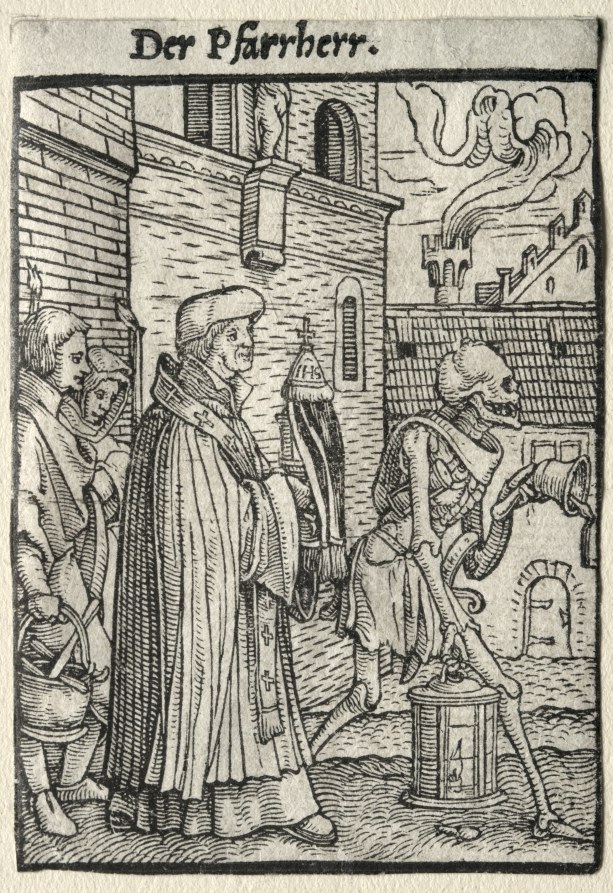
A woodcut or engraving depicting a procession or ceremonial moment in a Gothic or late medieval town square. A robed figure identified as a pastor or clergyman stands prominently in the center-left, wearing long clerical garments and a distinctive hat. He is attended by several figures: a woman and child to his immediate left, and other townspeople to the right. The setting is architectural—brick buildings with arched doorways and windows rise behind them—and in the upper right, demonic or skeletal figures emerge from the roofline in a swirling composition, suggesting the supernatural or allegorical content typical of the Danse Macabre tradition. The ground is unpaved and busy with activity. The title "Der Pfarrherr" (The Parson) indicates this is one figure or episode in a sequence illustrating how death comes for people of different social stations.
The dancing
The pastor stands in a formal, upright posture characteristic of his office and rank. The attending figures—woman, child, and other citizens—are shown in everyday stance and dress, with no visible choreography or codified movement. The figures to the right appear to be recoiling or gesturing toward the supernatural elements above, suggesting alarm or astonishment rather than dance movement. The composition emphasizes social hierarchy and the moment of confrontation rather than physical coordination or synchronized gesture.
The dance depicted
This is not a depiction of dance as a performed or social practice. It is an allegory from the Danse Macabre (Dance of Death) tradition, in which death, depicted as skeletons or demons, confronts figures of all social ranks. The 'dance' is metaphorical—a medieval moral narrative about the inevitability and democracy of death—rather than actual choreography. The pastoral and civilian figures are presented as subjects receiving this confrontation, not as participants in movement or rhythm.
How it was made
This is a woodcut or engraving, likely from the 16th century, executed with fine linear hatching to create tone and texture. The technique allows for sharp architectural detail, clear costume differentiation, and the dramatic contrast between the solid earthly figures and the swirling, gestural supernatural elements above. The medium suggests this was made for reproduction and wide circulation, consistent with the popularity of Danse Macabre prints across Northern Europe during the Renaissance and Reformation.
About this work
This is a German Renaissance woodcut depicting one figure from a Danse Macabre sequence—a memento mori allegory in which death confronts people from all social stations. The pastor, formally dressed and positioned as a man of rank, faces supernatural forces while attended by civilian dependents. The work belongs in a dance gallery not because it shows dance, but because the Danse Macabre was a pervasive cultural narrative expressed through visual sequences, prints, theatrical performances, and eventually formal choreography. Understanding this image is essential to understanding how medieval and Renaissance Europe imagined death, fate, and the body's ultimate powerlessness—themes that inflected how dance itself was understood and staged.
How to look at it
Notice the careful spatial separation: the pastor and his dependents occupy the foreground and ground plane, rendered in solid, naturalistic terms, while the demons or skeletons erupt from above in a more fluid, gestural idiom. This compositional contrast—the orderly, hierarchical social world below; the chaotic supernatural realm above—is the core visual argument of the Danse Macabre. Observe how the pastor's formal dress and posture are rendered with precision, emphasizing his earthly status, which death will render meaningless. The artist chose the moment of confrontation, not a narrative sequence, making this an emblematic rather than sequential image.
The artist
The artist is not recorded. The print style, subject matter, and use of German-language titling suggest a Northern European workshop, likely German, active in the 16th century. Danse Macabre prints were produced across Germany, the Low Countries, and Scandinavia by multiple hands in the tradition; attribution to individual printmakers is often impossible without marks or documentary evidence.
The period
The Danse Macabre tradition flourished in the 15th and 16th centuries across Northern Europe, reaching peak visual currency after the Black Death (1347–1351) had traumatized European consciousness. In the German-speaking lands, these prints proliferated as tools of religious instruction, moral pedagogy, and entertainment. The Reformation was underway during the probable period of this print, and Danse Macabre imagery—with its leveling message that death spares no rank, not even priests—carried Protestant resonance. Actual Danse Macabre processions and theatrical performances also occurred in this period, particularly in France and the Low Countries, making the image part of a multimedia cultural moment that blended visual art, performance, and memento mori theology.
Where it lives
This work is held in the Cleveland Museum of Art. It is catalogued as part of the museum's collection of dance-related imagery, though the provenance and specific accession details are not recorded. The work is a woodcut or engraving of unknown artist and date, typical of widely circulated Northern European Renaissance prints.
Questions about this work
Is this actually a dance?
Not a choreographed or performed dance. The 'Danse Macabre' (Dance of Death) is a medieval and Renaissance allegory, expressed in visual sequences, texts, theatrical performances, and eventually formal dances, in which Death personified confronts figures of all social ranks. This print is part of that allegorical tradition rather than a depiction of social or ceremonial dance.
Why is a priest the subject?
The Danse Macabre's moral force lay in its leveling message: death spares no rank, not even clergy. Priests and bishops feature prominently in these sequences precisely because their earthly authority and spiritual office offer no exemption from mortality. This was both a religious teaching and a covert social critique.
When was this made?
The exact date is unknown. The style, technique, and subject matter are consistent with 16th-century German or Northern European woodcuts and engravings. The Danse Macabre tradition was at its visual peak in the 15th and 16th centuries, though the tradition persisted longer.
Why does this belong in a dance gallery?
The Danse Macabre shaped how medieval and Renaissance people imagined the body, mortality, and movement. The tradition gave rise to actual choreographed dances, processions, and theatrical performances. Understanding the visual and allegorical tradition is essential to understanding the history of dance as a way of imagining fate, the social order, and death.
More dance artwork