49 works in this view — arrow keys or swipe to move between them.
Dance in Art
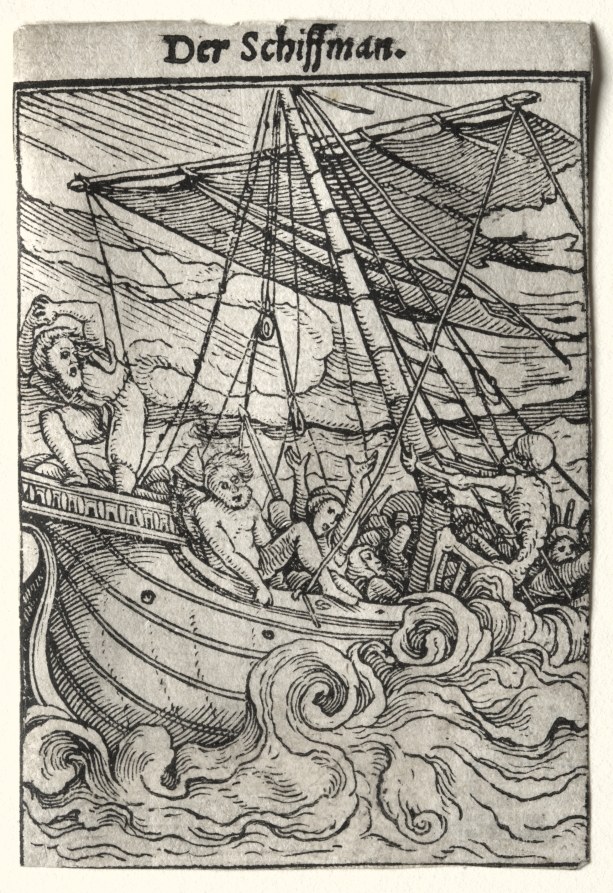
Dance of Death The Sailor
Hans Holbein the Younger (German, active England and Switzerland, 1497/98–1543)
- Source:
- Cleveland Museum of Art
- Rights:
- Public domain — free to use, share and adapt.
- Recorded as:
- CC0 (Public Domain)
The *Dance of Death* tradition fundamentally shaped how Europeans visualized the body in motion, mortality, and moral instruction. This print shows how the language of dance—gesture, tumult, ordered chaos—was deployed in secular and sacred art to express not joy but terror, futility, and the human condition. Understanding these works is essential to any history of how Western culture has used dance as a vehicle for meaning beyond entertainment.
What you are looking at
A German woodcut or engraving depicts a full-rigged sailing ship in stormy seas, its deck crowded with sailors and cherubs in chaotic motion. The vessel tilts dramatically, waves crash with baroque swirls around the hull, and the sky above is filled with billowing sails and rigging. Figures clamber across the deck, some falling or tumbling, their bodies caught mid-action in poses of distress or desperate movement. The composition is densely packed and energetic, with the human figures dwarfed by the ship's massive wooden structure and the violent seascape. The title "Der Schiffman" (The Sailor) appears in blackletter script at the top, identifying this as part of a didactic or allegorical series.
The dancing
The figures are rendered in a state of dynamic disorder—limbs akimbo, bodies twisted and contorted as they slip, fall, or struggle for purchase on the tilting deck. Several cherubs or putti appear among the sailors, adding a satirical or allegorical dimension. There is no organized dance frame or hold; instead, the bodies express panic, loss of balance, and desperate grasping. The artist has clearly studied human anatomy in extremis, with bent knees, outstretched arms reaching for rigging, and torsos bent at sharp angles. The multiplicity of figures and their overlapping positions create a visual chaos that reads as catastrophic rather than choreographed.
The dance depicted
This is not a depiction of dance in any conventional sense. The work belongs to the *Danse Macabre* or *Dance of Death* tradition—an allegorical genre that uses the visual language of dance to represent the inevitability of death and human folly. Here, the sailor's chaotic struggle against the sea and sinking ship is portrayed through the disordered, convulsive movement typical of Death Dance imagery. The "dance" is one of panic and dissolution, not artistry. The ship itself becomes the stage, and drowning or shipwreck the final choreography. This is didactic art using movement as metaphor for moral and physical peril.
How it was made
This is a woodcut or engraving in blackline, likely German or Northern European, executed with the dense cross-hatching and dramatic chiaroscuro typical of 16th-century Northern printmaking. The medium allowed for rapid reproduction and wide circulation, making it an ideal vehicle for allegorical instruction and moral commentary. The bold, legible blackletter title and the monumental composition suggest this was part of a series—a portfolio of cautionary tales about different professions or conditions. The technique of woodcut or engraving enabled fine detail in the rigging and anatomy while maintaining strong graphic impact from a distance.
About this work
This is a northern European allegorical engraving from the *Dance of Death* tradition, in which human struggle and mortality are rendered as a grotesque or convulsive dance. The work uses the maritime world and the drama of shipwreck to explore themes of chaos, divine judgment, and the leveling power of death. It belongs in a collection of dance imagery not because sailors perform any codified dance, but because the *Danse Macabre* tradition, which saturated European art and culture from the medieval period through the 17th century, embedded mortality and human folly within the visual and conceptual language of dance. The work reveals how dance was understood in Renaissance and early modern thought—not only as courtly or recreational performance, but as a metaphor for the body's vulnerability, loss of control, and subjection to forces beyond its will.
How to look at it
Attend to the artist's choice to render the sailors' struggle as a visual analogue to dance—a chaos of interlocking bodies, each figure twisted into an expressive pose that conveys panic rather than grace. Note how the cherubs or putti introduce an ironic or grotesque note: heavenly beings witness or participate in earthly disaster. The dense composition, with figures overlapping and cramped into the ship's space, refuses the viewer any calm focal point or moment of rest—the eye is drawn constantly into new tangles of limbs. This compositional restlessness mirrors the mental and physical state of the drowning sailors.
The period
The *Danse Macabre* emerged in late medieval Europe and flourished throughout the 16th and 17th centuries, driven by high mortality from plague, warfare, and disease. Northern European printmakers—particularly those working in the German lands and the Low Countries—were prolific producers of Death Dance imagery, which circulated widely and influenced both visual art and literature. The genre represented a democratizing vision: death and folly recognize no rank or profession. The sailor, the merchant, the priest, the nobleman—all tumble together in the same disordered dance. This print dates stylistically to the 16th century, an era when Northern printmaking was at its technical height and allegorical instruction was a primary purpose of visual art.
Where it lives
The work is held by the Cleveland Museum of Art. It is listed as part of the museum's dance-related art collection, suggesting it was acquired or catalogued with attention to its allegorical and cultural significance within the history of how dance and the body have been represented in Western art.
Questions about this work
Is this really a dance?
Not in the sense of a codified performance or technique. This is an allegorical image from the *Dance of Death* tradition, which used the metaphor of dance to represent death, chaos, and moral instruction. The sailors' convulsive, disordered movement stands in sharp contrast to the refined gestures of court dance, but it is still rendered as a visual and conceptual variant of dance—a perversion or inversion of it. The *Danse Macabre* tradition shows that Renaissance and early modern Europeans understood dance as a powerful language for expressing not only joy and courtship, but also terror, futility, and the human body's vulnerability.
What is the *Dance of Death* tradition?
The *Danse Macabre* (or *Totentanz* in German) emerged in late medieval Europe and became one of the dominant allegorical genres of the Renaissance and early modern period. The basic conceit is that Death—often personified or implicit—summons people from all walks of life (pope, peasant, merchant, maiden) to dance together. Despite their rank, wealth, or resistance, all are equal in death. These works functioned as memento mori (reminders of mortality) and as moral instruction, warning against pride, greed, and vanity. The tradition appeared in paintings, prints, sculptures, and poetry, and circulated throughout Europe with particular intensity in the German lands and Low Countries.
What does the shipwreck symbolize?
In the context of the *Danse Macabre*, the shipwreck and drowning sailors represent the sudden, indiscriminate strike of death. The sea and the sinking ship are forces of chaos and divine judgment that no human skill or rank can resist. The sailor's profession—already a byword for danger and exposure—made him a natural subject for Death Dance imagery. The tumult and disorder of the drowning figures embody the spiritual and physical upheaval that death brings, rendered as an involuntary, grotesque dance.
More dance artwork