49 works in this view — arrow keys or swipe to move between them.
Dance in Art
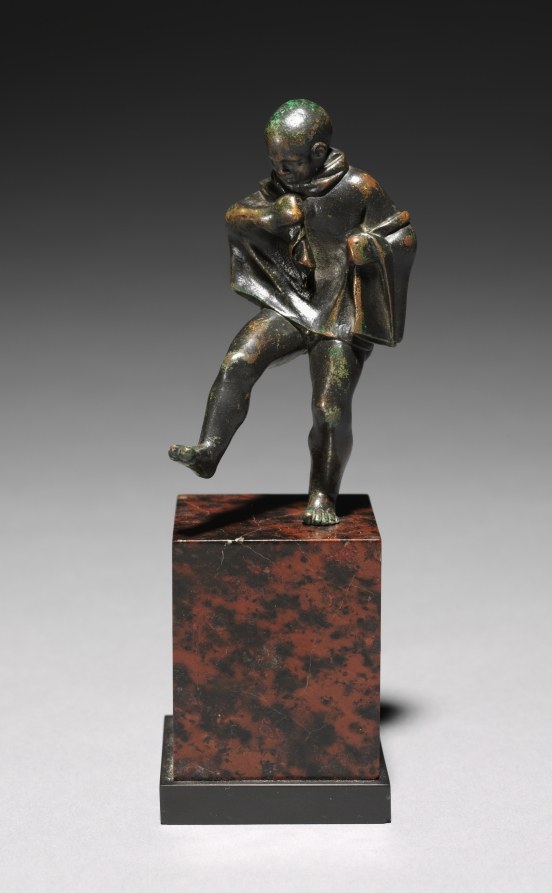
Dancing Boy
Unknown artist
- Source:
- Cleveland Museum of Art
- Rights:
- Public domain — free to use, share and adapt.
- Recorded as:
- CC0 (Public Domain)
This work documents how artists of the modern era—whether the 19th or early 20th century—understood the dancing body as a subject worthy of fine art and formal sculpture. The intensity and naturalism of the pose challenge any easy division between 'dance' and 'art'; the work shows how sculptors used movement to express mood, energy, and the liberation of youth.
What you are looking at
A bronze figure of a young male dancer, cast in dark patinated bronze with golden highlights, stands alone on a red-brown marble base. The boy is captured mid-movement in a pose of playful exuberance: his weight is thrown onto one leg while the other is raised high, his torso twists, and his arms are held in a dynamic crossed position across his body. His head is tilted back slightly, suggesting abandon or joy. The figure is nude except for what appears to be a draped fabric or garment slung across one shoulder and hip. The polished patina catches light on the raised surfaces—the upper torso, head, and the forward leg—creating strong modelling and emphasis. The marble plinth is substantial and formal, elevating the figure and treating it as a finished work of art rather than functional sculpture. The whole composition conveys a moment of uninhibited movement, perhaps play or improvised gesture.
The dancing
A single adolescent male figure, anatomically naturalistic and adolescent in build. The weight shifts dramatically: one leg bears the full load while the other kicks or extends upward with the hip thrust open. The torso rotates and leans, the arms cross protectively or expressively over the body, and the head is thrown back. The pose suggests flexibility, youthful energy, and a freedom from formal restraint. The anatomy and proportions are carefully studied—the musculature of the legs, the definition of the torso, the natural taper of the limbs all show a sculptor's close observation.
The dance depicted
This is not identifiable as a specific named dance or style. The pose is rather a study of youthful bodily freedom and expressivity—possibly influenced by Neoclassical or Classical Greek ideas of the dancing youth, or by late 19th- and early 20th-century interest in naturalistic childhood movement. The figure is too generalized and allegorical to pin to a particular dance tradition, but the energy and twisting dynamism could suggest balletic training or the kind of theatrical youth dance that was popular in early modern dance photography and sculpture. The nudity and marble base align the work with fine art sculpture traditions rather than documentary representation.
How it was made
This is a cast bronze sculpture with a natural dark patina, likely a foundry cast from a clay or plaster model. The patina is uneven, with lighter highlights on the raised forms—suggesting either intentional chasing or the natural wear of display over time. The marble base is integral to the presentation. Cast bronze allowed the sculptor to capture dynamic, fragile poses (the raised leg, the twisted torso) in permanent form, and the monumental base signals this as a gallery work intended for educated viewing rather than functional use. The technique and presentation suggest a work of art-historical ambition, not a decorative object.
About this work
This is a Neoclassical or early modernist bronze sculpture of a dancing boy, frozen in a moment of youthful exuberance and physical freedom. The figure stands alone on a marble plinth, positioned as a finished artwork for contemplation rather than as narrative scene or documentation. The work belongs to a tradition of fine-art sculpture engaged with the dancing body—a tradition that reaches back to Classical antiquity and forward through the 19th and into the 20th century, when photographers, painters, and sculptors became increasingly interested in capturing youth, movement, and natural gesture. The piece sits at the intersection of Neoclassical idealism and modern interest in authentic bodily expression.
How to look at it
Observe the weight shift from one leg to the other, and the spiral twist through the torso—the artist has chosen a moment of dynamic imbalance rather than static repose. Notice how the raised leg and thrown-back head create an upward visual movement that reads as exuberance. The cross of the arms over the torso is intimate and expressive rather than balletic; attend to how the formal marble base and careful anatomy elevate this moment of apparent abandon into art-historical significance.
The period
The Neoclassical movement and its successors throughout the 19th and early 20th centuries revived the Classical Greek and Roman tradition of sculpting the dancing figure. However, the uninhibited pose and emotional expressivity here suggest influence from later 19th- and early 20th-century ideas about natural movement, possibly linked to Isadora Duncan and the early modern dance movement's emphasis on freedom from academic restraint. The work may also reflect fin-de-siècle Symbolist or Decadent interest in youthful beauty and transgressive subject matter.
Where it lives
The work is held in the Cleveland Museum of Art, which has a dance-related art collection. The sculpture is catalogued as a work from an unknown era by an unrecorded artist, suggesting it may have been acquired as a fragment or minor work, or that attribution has been lost.
Questions about this work
Is this a classical ballet pose?
No—while the figure shows good muscular control and flexibility that could suggest ballet training, the pose is too asymmetrical and emotionally uninhibited for classical ballet vocabulary. It is more likely a study of natural, youthful movement or the freer choreography of early modern dance.
Why is the boy nude?
The nudity places the work within the fine-art sculptural tradition, which treated the human body as a subject for formal beauty and study. This was standard practice for figural sculpture from Classical antiquity onward and does not necessarily indicate pornographic intent, though the representation of adolescent nudity was contested in 19th- and 20th-century art.
What does the base tell us?
The substantial marble plinth signals that this is a finished artwork intended for gallery display and contemplation, not a functional object or architectural detail. It places the figure on a pedestal both literally and conceptually.
When was this made?
The catalogue record does not specify a date. The style and technique suggest late 19th or early 20th century, but without artist attribution or provenance information, this cannot be confirmed from the object alone.
More dance artwork