49 works in this view — arrow keys or swipe to move between them.
Dance in Art
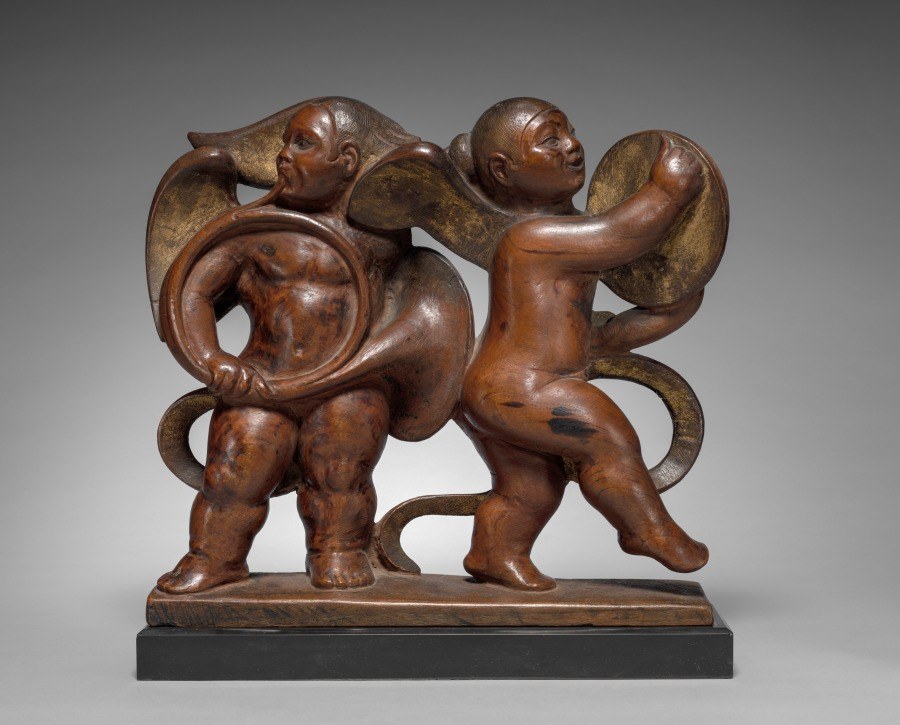
Dancing Children
Gaston Lachaise (American, born France, 1882–1935)
- Source:
- Cleveland Museum of Art
- Rights:
- Public domain — free to use, share and adapt.
- Recorded as:
- CC0 (Public Domain)
Though not a dance scene, this work demonstrates how deeply Renaissance sculptural practice was inflected by the language of movement and contrapposto that derived from observation of dance and trained classical bodies. For historians of Renaissance aesthetics and of how dance informed visual art, the work reveals the extent to which the moving human body was the model for all figurative representation.
What you are looking at
Two winged putti or cherubs in classical bronze are carved in a dynamic, playful composition. The figure on the left holds a large circular shield or tondo bearing a profile portrait, while leaning back with muscular tension. The figure on the right supports itself on one leg in a contrapposto stance, its torso twisted, one arm raised behind its head. Both figures have substantial wings rendered in bronze with feather detail, and stand on a simple rectangular base. The work appears to be Renaissance or early modern in its classical vocabulary—the muscularity, the contrapposto, the allegorical use of winged children to frame or present a portrait medallion suggest courtly humanist tradition rather than naturalistic observation. The bronze has darkened to a rich brown patina with areas of lighter wear.
The dancing
Both figures display trained classical poses: the left cherub's backwards lean creates muscular tension through the torso and legs, while the right figure's weight settles onto one straightened leg with the body curved in a gentle S-curve (contrapposto). The lifted arm of the right figure and the twisted spine both recall academic figure drawing. Neither figure is engaged in recognizable balletic or social dance vocabulary; instead they occupy the allegorical register of Renaissance and early modern sculptural ornament, where movement is expressive rather than choreographic.
The dance depicted
These are not dancers but allegorical putti in the classical tradition. However, the sculptor has chosen dynamic, energetic poses for both figures—twisted spines, extended limbs, weight shifts—that suggest movement and liveliness rather than static presentation. This belongs to the broader Renaissance and baroque vocabulary of movement in art, where the human body, even in mythological or decorative guise, was understood through the language of dance and classical contrapposto. The work belongs more to the history of how dance informed fine art representation than to the documentation of actual dance practice.
How it was made
This is a bronze relief or three-dimensional carved work, likely cast rather than carved from a single block. The weight and muscularity of the figures, the fine detail in the feathered wings, and the patina suggest a skilled metalworker, probably working in the Renaissance or early modern period. Bronze allowed the sculptor to achieve fine surface detail and to create an object that could be reproduced through casting, making it a work of considerable craft and likely considerable expense. The work would have circulated among wealthy patrons or courts.
About this work
This bronze sculpture presents two classical putti or winged children in poses derived from Renaissance academic figure drawing and contrapposto convention. The work does not depict actual dance but rather uses the sculptural language of movement—muscular tension, weight shifts, twisted spines—to create an allegorical or decorative object. The left figure frames a portrait medallion, suggesting the work functioned as an ornamental support for a portrait or as a freestanding sculptural group for a courtly collection. The piece belongs to the long tradition in which Renaissance and early modern artists understood human movement through the classical body and the principles that animated dance.
How to look at it
Look at how weight is distributed in each figure: the leftward lean of the left cherub creates tension against the mass of the shield, while the right cherub's straightened supporting leg and twisted torso embody the classical contrapposto that Renaissance artists learned from antique sculpture and from observation of trained dancers. The sculptor has frozen not a moment of dance but a state of dynamic balance—the kind of muscular intelligence that animated both academic figure drawing and choreographed movement.
The period
This work belongs to the Renaissance revival of classical contrapposto and the humanist tradition of using allegorical putti to frame or support important objects (often portraits). In the 15th and 16th centuries, artists studied the human body in movement as the foundation of all figure drawing, and dance—both courtly and classical—provided the vocabulary for understanding weight, balance, and expressive gesture. The work's use of winged children to present a portrait medallion is characteristic of courtly ornament and suggests a wealthy patron.
Where it lives
The work is part of the Cleveland Museum of Art's collection and is catalogued as 'Dancing Children,' though the catalogue record contains minimal information. The object is bronze, likely Renaissance or early modern in date, and the source record provides no artist attribution.
Questions about this work
Are these figures actually dancing?
No. These are allegorical putti (winged children) in classical poses, used as ornamental supports for a portrait medallion. However, the sculptor has rendered them with dynamic, energetic poses—twisted spines, weight shifts, muscular tension—derived from the classical contrapposto vocabulary that Renaissance artists learned from dance and from antique sculpture. The work uses the language of movement without depicting an actual dance.
What is the circular object the left figure is holding?
It appears to be a portrait medallion or tondo—a framed circular portrait in relief. The putti are arranged to present or support it, suggesting the work functioned as an ornamental frame or sculptural group commissioned by a wealthy patron to display a portrait.
Why is this in a dance art collection?
The work demonstrates how deeply Renaissance visual art was inflected by dance and classical body movement. The contrapposto poses, the muscular tension, the weight shifts—all these reveal how artists understood human movement through the vocabulary of trained dancing bodies. For historians of Renaissance aesthetics and of how dance informed visual culture, the work is important evidence.
More dance artwork