49 works in this view — arrow keys or swipe to move between them.
Dance in Art
Dancing Cripples
Cornelis Massys (Flemish, 1510/11–1556/57)
- Source:
- Cleveland Museum of Art
- Rights:
- Public domain — free to use, share and adapt.
- Recorded as:
- CC0 (Public Domain)
For historians of performance and the body, this engraving documents the theatrical traditions and satirical conventions that preceded and shaped later dance and performance practices. It reveals that Renaissance print culture gave serious attention to physical comedy and mime—forms often excluded from histories of dance because they lack codified technique, yet they represent a major stream of professional and social performance.
What you are looking at
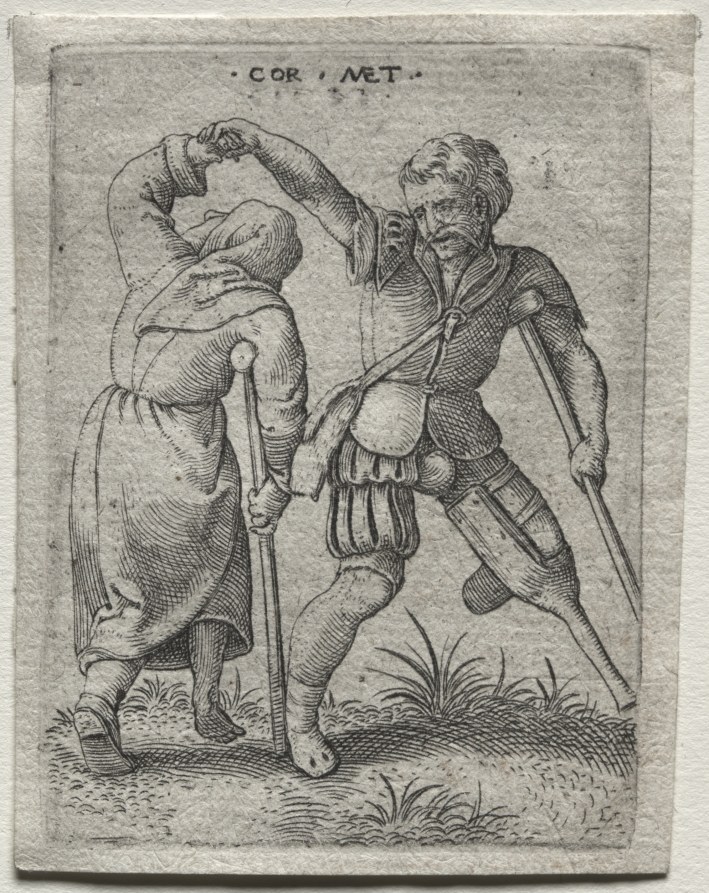
This engraving depicts two male figures in a moment of physical comedy or satirical pantomime. The figure on the left, viewed from behind, is stout and bent forward, wearing a long cloak or coat with heavy cross-hatching that suggests rich fabric. He leans on a staff or crutch and appears to be grimacing or straining. The figure on the right, bearded and more slenderly built, faces left and wears fitted Renaissance-era dress including what appears to be a doublet with decorative hatching and possibly armor plating at the waist. His posture is dynamic and engaged, with one arm raised toward his companion. The right figure also carries a sword. Both men stand on ground marked with sparse grass or weeds. The composition is tightly framed, with the figures filling most of the picture plane. The title "CORNET" appears at the top in capitals.
The dancing
Both figures are upright but bent or twisted from the vertical. The left figure's weight is forward and downward, concentrated on the staff; his body is rounded and his head dropped. The right figure's upper body leans toward his companion with arm extended and raised, suggesting he is gesturing, cajoling, or perhaps mocking. There is no formal dance hold, and no symmetry between the two bodies—instead, the composition creates tension and narrative drama through their opposed angles and relative positions. The relationship between them appears confrontational or comedic rather than cooperative.
The dance depicted
This work does not depict recognizable dance technique or a formal dance genre, but rather a scene of physical comedy, mime, or possibly commedia dell'arte performance. The title "Cornet" may refer to a stock character or performer type, and the exaggerated postures suggest theatrical or carnival buffoonery rather than ballroom or courtly dance. The engraving appears designed to satirize or ridicule disability, infirmity, or clumsiness—a common subject in Renaissance satirical prints. While the human body is in motion and performance, the work belongs more properly to the history of theatrical mime and physical comedy than to dance proper.
How it was made
This is an engraving on paper, executed in the Northern European Renaissance tradition, likely 16th century. The technique relies on fine parallel lines (hatching and cross-hatching) to build tone and suggest fabric texture, particularly visible in the cloak of the left figure. Engraving allowed precise linear detail and was the standard reproductive medium of the period, making prints like this widely circulated in collections and workshops. The small scale and portable format suggest this was part of a series or set of satirical character studies, likely intended for a learned or courtly audience familiar with classical mockery of physical deformity.
About this work
This engraving is a Northern European Renaissance satirical print depicting two figures in exaggerated physical postures, seemingly engaged in mime or theatrical comedy. The work belongs to the tradition of character and costume studies that Renaissance artists drew from commedia dell'arte, classical literature, and the carnivalesque culture of early modern Europe. Although it represents human bodies in dramatic movement and theatrical performance, it documents mime and physical comedy rather than formalized dance technique. The inclusion of the title "Cornet" suggests identification with a specific performance type or character, making this a valuable record of how Renaissance audiences understood and represented theatrical performance beyond the ballroom and court.
How to look at it
Attend first to the contrast in body position between the two figures: the left is compressed, rounded, and earthbound; the right is extended, angular, and reaching. The artist has frozen a moment of physical interaction or confrontation, using exaggeration and distortion to generate comedy or ridicule. Look at the careful rendering of the cloak and garments to understand the print's technical sophistication. The title at the top invites you to read this as a named character or performance type, not as an isolated moment of random physical behavior.
The period
This engraving dates to the Northern European Renaissance, a period when printed satirical images of social types, professions, and physical conditions circulated widely among the educated classes. Commedia dell'arte was flourishing in Italy and spreading northward; stock characters, exaggerated physicality, and mockery of disability or infirmity were popular subjects. The engraving likely belongs to a tradition of character and costume prints that included dancers, musicians, soldiers, servants, and grotesque or deformed figures. Such prints served both as documentation of performance practices and as vehicles for social satire.
Where it lives
The work is held in the Cleveland Museum of Art and catalogued as part of the museum's collection of dance-related art. The print's original source, date, artist, and complete title remain unrecorded in the available catalogue information.
Questions about this work
Is this actually a dance?
Not in the formal sense. This engraving depicts theatrical mime or physical comedy—likely commedia dell'arte or similar performance traditions—rather than a codified dance form with technique and steps. However, it documents how Renaissance performers moved and used their bodies for entertainment, and belongs to the broader history of performance culture.
What does 'Cornet' mean?
The title likely refers to a character type or stock performer, possibly a servant or clown figure in commedia dell'arte or Renaissance theater. 'Cornet' may be a specific named character or role, but without further documentation, its exact meaning remains uncertain.
Why does the left figure have a crutch or cane?
The engraving appears to satirize disability or physical deformity for comic effect—a common subject in Renaissance satirical prints. The figure's bent posture, heavy garments, and staff suggest age, infirmity, or grotesqueness as sources of ridicule or entertainment.
More dance artwork