49 works in this view — arrow keys or swipe to move between them.
Dance in Art
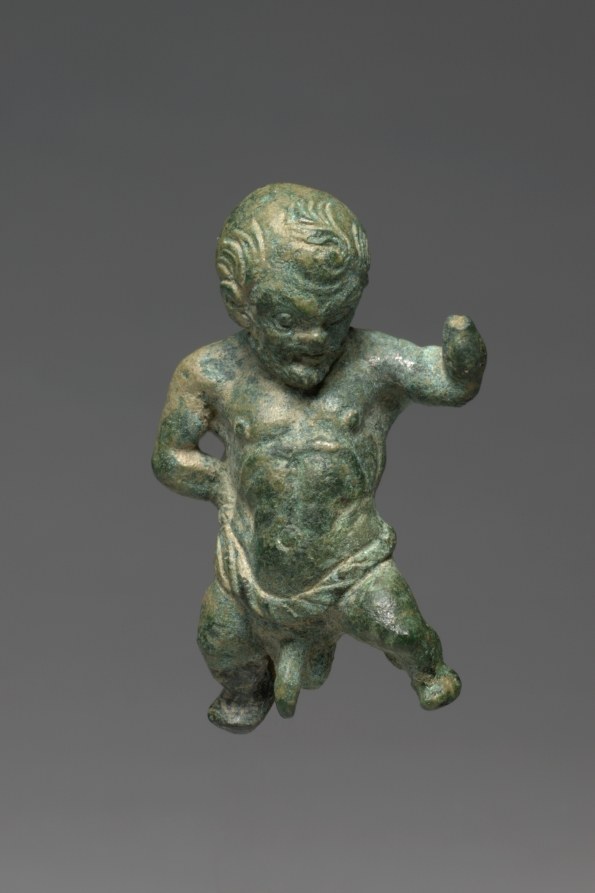
Dancing Dwarf
Unknown artist
- Source:
- Cleveland Museum of Art
- Rights:
- Public domain — free to use, share and adapt.
- Recorded as:
- CC0 (Public Domain)
The work illustrates how dance was understood in Renaissance and Baroque European thought—not as a technical discipline but as a natural, joyful expression of life and divine pleasure. For dancers and historians, it provides evidence of how movement was aestheticized and valued in a period when dance was becoming increasingly formal and codified.
What you are looking at
A small bronze figure of a child or cherub frozen mid-dance stands alone against a neutral ground. The figure is in active motion, with weight shifted forward onto one leg while the other extends behind, and both arms raised—the right arm lifted higher than the left in an exuberant gesture. The musculature is rendered with careful attention: the torso is bare and modeled with anatomical precision, showing the defined chest and abdominal muscles of a young body in vigorous action. The child wears what appears to be a draped cloth or skirt around the hips and lower body. The surface of the bronze shows a rich verdigris patina, ranging from pale green-gold in the highlights to deeper blue-green in the shadows, with areas of darker oxidation that suggest considerable age.
The dancing
A single standing figure, likely a cherub or putto, dances in a pose suggesting either a moment of joyful exultation or active choreography—the raised arms, forward-tilted trunk, and the play of weight between the legs all suggest energetic movement rather than a static pose. The figure's proportions are childlike but idealized, with careful anatomical modeling typical of classical sculpture. The drapery is minimal and functional rather than elaborate, allowing the body's movement to read clearly.
The dance depicted
This is not identifiable as a specific dance style, but rather as a generic representation of youthful joy and exuberance in motion. The figure type—the putto or cherub—was a conventional vehicle for representing divine joy, love, and celebration across European art, particularly in Renaissance and Baroque contexts. The pose suggests a dance of celebration or festivity rather than a formal, codified dance practice; it is the idea of dance as an expression of pleasure rather than a technique to be learned.
How it was made
This is a bronze sculpture, cast rather than carved, as is evident from the smooth surface finish and the precision of the modeling. Bronze casting allowed the sculptor to achieve fine anatomical detail and a convincing sense of movement within a small, portable object. The patina indicates this is an old work, likely created centuries ago and allowed to oxidize naturally over time. Such bronze figurines were common in the Renaissance and Baroque periods, often created as independent artworks for private collection or as models for larger works.
About this work
This small bronze figure represents an ancient tradition in European art: the use of the child or cherub as a vehicle for depicting dance and celebration. The work captures a moment of joyful exuberance—a child or divine spirit in the midst of uninhibited, celebratory movement. As an object, it belongs to the long history of Renaissance and Baroque bronzes, small enough to hold and display in a cabinet or on a mantle, yet ambitious in its anatomical modeling and its capture of dynamic movement. It speaks to the importance of dance in European culture as an expression of joy and spiritual exuberance, and to the ways artists have used the figure of the child to represent this kind of unguarded pleasure.
How to look at it
Observe the specific moment the sculptor chose: the figure is caught mid-stride, with the weight-bearing leg clearly distinguished from the extended leg, and with both arms raised in a gesture that reads as celebratory. The raised right arm is higher and more extended, creating an asymmetry that conveys movement and energy. The minimal drapery and careful anatomical modeling allow the viewer to read the mechanics of the movement—the torso's tilt, the play of tension in the legs—as clearly as possible. This is not a static pose but a single frame from an imagined dance.
The period
The figure type and style suggest a work from the Renaissance or Baroque period, though the precise dating is unknown. During these centuries, dance was increasingly important in courtly and religious contexts, and representations of dance—particularly dance associated with joy, love, and celebration—were common in all media. The use of the putto as a motif for representing dance and pleasure draws on classical precedent and reflects the Renaissance fascination with antique forms and subjects. In this period, dance was understood both as a courtly accomplishment and as a natural expression of joy, and artworks frequently depicted it in both contexts.
Where it lives
The work is held by the Cleveland Museum of Art and is catalogued as a bronze figurine in their collection. The catalogue record provides no date, artist attribution, or medium confirmation, though visual analysis confirms it is cast bronze.
Questions about this work
What period is this from?
The style, patina, and subject matter suggest a Renaissance or Baroque date, but the catalogue record does not specify one. The work could range anywhere from the 16th to 18th century.
Is this definitely a cherub or could it be something else?
The term 'dwarf' in the title may refer to a human child or to a dwarf performer, both of whom were subjects of Renaissance and Baroque art. However, the idealization of the body and the celebratory pose are consistent with a cherub or putto—a figure from classical and religious tradition representing divine joy.
Why does it matter that the arms are raised?
Raised arms were a conventional gesture for expressing joy, exuberance, and celebration in European art. The specific asymmetry of this pose—with one arm higher than the other—suggests both spontaneous emotion and a moment within an actual choreographed movement.
Could this be a model for a larger work?
Possibly. Small bronze figurines like this were often created as independent artworks, but they were also sometimes used as maquettes or models for larger sculptures. Without additional documentation, this cannot be determined.
More dance artwork