49 works in this view — arrow keys or swipe to move between them.
Dance in Art
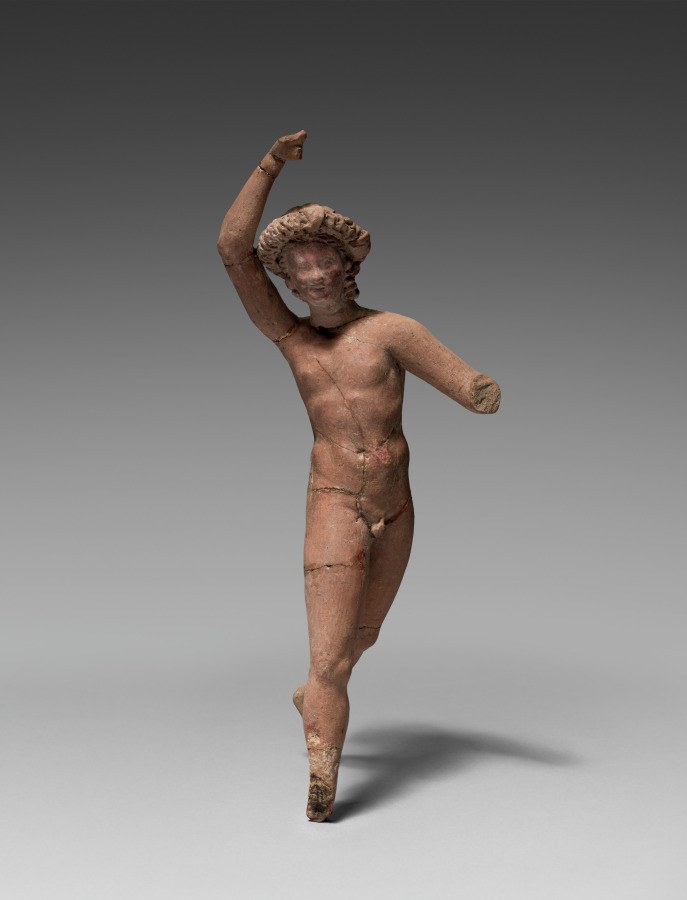
Dancing Eros
Unknown artist
- Source:
- Cleveland Museum of Art
- Rights:
- Public domain — free to use, share and adapt.
- Recorded as:
- CC0 (Public Domain)
This figurine demonstrates that ancient artists understood and valued the representation of the moving body as an end in itself. The pose shows sophisticated anatomical knowledge and an interest in capturing the dynamic moment—not the static ideal, but the body as it lives in time and space. For dancers and choreographers, it offers evidence that the gesture, the lifted arm, the tilt of the head were understood as carriers of meaning and beauty across the ancient world.
What you are looking at
A terracotta or clay figurine depicts a youthful male nude in a dynamic, celebratory pose against a neutral gray background. The figure stands with his weight shifted slightly forward, his left arm raised high above his head in an exuberant arc, while his right arm extends outward at roughly shoulder height. His head is turned upward and to the left, following the line of the raised arm, with curled hair rendered in classical style. The body shows careful anatomical modeling—defined musculature across the chest and abdomen, with delicate attention to the proportions of a young man at the peak of physical idealization. The figure stands on one leg with a subtle contrapposto, the stance both poised and full of kinetic energy. The warm terracotta tone, with areas of darker patination, suggests considerable age.
The dancing
A single male figure occupies the entire composition, rendered in full three-dimensional form. The body demonstrates a deep understanding of classical contrapposto: the weight rests primarily on the right leg while the left leg is relaxed, allowing the torso to rotate slightly. The raised left arm sweeps upward and back in an arc suggesting either celebration, worship, or the height of a movement phrase. The extended right arm balances the composition. The head's tilt and gaze direction follow the left arm, creating a unified line of energy from the lower body through the torso and into the upraised limb.
The dance depicted
This figure almost certainly represents Eros (Cupid) in a moment of joyful movement or triumph rather than depicting a specific named dance. The pose suggests classical antiquity's representation of youthful exuberance and divine pleasure—the raised arm might depict a gesture of revelation, victory, or ecstatic movement. The work belongs to a long tradition of Hellenistic and Greco-Roman figurines showing young male nudes in dynamic poses, often associated with festive or sacred contexts. The dance-like quality lies in the body's clear engagement with movement: this is not a static pose but the capture of a moment mid-gesture, with energy flowing through the frame.
How it was made
This is a terracotta figurine, hand-modeled from clay and likely fired. The small scale and evidence of hand-tooling—visible in the surface texture and the working of details like the curled hair and musculature—indicate this was a craft object made for circulation and handling rather than monumental display. Terracotta's relative fragility and warmth made it ideal for intimate viewing and domestic ownership. The patination and wear visible in the photograph suggest considerable age; the style and technique point toward Hellenistic or Roman manufacture, periods when such figurines were produced in quantity across the Mediterranean world.
About this work
This small terracotta figurine preserves a moment of youthful exuberance rendered in the classical tradition of depicting the male nude body. The figure of Eros or a youthful male attendant spirit is captured mid-gesture, one arm raised in celebration or invocation, the body alive with kinetic energy even in its stillness. The work exemplifies how dance and movement were central to classical ideals of beauty and divine presence: the body is shown not at rest but in motion, demonstrating the sculptor's attention to how weight, balance, and gesture work together.
Within the history of dance in art, this figurine represents an important principle: movement does not require grand historical narrative or theatrical context to be worth representing. A single figure's gesture—the way the body extends into space—can contain all the vitality and meaning of a dance. The work belongs to a vast tradition of small-scale figurines that served both devotional and domestic purposes, objects that moved through people's hands and domestic spaces, bringing the idealized beauty of moving bodies into everyday life.
How to look at it
Notice how the artist has frozen the figure at the apex of a movement—the moment when weight is distributed across both legs and the raised arm pulls the viewer's eye upward, following the figure's own gaze. The contrapposto stance (weight on one leg, the other relaxed) was the classical solution to showing a body that could move, that had life within it. Look at how the extended right arm counterbalances the raised left: this is not accidental symmetry but the artist's way of showing how a body maintains equilibrium while in motion. The slight turn of the torso and head amplifies the sense of a gesture in progress rather than a static pose.
The period
The style and technique of this figurine suggest manufacture in the Hellenistic period (roughly 323–31 BCE) or the Roman period that followed. During the Hellenistic era, there was a marked increase in the production of small-scale figurines depicting mythological subjects, young nudes, and figures in dynamic poses. These objects circulated widely throughout the Mediterranean and were owned by people of moderate means; they served both religious purposes and as markers of cultural taste and education. The interest in capturing movement and emotion—the so-called 'baroque' quality of Hellenistic art—is evident in this figure's energetic pose.
In the period when this was likely made, dance held a central place in religious ritual, theatrical performance, and social life. Young male nudes performing movements for gods and mortals were standard subjects in vase painting, sculpture, and literature. This figurine sits within a cultural moment that valued the representation of the youthful, moving body as an ideal worthy of preservation in permanent materials.
Where it lives
The figurine is held in the Cleveland Museum of Art collection, catalogued as part of the museum's dance-related art collection. It is identified as coming from the museum's records but lacks documented details of acquisition, earlier provenance, or precise dating.
Dance in this work
Questions about this work
Is this actually a dancing figure, or is it just a generic young male nude?
The distinction is subtle but important. While the figure is anatomically idealized in the classical tradition, the specific pose—the raised arm, the upward gaze, the forward momentum of weight—suggests a captured moment of action rather than a simple standing pose. Classical and later art traditions understood the raised arm, the tilted head, and the contrapposto stance as signs of vitality and movement. In this sense, the figure is shown 'dancing' or at least performing—enacting a gesture meant to convey joy, reverence, or exuberance.
What is the connection to Eros specifically?
The title 'Dancing Eros' identifies the figure as Eros (Cupid), the Greek god of love. Young male nudes in ecstatic or celebratory poses were a standard way of depicting Eros in Hellenistic and Roman art. The raised arm and upward gaze are consistent with representations of divine joy or the act of showering blessings. The exact narrative or mythological moment is not clear from the image alone, but the identification as Eros suggests this is meant to show the god in a moment of triumph or pleasure.
How old is this figurine?
The catalogue record does not provide a specific date. The style, technique, and form suggest manufacture in the Hellenistic period (roughly 323–31 BCE) or the Roman period following. Terracotta figurines of this type were produced over several centuries and in many locations around the Mediterranean. More detailed analysis of the clay, the techniques used, and comparison with securely dated examples would be needed to narrow the dating further.
What was this object used for?
Small terracotta figurines of this type served multiple purposes in ancient Greek and Roman households and religious contexts. They might be votive offerings left at shrines, decorative objects owned by people of moderate means, or religious tokens. The scale and portability suggest it was a personal or domestic object, handled and viewed close at hand rather than displayed publicly. The subject—a youthful, joyful figure—suggests it may have been kept for its beauty and its association with divine pleasure and abundance.
More dance artwork