49 works in this view — arrow keys or swipe to move between them.
Dance in Art
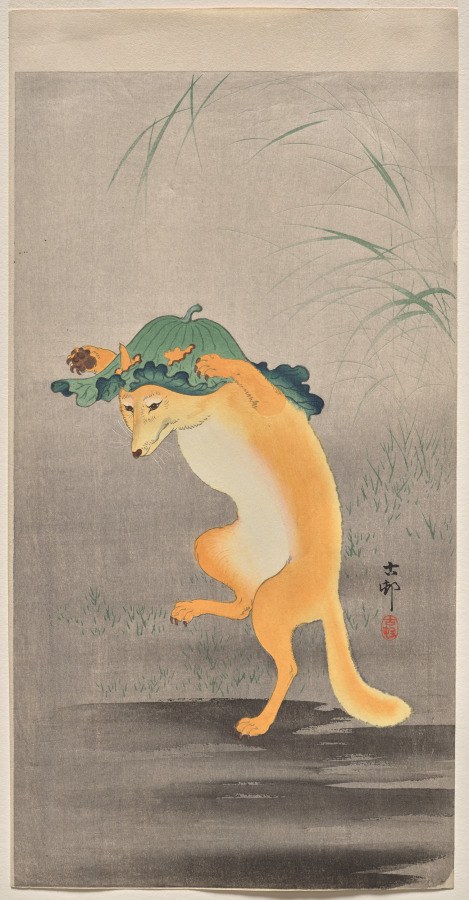
Dancing Fox
Ohara Koson (Japanese, 1877–1945)
- Source:
- Cleveland Museum of Art
- Rights:
- Public domain — free to use, share and adapt.
- Recorded as:
- CC0 (Public Domain)
The work demonstrates that dance imagery extends beyond literal human performance into imaginative, cross-species representation. For choreographers and dance historians, it reveals how the visual markers of dance—verticality, balance, gesture, adornment—operate as a semiotic system that can evoke movement and intention even when applied to fantastical subjects. The fox's deliberate ornamentation and poised stance suggest that in East Asian visual culture, even animals could be understood as dancers or performers.
What you are looking at
A solitary canine figure dominates this composition, standing upright on hind legs in an almost human posture against a plain, neutral background. The animal—rendered in warm orange-gold tones with a cream-white belly—wears an elaborate headdress or cap in deep green decorated with what appears to be flowering branches or foliage in orange and gold. The fox's posture is dramatically vertical, weight shifted onto its back legs, front legs slightly flexed as if mid-movement. Delicate wisps of pale green vegetation (grasses or reeds) suggest a natural setting in the lower portion of the composition. The painting employs a restrained palette and minimal background, focusing all attention on the figure's poised, animated stance. An artist's seal appears in red in the lower right corner, indicating an East Asian tradition, likely Japanese.
The dancing
The fox's body demonstrates remarkable anthropomorphic qualities: it balances on extended hind legs with torso nearly vertical, front limbs curved and held at chest height in a posture that evokes human arm position during movement. The weight distribution suggests active equilibrium rather than static standing—the rear legs are slightly bent and tensioned as though ready to shift position. The animal's head tilts slightly, and the overall frame suggests momentary suspension in an animated gesture rather than rest.
The dance depicted
This appears to depict a stylized, imaginative fox engaged in a personified dance or celebratory movement. The upright stance, the deliberate arm positioning, and the ornamental headdress all suggest a choreographed or ritualistic act rather than naturalistic animal behavior. In Japanese artistic tradition, the kitsune (fox) was understood as a magical or supernatural creature capable of transformation and human-like behavior; this work likely draws on that cultural frame. The fox is not performing a recognizable human dance form, but rather embodying a fantastical performance mode unique to the animal itself—a personified dance that blurs the line between animal observation and imaginative anthropomorphism.
How it was made
This is a woodblock print (likely from the technical evidence of the clean lines, flat color areas, and the artist's seal format). The work demonstrates the characteristic aesthetic of Japanese ukiyo-e or shin-hanga: bold outlines in muted greens and browns defining form, warm ochres and golds for the main figure, and sophisticated use of negative space and pale wash backgrounds. Woodblock printing would have allowed this image to circulate as a relatively affordable work, accessible beyond elite collectors.
About this work
This undated print presents an anthropomorphized fox in an upright, dance-like posture, wearing an ornamental headdress, against a minimal landscape. The fox's balanced stance and positioned limbs suggest active movement rather than passive observation. The work belongs in a dance collection not because it depicts human choreography, but because it uses the visual language of human movement—weight, balance, gesture, and ornamentation—to imagine an animal in performance. The painting reveals how dance vocabulary extends into fantasy and imagination, and how artists use dance-like posture to convey animation, agency, and ceremony even in non-human subjects. The headdress and grooming suggest that this is a special moment, a performance or transformation, not everyday animal behavior.
How to look at it
Observe the fox's center of gravity and weight distribution—the artist has captured a moment of active balance rather than static rest, achieved through the slight bend of the hind legs and the position of the torso. Note how the headdress elevates the figure and frames the head as if for ceremony or performance. The minimalist background and the fox's frontal, vertical orientation direct all focus to the posture itself; the artist wants you to read the body as active, intentional, and performed rather than as natural animal behavior.
The artist
The artist is not recorded in the catalogue. The style, technique, and seal format suggest a Japanese woodblock print artist, likely from the 19th or early 20th century, working within or influenced by the ukiyo-e tradition or its later shin-hanga evolution. The work's whimsical subject matter and refined execution indicate a trained artist working within established aesthetic conventions.
The period
Japanese woodblock printing tradition (from the 17th century onward) frequently depicted anthropomorphized animals, supernatural creatures, and fantastical scenes alongside more naturalistic subjects. The kitsune (magical fox) was a recurring figure in Japanese folklore and visual arts, often depicted as trickster, transformer, or performer. By the 19th century, this tradition was becoming increasingly focused on decorative subjects, imaginative scenes, and studies of movement and gesture rather than purely documentary purposes.
Where it lives
Held by the Cleveland Museum of Art. Classified as part of the museum's dance-related art collection, indicating the institution recognizes the work's resonance with movement and choreographic imagery despite its animal subject.
Questions about this work
Is this actually about dance, or is it just a picture of an animal?
It is both. The artist has deliberately posed the fox in an upright, balanced stance with positioned limbs that mirror human dance posture and gesture. The ornamental headdress further suggests a ceremonial or performative moment. The work uses the visual language of dance—verticality, balance, adornment, intentional gesture—to create meaning, even though the dancer is not human.
What is the fox wearing?
A headdress or cap in deep green, decorated with flowering branches or foliage in orange and gold tones. In Japanese artistic tradition, such ornament signals a special moment, ceremony, or transformation. The headdress elevates and frames the head as if for performance.
Why would a fox be depicted dancing?
In Japanese folklore and visual culture, the kitsune (fox) was understood as a magical or supernatural creature capable of transformation and human-like behavior. The kitsune could be a trickster, a shapeshifter, or a performer. This work draws on that tradition, imagining the fox as an animated, perhaps magical being engaged in celebration or transformation.
More dance artwork