49 works in this view — arrow keys or swipe to move between them.
Dance in Art
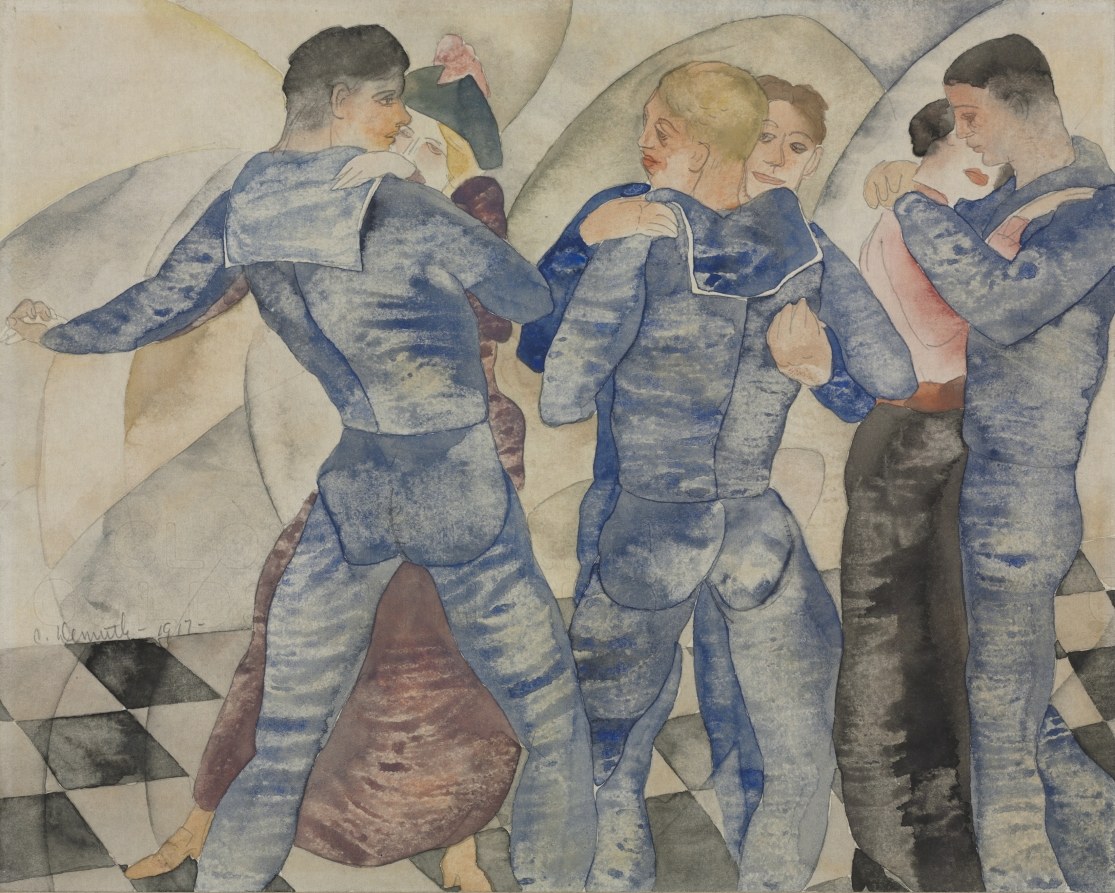
Dancing Sailors
Charles Demuth (American, 1883–1935)
- Source:
- Cleveland Museum of Art
- Rights:
- Public domain — free to use, share and adapt.
- Recorded as:
- CC0 (Public Domain)
The image challenges assumptions about what counted as dance in the early modernist period: rather than ballet, music hall, or folk forms, here the artist finds dance-like choreography in the casual physicality of working men. For historians of modernism and dance, it documents the era's fascination with the male body in motion and the blurred boundary between social gesture and artistic representation.
What you are looking at
Five male figures in blue-grey athletic or dance wear are arranged in a dynamic group against a soft, neutral background with curved architectural forms suggesting an interior space. The figure on the far left turns his head back over his shoulder while extending one arm, his body twisted in a pose of motion or exertion. The central pair embrace or support one another, their bodies intertwined. A third figure on the right clasps or steadies the shoulders of a smaller companion. All five wear matching or similar close-fitting garments with visible musculature rendered beneath; the cloth shows varied pigmentation suggesting either wear or deliberate shading to emphasize form. The composition has an Art Deco or early modernist character, with simplified anatomical forms and a carefully orchestrated sense of movement frozen in space. A signature and date (appearing to read 'Clausen 1912') are visible in the lower left.
The dancing
The bodies are rendered with strong anatomical emphasis and are positioned in contact with one another—clasping, supporting, or leaning into shared weight. The poses suggest either shipboard camaraderie, athletic exertion, or rehearsed ensemble movement rather than ballroom or folk dance partnership. Weight is distributed unevenly, with twisted torsos and heads turned away from the body's direction, creating a sense of arrested action. The figures are approximately equal in size and appear to be male, with no formal ballroom frame or classical dance line visible.
The dance depicted
The title *Dancing Sailors* identifies the subject as nautical workers rather than trained dancers, yet the composition's careful arrangement and the physical contact between figures suggests choreographed movement or at least a staged moment of shipboard sociability. The style of dress—fitted, uniform-like garments—and the homosocial group dynamic are consistent with early 20th-century sailor culture. The image does not clearly depict a recognizable dance form; instead, it captures what may be a shipboard celebration, folk movement, or modernist reinterpretation of masculine physicality. The date (1912) and aesthetic suggest this is a theatrical or artistic representation rather than documentary evidence of actual sailor dancing practices.
How it was made
The work appears to be a watercolor or mixed-media drawing on paper, with soft washes of color over pen or pencil underdrawing. The artist has used color selectively—blues and greys dominate, with touches of brown and flesh tones—allowing the paper to show through in places and creating a sense of immediacy. The technique is characteristic of early modernist sketch work or study material intended for reproduction or exhibition, rather than finished oil painting. The signature and date suggest this is an autonomous artwork rather than a preliminary study, despite its sketch-like quality.
About this work
This 1912 work depicts five male sailors in close physical contact, arranged in a composition that emphasizes muscularity and group cohesion through interlocking poses. Whether the artist intended to document actual sailor dancing or to use the sailors as a vehicle for exploring modernist male physicality and homoerotic tension remains ambiguous. The work sits at the intersection of genre painting, modernist figure study, and dance documentation—and its presence in a dance art collection reflects the early 20th-century interest in movement, the body, and unconventional performance contexts beyond the concert stage.
How to look at it
Attend to the artist's choice to render the sailors not in a recognizable ballroom or folk dance position, but in a moment of intimate physical support and exertion. The twisted torsos, averted gazes, and interlocking limbs suggest a moment caught between rest and motion—neither clearly the beginning nor the end of a movement sequence. This ambiguity is deliberate: the artist is inviting the viewer to see dance and choreography in the everyday physicality of male camaraderie, a modernist gesture that questions where dance begins and social gesture ends.
The artist
The signature reads 'Clausen 1912.' This may refer to a Northern European artist working in the early modernist idiom, though without secure provenance or additional documentation, a fuller biography cannot be established from the image alone. The style is consistent with Expressionist and early modernist figure work of the period, with emphasis on simplified form and emotional or physical intensity over naturalistic detail.
The period
In 1912, the modernist avant-garde was actively reimagining the body and movement as subjects for serious art. The Russian Ballets Russes had premiered in 1909, bringing exotic and experimental choreography to European audiences; simultaneously, artists were turning away from academic figure painting toward expressive distortion and primitivism. Working-class and non-elite subjects—sailors, laborers, street figures—were increasingly valued as authentic expressions of modern life, and masculine physicality was a key theme in Expressionist art. The image reflects this moment when dance was expanding beyond theatrical venues into everyday gesture and the artistic avant-garde was eager to discover movement and choreography in unexpected places.
Where it lives
The work is held in the Cleveland Museum of Art and is documented as part of the museum's dance-related art collection, indicating that it was actively acquired or catalogued with an awareness of its relevance to dance history and representation.
Questions about this work
Did sailors actually dance like this?
Sailors certainly danced socially aboard ship and in ports, but this image is not a documentary record. The carefully composed, interlocking poses and the modernist aesthetic suggest the artist was creating an artistic interpretation, using sailors as a subject to explore masculinity, physicality, and group dynamics rather than attempting ethnographic accuracy.
Why is this in a dance collection?
The work is included because it represents a dance-adjacent moment—movement, physical contact, and group choreography—and reflects the early modernist expansion of what counted as dance subject matter. Museums began collecting such works to document how artists imagined and represented movement and the dancing body.
What is the date and artist?
The signature appears to read 'Clausen' and is dated 1912. Without additional documentation, a fuller identification cannot be made from the image alone, but the style is consistent with Northern European modernism of that period.
More dance artwork