49 works in this view — arrow keys or swipe to move between them.
Dance in Art
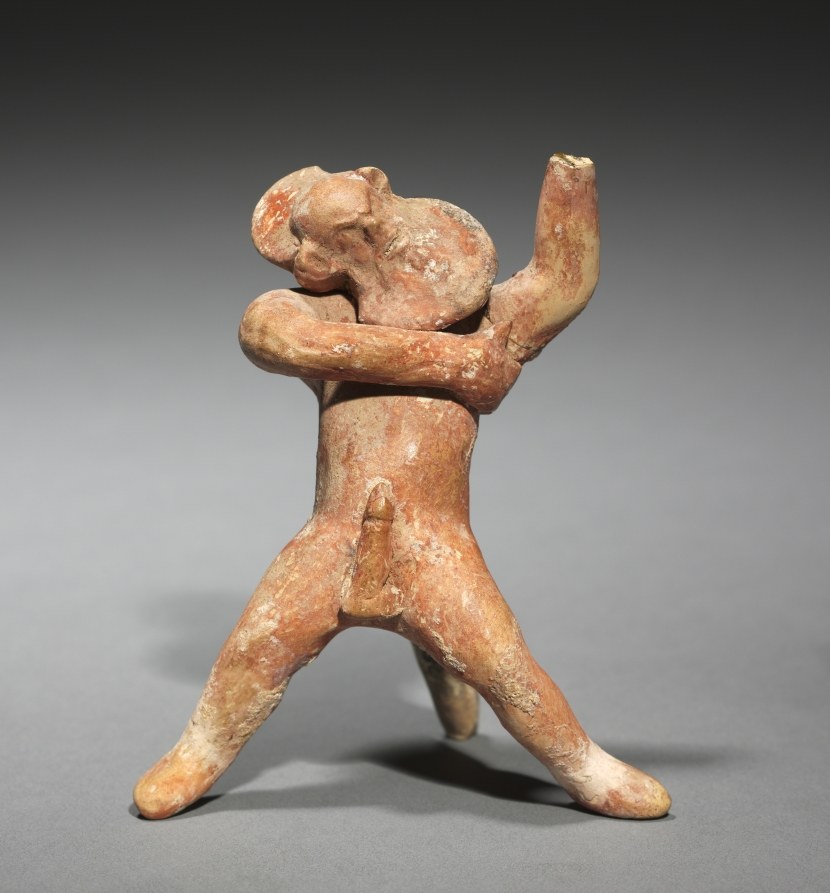
Dancing Satyr
Unknown artist
- Source:
- Cleveland Museum of Art
- Rights:
- Public domain — free to use, share and adapt.
- Recorded as:
- CC0 (Public Domain)
This work shows that ancient cultures represented ecstatic and revelrous dancing through explicit physical extremity—asymmetrical posture, wide balance, twisted spine—rather than through grace or control. For anyone studying how dance has been visualized across time, this satyr is evidence that the body in celebration was understood as unstable, exuberant, and ruled by abandon rather than technique. It is one of the few surviving visual records of pre-classical attitudes to male dancing and revelry.
What you are looking at
A terracotta figure of a satyr in an exuberant pose, captured mid-movement with legs splayed wide in a dynamic stance. The satyr's upper body twists upward, with one arm raised and bent at the elbow in a gesture of abandon or ecstasy. The head is thrown back slightly, with a bearded face and distinctive pointed ears visible. The figure shows signs of age—patches of ochre pigmentation and surface wear consistent with ancient ceramic—and stands on a cylindrical base. The modelling is energetic rather than naturalistic, emphasizing the physical exuberance of the pose over anatomical precision.
The dancing
A single male figure with legs in a wide, lunging stance—the weight appears shifted between them with an open, unstable balance. The torso arches backward and to one side while one arm extends upward with the forearm bent, creating an S-curve through the spine and limbs. This asymmetrical, physically extreme posture conveys rapid motion or ecstatic movement rather than a controlled position. The saturated pose suggests the artist understood dance as a state of abandon rather than formal technique.
The dance depicted
This appears to depict satyric dance—the mythological celebration and revelry associated with satyrs in ancient Greek and Roman contexts. Satyrs were stock figures in satyr plays and Dionysian festivities, known for leaping, phallic display, and uninhibited physical expression. The pose here—extreme, unbalanced, with the body twisted in multiple planes—is consistent with the kordax, the crude, acrobatic dance of comedy and satyr drama in antiquity. The raised arm and thrown-back head suggest abandon and intoxication. This is not theatrical ballet or contemporary dance, but rather a record of how ancient cultures imagined ecstatic or revelrous male dancing.
How it was made
This is a hand-modelled terracotta sculpture, likely created by additive building and assembly of separately formed clay pieces (head, torso, limbs, base) joined together. The material's brittleness and the figure's extremity of pose suggest this was not meant for daily use but as a votive, decorative, or narrative object. The surviving ochre pigment indicates the sculpture was originally painted. Terracotta was the dominant sculptural medium for affordable or portable figures in the ancient Mediterranean, allowing wide circulation among non-elite audiences and preservation in archaeological contexts.
About this work
This terracotta satyr is a document of how ancient cultures imagined male revelry and ecstatic movement. The figure is frozen mid-gesture in a pose of such physical extremity—wide-legged, spine-twisted, arm raised—that it captures not a realistic representation of human dancing but an idea of dance as loss of control and Dionysian excess. The work belongs to a long tradition of ancient Greek and Roman satyric art, part of the material culture surrounding satyr plays and fertility rituals. It is the work of an unknown sculptor, likely made for a modest audience in a Mediterranean pottery workshop, and survives as terracotta, a material that preserved such objects underground for millennia.
How to look at it
Observe the extreme separation between left and right leg—this is not a natural standing position but a lunge or split, suggesting rapid, forceful movement. Follow the spine upward and notice how the torso twists away from the legs, creating a counter-rotation that implies the body is mid-pivot or mid-leap. The raised arm is not extended in a balletic line but bent at the elbow with the forearm angled, suggesting momentum and release rather than control. The thrown-back head is the key to reading this as ecstasy or intoxication rather than formal dancing.
The period
Satyric dance and satyr imagery dominated Greek and Roman popular culture, particularly during the Classical and Hellenistic periods. Satyr plays were a formal genre of drama performed at festivals, featuring crude choreography and obscene gesture. Terracotta figurines of satyrs and other mythological figures were mass-produced in pottery workshops across the Mediterranean and served multiple functions: votive offerings, toys, narrative decoration, and souvenirs. This figure likely dates to the Classical or Hellenistic period, when such representations became widespread and affordable.
Where it lives
The work is held by the Cleveland Museum of Art and identified as part of the museum's dance-related art collection. It is documented in the collection record as a terracotta figure of unknown date, maker, and materials provenance, indicating it arrived at the museum without detailed provenance documentation.
Dance in this work
Questions about this work
What is a satyr in ancient art?
A satyr was a mythological male creature—part human, part goat—associated with Dionysus, fertility, wine, and revelry. Satyrs appeared constantly in ancient Greek art, theater, and religious ritual. They were portrayed as lustful, drunken, and physically uninhibited, and satyr plays were a major dramatic genre. Terracotta figurines of satyrs like this one were popular portable objects across the ancient Mediterranean.
How does ancient ecstatic dance differ from later theatrical dance?
Ancient ecstatic and revelrous dance—associated with satyr plays, fertility rites, and Dionysian festivals—was portrayed as physically extreme, unbalanced, and ruled by abandon. Later theatrical traditions like ballet emphasized control, extension, and formal positions. This satyr embodies the ancient ideal: the body as a site of loss of control rather than mastery.
Is this a realistic depiction of how satyrs actually danced?
No. This is an imaginative and exaggerated representation designed to convey the idea of ecstatic, intoxicated, or lustful movement. The pose is so extreme—the wide-splayed legs and twisted spine—that it could not be held in actual dance. Instead, it expresses the cultural concept of satyric abandon and revelry through physical impossibility.
What does the terracotta material tell us about this figure?
Terracotta was the material of choice for small, portable, affordable sculpture in the ancient Mediterranean. This figure was likely mass-produced in a workshop and sold or given as a votive offering, souvenir, or decorative object. Its survival is due to the durability of fired clay, which preserved it underground until excavation.
More dance artwork