49 works in this view — arrow keys or swipe to move between them.
Dance in Art
Dancing Satyr Group
Unknown artist
- Source:
- Cleveland Museum of Art
- Rights:
- Public domain — free to use, share and adapt.
- Recorded as:
- CC0 (Public Domain)
Satyr revels became the Western tradition's primary visual shorthand for ecstatic, uninhibited group movement—a counterpoint to the ordered choreography of court and theater. These figures establish the iconic poses and gestures (raised arms, wide legs, asymmetrical torsos) that artists and audiences recognized as marking dance outside social convention. Understanding this imagery is essential to reading how later artists used dance to signal transgression, freedom, or Dionysian excess.
What you are looking at
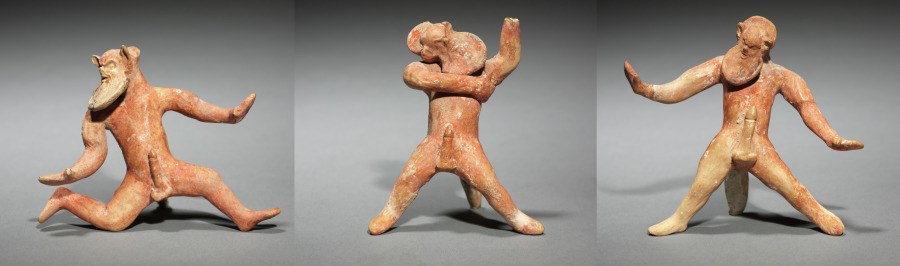
Three terracotta figures in dynamic poses suggest a satyr revel or bacchanal scene. Each figure is modeled in the round and stands independently, their bodies animated and gestural. The leftmost satyr lunges forward with one leg extended, arms spread asymmetrically—one raised high, the other lower—as if in mid-stride or caught in a moment of revelry. The central figure stands with legs wide apart and both arms raised in an ecstatic or celebratory gesture, the torso muscular and compact. The rightmost satyr echoes a similar stance with arms extended outward at shoulder height, weight distributed in a wide base. All three figures are nude or nearly so, rendered with simplified anatomical detail consistent with ancient Greek or Hellenistic work. The clay is burnished to a warm reddish-brown, with slight surface variation suggesting age or intentional surface treatment. The poses suggest synchronized or related movement rather than isolated gestures—three participants in the same revelry, perhaps dancing.
The dancing
All three figures employ a wide, grounded stance with bent knees, suggesting weight distributed across the balls of the feet rather than upright balletic carriage. The satyr arms are raised, spread, or extended in celebratory rather than formal positions—a key difference from courtly or theatrical dance of later periods. The leftmost figure's asymmetrical arm positions suggest movement in progress: one arm high and back, the other lower, implying torque through the spine. The central figure's raised arms with elbows slightly bent and palms open convey exuberance. The rightmost satyr mirrors this openness. None of the figures displays the closed holds, neat frames, or precise lines of European ballroom or ballet tradition. The musculature is emphatic—broad shoulders, defined abdomens—and the proportions slightly stylized, typical of ancient Greek representational convention.
The dance depicted
These appear to be satyrs engaged in a revel, a stock subject in ancient Mediterranean art. Satyrs were mythological followers of Dionysus, depicted as hybrid creatures (man and goat) prone to uncontrolled revelry, drunkenness, and uninhibited movement. The dance they enact is not a named form in the modern sense but rather a generic ecstatic or Dionysian revel—the kind of wild, group movement associated with Bacchic worship and symposium entertainment. The wide stances, raised arms, and dynamic asymmetry suggest movement that is deliberate but unrestrained, neither formal procession nor rigid choreography. This imagery circulated widely in Greco-Roman culture as decoration on vessels, in sculpture, and in relief; it represented a fantasy of transgressive freedom. The subject and style suggest a work either from antiquity or made in later imitation of ancient models.
How it was made
This is a terracotta sculpture—hand-modeled clay, likely fired in a kiln. The three figures are created separately and stand as independent pieces rather than a continuous frieze or relief. The modeling is economical: large planes of clay shaped and smoothed, anatomical detail incised or impressed rather than carved. The burnished warm-brown surface suggests either intentional finishing to enhance color, or the natural result of careful firing. Terracotta was the medium of choice for small votive figures, domestic decoration, and theater-related imagery in the ancient Mediterranean and remained popular for reproduction and collection in later periods. The fact that three related pieces survive suggests they may have been made as a set, possibly for a collector or enthusiast of ancient art.
About this work
These three terracotta satyrs capture a moment of Dionysian revelry in a medium and style that evokes ancient Greek and Hellenistic culture. Satyrs—the mythological attendants of the wine god—were perennial subjects in Mediterranean art, embodying a fantasy of ecstatic, uncontrolled movement in sharp contrast to the ordered social dances of human mortals. The dynamic poses, wide stances, and raised gestures convey rhythm and abandon without naming a specific choreography; instead they represent the idea of revel itself. Whether ancient originals or later pastiches, these sculptures belong to a long tradition of using the satyr as a cipher for dance unbounded by social rules or geometric precision.
They matter to the history of dance imagery because they establish a persistent visual vocabulary for ecstasy, group movement, and the transgressive body. Later European artists would invoke satyr imagery when they wanted to suggest wildness or carnivalesque freedom in contrast to courtly restraint. These small clay pieces encode a very old idea: that dance can be read as the body's argument against hierarchy and control.
How to look at it
Notice the weight distribution in each figure: the wide legs and bent knees anchor the body to the ground, making these satyrs grounded rather than weightless. The arms—raised, spread, asymmetrical—are not a single pose but three variations on the gesture of ecstasy or celebration. The artist has caught not a moment of stillness but the body in motion, with the spine twisted, the limbs extended at different angles. Compare these stances to the formality of later dance imagery: the satyr body is all dynamic contradiction and asymmetry, a visual argument that true dance is the opposite of perfect balance.
The period
Satyrs appear in Greek art from the Archaic period onward, proliferating in the Classical and Hellenistic periods as Dionysian imagery became central to symposium culture, comedy, and religious festivity. Terracotta figurines of satyrs were mass-produced for domestic use and as votive offerings. In the Hellenistic era (4th–1st century BCE), satyr imagery became more naturalistic and psychologically charged, reflecting the period's interest in untamed nature and ecstatic experience. The satyr revel also appeared in Roman art as a sign of cultured leisure and philosophical freedom. From the Renaissance onward, European artists mined ancient satyr imagery as a source of legitimacy for depicting uninhibited movement, carnival scenes, and the wild dances of a pre-Christian, nature-bound past.
Where it lives
Held by the Cleveland Museum of Art. Documented as part of the museum's dance-related art collection, these pieces entered the CMA collection through sources now unrecorded. They are terracotta figurines, the kind of small-scale, portable works that circulated widely in antiquity and were often collected by European and American museums in the 19th and 20th centuries.
Questions about this work
What are satyrs and why do they dance in ancient art?
Satyrs were mythological creatures—men with some animal features—who served as attendants of Dionysus, the god of wine and ecstasy. In ancient Greek and Roman culture, they represented the wild, uninhibited side of nature and were depicted in revels, symposia, and Bacchic processions. Dance was their signature activity: it expressed their nature as beings of instinct rather than reason, and made them visual shorthand for ecstatic or transgressive movement.
Are these sculptures ancient or later reproductions?
The catalogue record does not specify the date or origin. Based on the style, technique, and material alone, they could be ancient Hellenistic originals or later scholarly recreations made during the Renaissance or later revival periods when collectors and artists sought to emulate ancient models. Only scientific analysis or archival research could settle this question.
What does the satyr revel tell us about ancient Greek dance?
These images represent fantasy and myth rather than documentary evidence of actual Greek dance practice. They express cultural values—freedom, ecstasy, the body unleashed—rather than technique or choreography. However, they do confirm that ancient artists understood dance as involving the whole body in motion, with raised arms and dynamic asymmetry, and that they distinguished theatrical or divine dance from the restrained movement expected of citizens in public life.
Why do these figures appear in a gallery of dance?
Dance in Western art is not always about living dancers or named styles. Mythological scenes of movement—satyrs, muses, bacchanals—shaped how artists and audiences thought about what dance could mean visually and symbolically. These terracotta satyrs are part of the deep tradition that allows later artists to invoke 'satyr-like' energy or 'Dionysian' freedom in their own dance imagery.
More dance artwork