49 works in this view — arrow keys or swipe to move between them.
Dance in Art
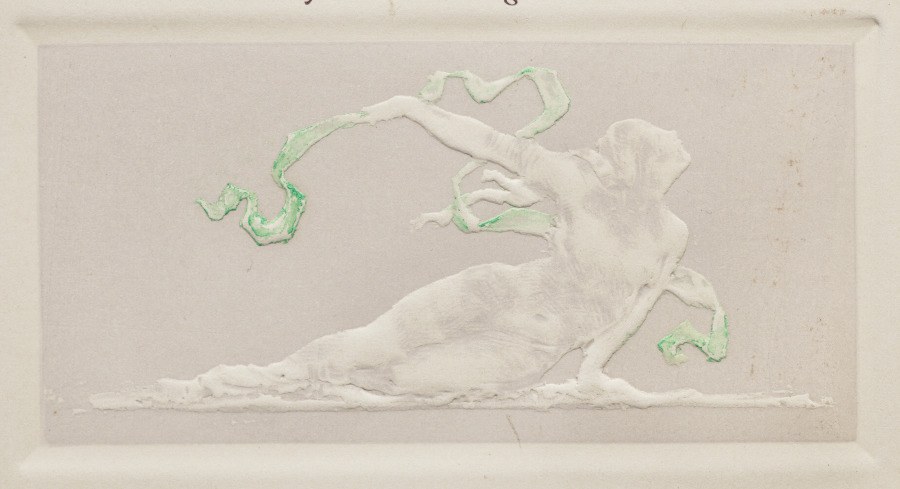
Dancing Woman in Reclining Pose
Pierre Roche (French, 1855–1922)
- Source:
- Cleveland Museum of Art
- Rights:
- Public domain — free to use, share and adapt.
- Recorded as:
- CC0 (Public Domain)
This work documents the enduring presence of graceful, idealized bodily movement in fine-art discourse, particularly the way academic art traditions used the human figure—and especially the female figure—as a site for exploring line, proportion, and beauty. For dance historians, it illustrates how the vocabulary of dance (flowing line, elongation, bodily ease) entered classical and neoclassical visual culture, and how difficult it can be to distinguish between an actual representation of a specific dance and a more general celebration of graceful motion.
What you are looking at
A reclining female figure dominates a shallow, neutral composition executed in white relief against a pale ground. The woman lies stretched diagonally across the lower register, her body elongated and her head turned toward the upper left, supported on one arm in a pose of ease or repose. Her musculature is rendered with classical restraint, emphasizing the torso and limbs through subtle modeling. To the left and upper right, faint green outlines—possibly indicating a framing device, a seaweed or floral motif, or abstract movement lines—punctuate the composition. The work has the character of a sculptural relief or a classical engraving, with its monochromatic palette and emphasis on linear definition over spatial recession.
The dancing
A single figure occupies the composition. The dancer reclines with weight distributed along her torso and extended legs, one arm bent beneath her head in a pose of languorous support. The body is elongated and relaxed, showing no tension or strain; the head is inclined upward and to the left, the gaze directed outward. The pose is fundamentally static and passive rather than active, suggesting a moment of rest, contemplation, or repose rather than the dynamic weight shifts or partnered interaction typical of social or theatrical dance.
The dance depicted
The work is difficult to identify with confidence as any single codified dance tradition. The reclining pose, the classical body treatment, and the allegorical or mythological character of the image suggest this may depict a classical or academic ideal—possibly a nymph, muse, or personification—rather than a historically specific dance style. The passivity of the figure and the absence of clear costume detail, footwork, or partnered interaction make dance identification uncertain. This may be a classical or neoclassical study that employs the human figure in a dance-like or graceful pose without reference to performed dance.
How it was made
The work appears to be an engraving or bas-relief, executed in white or cream against a light ground, with minimal tonal variation and strong reliance on linear definition. The technique is consistent with classical relief sculpture or a print process such as engraving on metal; the precision of line, the subtle modeling of the body, and the monochromatic scheme are all typical of reproductive or fine-art prints of the 18th or 19th century. The use of faint green accents—possibly hand-coloring or a secondary printing layer—suggests the work may have been finished or emphasized by hand after the primary printing or casting process.
About this work
This work is a classical study of the reclining human figure in a pose suggestive of ease, rest, or allegorical meaning. The artist has emphasized the body's musculature and graceful line through the conventions of relief sculpture or fine-art engraving, a technique that dominated academic training and fine-art reproduction from the Renaissance through the 19th century. The figure's pose and the work's formal vocabulary place it within the tradition of classical and neoclassical art, which frequently drew on idealized human form—including idealized dancers and muses—as a vehicle for exploring beauty, proportion, and the movements of the body. While the catalog record identifies this as depicting a "dancing woman," the evidence for actual dance is limited; the pose is more aligned with classical or allegorical representation than with any recognizable social or theatrical dance of a specific era or tradition.
How to look at it
Attend first to the artist's choice to show the figure not in action but in repose—a deliberate suspension of movement that emphasizes the body's formal beauty over its capacity for gesture or expression. The elongated line of the torso and legs, the supported head, and the relaxed musculature all direct the eye along a curve that suggests ease and languor. The green outlines remain enigmatic; they may indicate movement, growth (floral elements), or may simply be a later addition. The work invites comparison with classical sculpture and with the idealized reclining figures of Renaissance and Baroque art, as well as with 19th-century Romantic imagery of the swooning or dreaming female body.
The artist
The artist is not recorded. The work's style, technique, and classical vocabulary suggest a European fine artist working in the 18th or 19th century, trained in the academic tradition of drawing, relief sculpture, or print-making. The emphasis on the idealized female figure and the classical pose place it within a long tradition of academic study and reproductive art.
The period
From the 18th century onward, European academic art institutions emphasized the classical body as the foundation of artistic training. The study of idealized human form—drawing from antique sculpture, anatomy, and living models—was central to the curriculum. During the same period, Romantic ballet was developing (early 19th century), introducing the ethereal, reclining or swoon-like poses of Romantic heroines into theatrical practice. This work's classical vocabulary and its emphasis on ease and elongation align with broader aesthetic currents that valued graceful, naturalized bodily movement. The green accents and the relief technique suggest this may be a study or reproductive print, possibly intended for circulation among art students or connoisseurs.
Where it lives
The work is held in the Cleveland Museum of Art and is catalogued as part of the museum's collection of dance-related imagery. Little is known about its creation, artist, date, or original function, though the catalog record's identification as "artwork from the Cleveland Museum of Art" suggests it entered the museum's collection as a valued study or print.
Questions about this work
Is this woman actually dancing?
It is unclear. The pose is reclining and passive, showing no active footwork, partnered interaction, or the dynamic engagement typical of historical dance. The work may depict a dancer in a pose of rest, or it may simply represent a graceful or idealized female figure without reference to any specific dance. The catalog's title calls her a "dancing woman," but this may reflect the artist's intent to show the body as an instrument of beauty and grace rather than to document actual dance.
What technique was used to make this?
The work appears to be an engraving or a carved relief in white or cream, with linear modeling and minimal tonal range. The addition of faint green accents suggests hand-coloring or a secondary printing process. This technique was standard for academic study, reproductive fine art, and the training and circulation of images in European art from the 18th and 19th centuries.
When and where was this made?
The date and artist are unknown. The style and technique suggest a European origin in the 18th or 19th century, and the classical vocabulary indicates academic training. Without additional documentation or attribution, the specific time and place of creation cannot be established.
Why is this in a dance collection?
The work enters the collection by way of the catalog's identification of the figure as a "dancing woman," and because the graceful, elongated treatment of the body reflects ideals of movement and beauty that were central to both visual art and dance during the period. Academic art and theatrical dance shared a vocabulary of idealized bodily form.
More dance artwork