49 works in this view — arrow keys or swipe to move between them.
Dance in Art
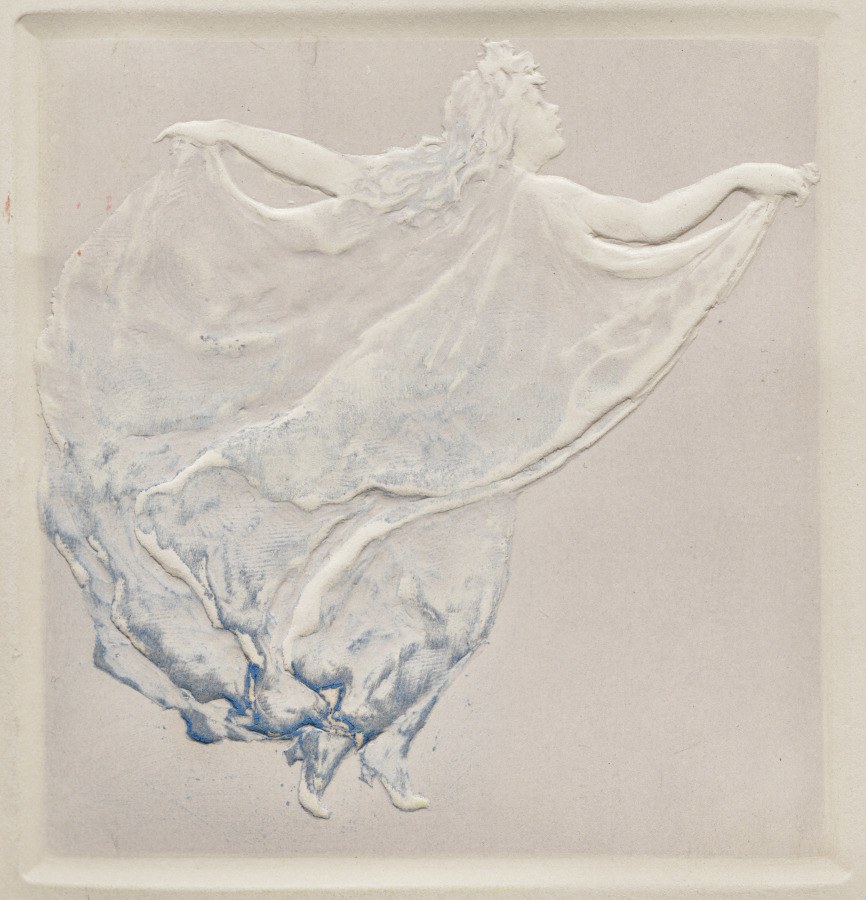
Dancing Woman with Arms Spread
Pierre Roche (French, 1855–1922)
- Source:
- Cleveland Museum of Art
- Rights:
- Public domain — free to use, share and adapt.
- Recorded as:
- CC0 (Public Domain)
This relief preserves a moment of female physical exuberance and agency that many societies have worked to suppress or constrain. The artist has chosen to commemorate not restraint but abandon, not decorum but the ecstatic body. For historians of dance, the image documents attitudes toward the female body in motion, the kinds of dances considered worthy of artistic representation, and the association between dance and the sacred or the transgressive.
What you are looking at
A single female figure dominates this relief composition, captured in a moment of expansive, buoyant movement. She is shown in three-quarter view, her body twisting and rising as if in flight or at the apex of a jump. Her arms spread wide—the left arm extended upward and back, the right arm reaching outward—creating a sense of joyful abandon. Her hair is rendered in loose, curling detail, suggesting movement through space. The drapery of her garment—likely a classical chiton or similar draped fabric—swirls and billows around her legs and lower body, catching and clinging to the form in ways that suggest rapid motion. The folds are deeply carved, creating strong shadows that emphasize the turbulence of the cloth. The figure appears weightless, as if propelled upward or suspended in the moment of greatest elevation. The background is plain and neutral, focusing all attention on the body and its dynamic gesture. The relief is shallow but skilled, with particular attention to the interplay of light and shadow across the drapery.
The dancing
The dancer's weight appears to be gathered and lifted, the body in a state of ascending suspension rather than grounded movement. Both arms are raised and spread, with the upper back and shoulders thrown open in a posture of exultation. The legs are not clearly separated in the shallow relief, but the drapery clings to them in ways suggesting they are drawn up or extended dynamically. The torso twists, allowing the hips and upper body to move in different planes. This is a figure in vertical momentum—the kind of pose that appears in depictions of ecstatic or celebratory dance from classical antiquity through the Renaissance.
The dance depicted
The posture and energy suggest a woman in a state of joyful, unrestrained movement—possibly a bacchante (a follower of Dionysus), a maenad, or a figure from myth engaged in sacred or celebratory dance. The raised arms, the twist of the torso, the billowing drapery, and the sense of upward momentum are consistent with representations of orgiastic or ecstatic dance in Greco-Roman and Renaissance art. The image does not depict a codified dance form with steps or partnering, but rather captures the mood and physical abandon associated with festive, sacred, or theatrical celebration. Without a signature, date, or inscription, the specific historical context and the artist's intent remain uncertain, though the classical body type and treatment of drapery suggest either direct imitation of antique precedent or a later interpretation of classical themes.
How it was made
This is a relief—most likely marble or limestone, carved in shallow relief with sensitive attention to the play of light across surfaces. The technique allows the artist to create deep shadows in the drapery folds while keeping the figure itself relatively frontal and legible. The carved surface shows skilled modeling of the human form and considerable attention to the sensuality of draped fabric. Relief sculpture of this kind was typically displayed in architectural or domestic contexts and reached audiences of educated patrons familiar with classical references. The shallow depth suggests this may be a decorative panel, a study, or a work intended for intimate viewing rather than monumental public display.
About this work
This is a relief sculpture depicting a single female figure in a moment of exuberant, upward-surging movement. The raised arms, twisting torso, and billowing drapery all suggest a woman lost in ecstatic or celebratory dance—possibly a bacchante or maenad from classical mythology, or a figure representing festive abandon more broadly. The carving shows classical training and a deep understanding of how drapery moves with and reveals the body in motion. The work sits in a long tradition of artists capturing the moment of physical liberation and joy in dance, a tradition that runs from classical antiquity through the Renaissance and into later periods of revival and reinterpretation of classical themes.
How to look at it
Pay attention to how the drapery tells the story of motion—the way the cloth clings and billows reveals where the body is moving and how fast. Notice the twist of the torso and the asymmetry of the raised arms, which create a sense of spiraling upward motion rather than static display. Observe how the artist has used the shallow depth of the relief to create drama through shadow and highlights on the folds of fabric. The choice of the moment of maximum elevation—when the body is most weightless and the drapery most alive—is crucial to the emotional effect.
The period
The treatment of the figure and drapery, the classical body type, and the apparent familiarity with antique precedent suggest this work was made in a period of classical revival—most likely the Renaissance, the Neoclassical period of the 18th–19th centuries, or the 19th-century academic tradition. The shallow relief format was popular in all these periods. The subject of the ecstatic or orgiastic dance—particularly the bacchante or maenad—was a recurring theme in art whenever artists looked back to classical antiquity as a model for representing the human body and human emotion. The association of dance with divine possession, with the feminine, and with the transgression of social boundaries is ancient; this work inherits and perpetuates that association.
Where it lives
The work is held at the Cleveland Museum of Art. It is catalogued as an artwork related to dance, part of the museum's holdings in this thematic area, though its broader provenance, maker, and date of creation are not recorded.
Dance in this work
Questions about this work
Is this a Greek or Roman original?
There is no indication from the image or the catalogue record. The classical style and subject could indicate an ancient work, or a Renaissance or later revival of classical themes. The record does not establish a date or origin.
What kind of dance is this?
The posture and energy suggest ecstatic or celebratory dance associated with Dionysian ritual or mythological bacchantes—not a courtly or social dance form with steps. The artist is capturing a mood and a quality of movement—joyful, abandoned, physically liberated—rather than a specific choreography.
Why is there no artist's name?
The record does not provide one. Relief sculpture was made across many periods and by many hands, from apprentices and craftspeople to trained artists. Smaller works, copies, or works of decorative intent were sometimes left unsigned or the signature was lost to time.
More dance artwork