49 works in this view — arrow keys or swipe to move between them.
Dance in Art
Egúngún Masquerade Dance Costume
Unknown artist
- Source:
- Cleveland Museum of Art
- Rights:
- Public domain — free to use, share and adapt.
- Recorded as:
- CC0 (Public Domain)
The Egúngún masquerade represents one of the world's most sophisticated and sustained traditions of masked performance and ancestral veneration. Understanding how Egúngún works—as costume, as dance, as spiritual practice, and as community ritual—challenges Western divisions between art object, performance, and religious ceremony. This costume demonstrates that some of the most important dance forms are inseparable from textile arts, carving, music, and collective memory.
What you are looking at
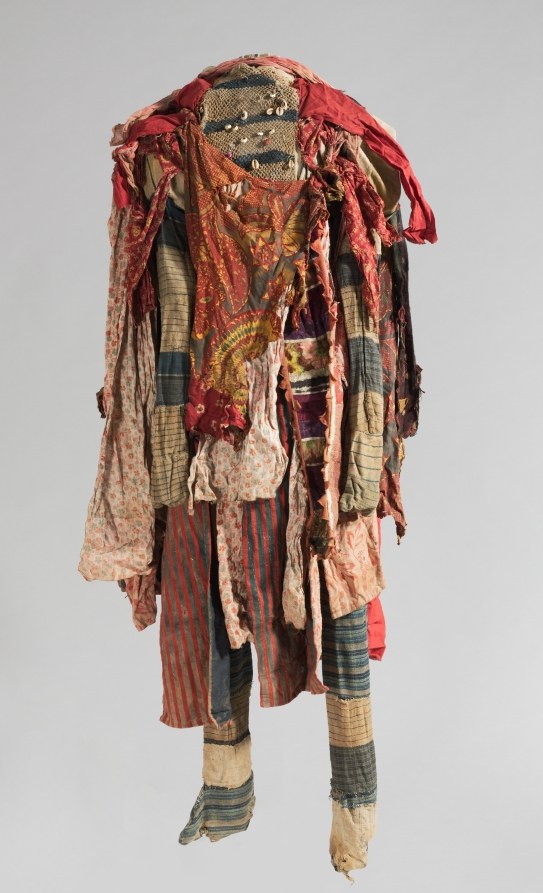
A single figure stands against a neutral ground, dressed in an elaborate masquerade costume of West African origin. The figure wears a carved wooden mask with prominent facial features, geometric patterns, and what appears to be a woven or raffia surface covering parts of the face. The body is swathed in layered textiles—a voluminous patchwork of fabrics in red, indigo, cream, and earth tones, bound together in loose, draped layers that fall from shoulders to ankles. The costume suggests movement even in stillness: the fabrics billow and fold naturally, creating a silhouette both sculptural and fluid. The legs visible below the wrapped costume show patterned cloth wrapping the lower limbs, with striped bands in indigo and cream. The overall effect is of a being transformed—neither fully human nor fully abstract, but somewhere between.
The dancing
The figure stands upright, grounded and stable, with the weight distributed evenly through both legs. The arms are hidden within or wrapped by the costume layers, suggesting containment rather than display. The body is essentially columnar, with no visible articulation at waist, hip, or shoulder—the dancer exists as a unified sculptural form. The head sits atop the layered mass, the mask facing forward. This is not a pose of action or narrative drama but of presence and threshold: the moment of transformation into the spirit being represented.
The dance depicted
This is an Egúngún (or Egungun) masquerade costume, from the Yoruba peoples of West Africa. The Egúngún masquerade is a sacred-ceremonial practice in which dancers embody ancestral spirits through elaborate costuming and movement. The figure shown here is likely in the moment of emergence or standing for presentation rather than mid-movement—the costume itself, rather than the dancer's articulation, is the primary medium of expression. Egúngún performances involve processional movement, rhythmic dancing, and the creation of visual spectacle through the manipulation of heavy, layered fabrics. The costume's weight and volume mean the dancer must develop tremendous control and awareness; movement is deliberate, grounded, and ceremonially paced.
How it was made
This is a three-dimensional textile object—a wearable costume constructed from assembled and layered fabrics, bound together with cord or thread, with an attached carved wooden mask. The object itself is the artwork, not a representation of one. It is the product of skilled textile workers, carvers, and often the communities that maintain and perform in the costume over generations. The layering technique—patching together fabrics of different ages, colors, and weaves—creates a visual and tactile record of the costume's history and repeated use. Objects like this rarely survive intact in museum collections; the fact that this example exists suggests careful preservation.
About this work
This is an Egúngún masquerade costume, one of the most iconic and visually arresting forms of West African performance practice. The Egúngún masquerade is both a dance form and a spiritual technology through which Yoruba communities honor and communicate with ancestral spirits. The costume transforms the wearer into a conduit for the ancestor; the dancer's body becomes a vehicle for another being's presence. The visual impact of the heavily layered, voluminous fabric creates an almost otherworldly silhouette—part human, part spirit, part textile sculpture.
This particular example shows the costume in a state of display or documentation, preserved as a three-dimensional object. In performance, the costume would move through space with its own logic: the fabrics would swing and settle with the dancer's weight, creating visual rhythms distinct from the body's articulation beneath. The mask, with its carved features and surface patterning, serves as the anchor point for the spirit's identity; the layered wrappings below constitute the spirit's substantial presence in the world.
How to look at it
Approach this object as both a sculptural form and a performance apparatus. Observe how the mask—the only carved, permanent element—anchors the identity of the spirit being represented, while the fabric layers below it constitute a kind of ephemeral, responsive body. Notice the weathering and age visible in the textiles, the irregular patching, the different dye colors and weaves—these signs of use and repair are not flaws but evidence of the costume's continuous life. If possible, imagine how this costume would move: the weight of the fabrics, the way they would swing with the dancer's step, the sound they might make, and the way the figure would appear to expand and contract with movement.
The period
The Egúngún masquerade has been practiced by Yoruba peoples for centuries and continues today. The specific dating of this costume is unknown, but Egúngún traditions were fully developed by the colonial period and remain central to Yoruba cultural and spiritual life. The practice itself is not historically bounded; Egúngún is understood as an ancestral tradition that exists outside linear historical time, even as the specific costumes, masks, and performance styles evolve with each generation. Masquerade practices across West Africa have historically served multiple functions: marking rites of passage, honoring the dead, social regulation, entertainment, and the maintenance of community bonds.
Where it lives
This object is held by the Cleveland Museum of Art as part of their collection. It is documented as part of the museum's holdings and presented here as a photograph or museum documentation image of a three-dimensional textile and carved object.
Dance in this work
Questions about this work
Is Egúngún a type of ballet or theatrical dance?
No. Egúngún is a sacred-ceremonial masquerade tradition originating with Yoruba peoples of West Africa. While it involves costuming, masked performance, and choreographed movement, it functions as a spiritual practice and community ritual rather than as theater in the Western sense. The costume and mask are understood as vehicles for ancestral presence, not as costumes for an actor playing a character.
Who wears and performs in these costumes?
Historically, initiated male members of Egúngún societies wore and danced in these costumes during masquerade festivals and commemorations of the dead. In contemporary practice, Egúngún remains primarily a male-associated tradition, though this varies across different Yoruba communities. The identity of the wearer is concealed; the focus is on the ancestor or spirit being represented, not on displaying the performer's individual skill.
What are the layered fabrics made from?
Egúngún costumes are constructed from whatever textiles are available—commercial cloth, indigo-dyed locally woven fabric, vintage or recycled garments, and sometimes raffia or other plant-based materials. The patchwork appearance reflects both aesthetic choice and practical resourcefulness. The layering can involve dozens of cloths, creating tremendous weight and volume.
How do these costumes move in performance?
The weight and bulk of the costume require the dancer to move deliberately and with strength. Egúngún dancers often perform processional movement, rhythmic walking or stepping in time to drums, and controlled spinning or turning that allows the fabrics to billow outward. The costume's movement is part of the performance; the fabrics create visual rhythms and spatial presence that are as important as the dancer's footwork.
More dance artwork