49 works in this view — arrow keys or swipe to move between them.
Dance in Art
Egúngún Masquerade Dance Costume
Unknown artist
- Source:
- Cleveland Museum of Art
- Rights:
- Public domain — free to use, share and adapt.
- Recorded as:
- CC0 (Public Domain)
The Egungun masquerade is a foundational example of how ceremonial dance can invert the relationship between body and costume. Rather than displaying a dancer's technique, the costume subordinates human movement to spiritual presence and community ritual. Understanding Egungun expands how we define dance performance itself: it is as much about transformation, community gathering, and ancestral invocation as about steps and technique.
What you are looking at
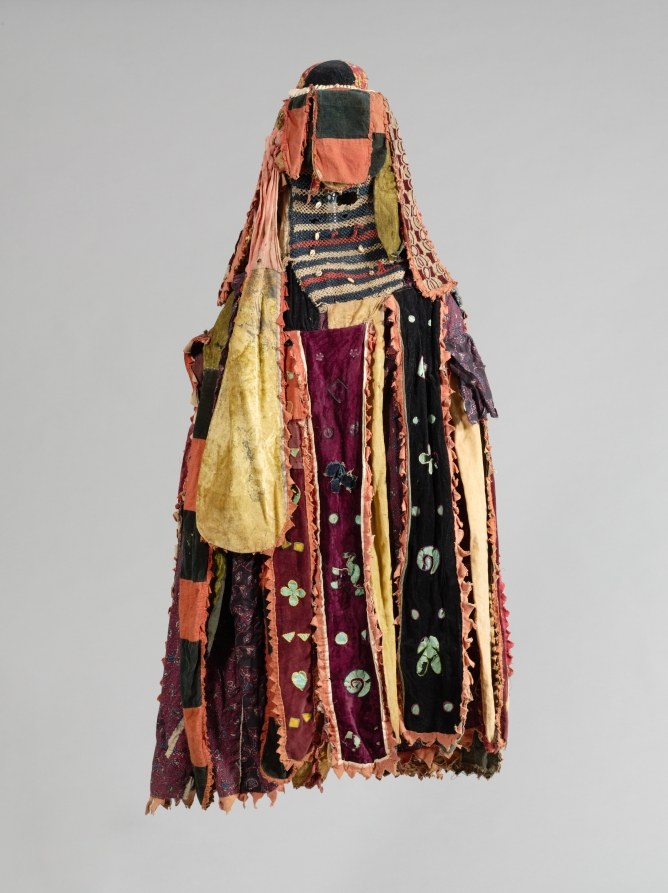
This is a ceremonial masquerade costume displayed on a mannequin or stand, photographed against a neutral gray background. The ensemble comprises an elaborate layered structure of fabric strips and decorative panels that extend from the wearer's head to the ground, creating a voluminous, tent-like silhouette. The costume is constructed from panels of richly colored fabrics—deep maroon velvet with embroidered white motifs, black cloth with small white dots, golden-yellow silk, rust and coral-colored brocade, and patterned woven strips. At the top sits a dark cylindrical head covering or crown with protruding rectangular ornaments at the sides, from which long swathes of translucent rust-colored fabric drape down like a veil. The overall construction suggests movement would transform the hanging strips into a sweeping, mobile sculptural form rather than a fitted garment; the dancer's body is entirely concealed by the layering.
The dancing
No human figure is visible within this costume; it is displayed as an object. The construction is designed to completely obscure the dancer's body and movement. The costume's form suggests a vertical, columnar presence; the dancer inside would be largely immobilized by the weight and construction of these overlapping panels, able perhaps to sway or turn but not to execute articulate footwork or complex arm positions. The costume functions as a masked personage rather than displaying the dancer's body.
The dance depicted
This is an Egungun masquerade costume from Yoruba culture, as indicated by the title and the distinctive construction. Egungun masquerades are ceremonial performances found among Yoruba peoples of West Africa, particularly in Nigeria. The masked performer wearing this costume embodies ancestral or spiritual presences and dances in processions, ceremonies, and celebrations. The Egungun dancer's movement is characteristically stately and processional; the voluminous costume itself becomes the primary visual statement, and the dancer's steps are subordinate to the sculptural presence of the cloth. The costume's construction—strips of fabric hung from a framework or the dancer's body—allows the cloth to move semi-independently of the wearer, creating rippling and swaying effects with minimal dancer effort.
How it was made
This is a three-dimensional textile artifact: a constructed garment or ceremonial dress made from pieced and layered fabric panels sewn or attached to a supporting structure. The materials include hand-loomed cloth, embroidered velvet, commercial brocade, and silk fabrics, indicating both traditional and imported textiles in use. The construction technique involves careful arrangement and layering of strips to create visual impact and volume without requiring the wearer to move dynamically. This is not a representation of dance but an actual costume object made for performance, preserved and displayed as an artifact.
About this work
The Egungun masquerade costume is a centerpiece of Yoruba ceremonial life, transforming a dancer into a mobile ancestor or spirit presence. Rather than displaying the dancer's body and skill, the costume itself becomes the primary artwork and performer: a towering, cloth-draped figure that processes through public space on ritual occasions. The layered construction of variegated fabrics—each piece carefully chosen for color, pattern, and texture—creates a visual spectacle of abundance and spiritual presence. This object belongs in a dance collection not because it documents a recognizable choreography, but because it is the primary apparatus through which an important ceremonial dance tradition manifests. The Egungun costume transforms the wearer into something other than human and demands a mode of movement profoundly different from the solo dancer: processional, stationary at moments, and invested with ancestral agency.
How to look at it
Examine the layering sequence and color relationships: which fabrics face outward, which are hidden, how the eye is drawn through the chromatic complexity. Notice the weight and volume—this costume is substantial and would constrain movement to slow, processional motion. Look at the head covering and side ornaments as the directing presence: these elements would be visible above the crowds during procession and would be the first thing spectators see. The costume is designed for visual impact from a distance and at spectacle scale, not for intimate viewing of technique.
The artist
Egungun masquerades are a collective cultural practice rather than the work of an individual artist. The costume is the product of Yoruba textile makers, tailors, and the traditions of specific communities or masquerade societies (each Egungun 'house' has its own aesthetic and protocols). The creation of such a costume involves knowledge of appropriate materials, colors, and construction that is transmitted through apprenticeship and community practice. Individual artisans—weavers, dyers, and costume makers—contributed to this work, but they remain anonymous in the historical record.
The period
Egungun masquerades have been documented among Yoruba peoples for centuries, with particular cultural efflorescence in the twentieth century. This object likely dates from the mid-twentieth century or earlier, based on the mix of hand-loomed cloth and early industrial fabrics. During the colonial and early postcolonial period in Nigeria, Egungun traditions were maintained and adapted; masquerade festivals continued as sites of community identity and cultural continuity. In museum contexts, Egungun costumes came to be collected and preserved as artworks beginning in the mid-twentieth century, reflecting increasing international recognition of African textile and performance traditions.
Where it lives
This work is held in the Cleveland Museum of Art's dance-related art collection. Such objects entered Western museums in the twentieth century through colonial collecting practices and, later, through institutional efforts to document African performance traditions. The museum's classification of this as a dance-related artwork reflects recognition of the ceremonial performance context in which it functioned.
Dance in this work
Questions about this work
Who dances in an Egungun costume?
In traditional practice, men from masquerade societies or Egungun 'houses' wear these costumes. The masquerader becomes a sacred figure embodying ancestors or spiritual presences and is often referred to in the third person—as 'Egungun' (the ancestor) rather than by the man's own name. In some contexts, the identity of the wearer is kept secret to preserve the illusion of spiritual presence.
How does a dancer move in such a heavy costume?
Egungun movement is characteristically processional and stately rather than acrobatic or fast. The dancer typically walks slowly, sometimes pausing, allowing the costume to sway and ripple. The layered cloth moves semi-independently of the body, creating visual effects with minimal dancer exertion. Some Egungun performances include spinning or sudden movements, but these are punctuation rather than the default mode.
What do the different fabrics and colors mean?
Each Egungun society or family has its own color preferences and aesthetic conventions. The mix of hand-loomed cloth, imported brocade, and commercial velvet suggests both tradition and access to goods, making the costume a statement of the wearer's community status and resources. The colors and patterns chosen carry significance within the community context, though these meanings are not standardized across all Yoruba Egungun traditions.
When and where are Egungun masquerades performed?
Egungun festivals occur at specific times in the community calendar, often annually or at major celebrations. They take place in public spaces—streets, plazas, compound yards—where the masked figure can process and be seen by the entire community. The performance is a public ritual reaffirming community bonds and honoring ancestors.
More dance artwork