49 works in this view — arrow keys or swipe to move between them.
Dance in Art
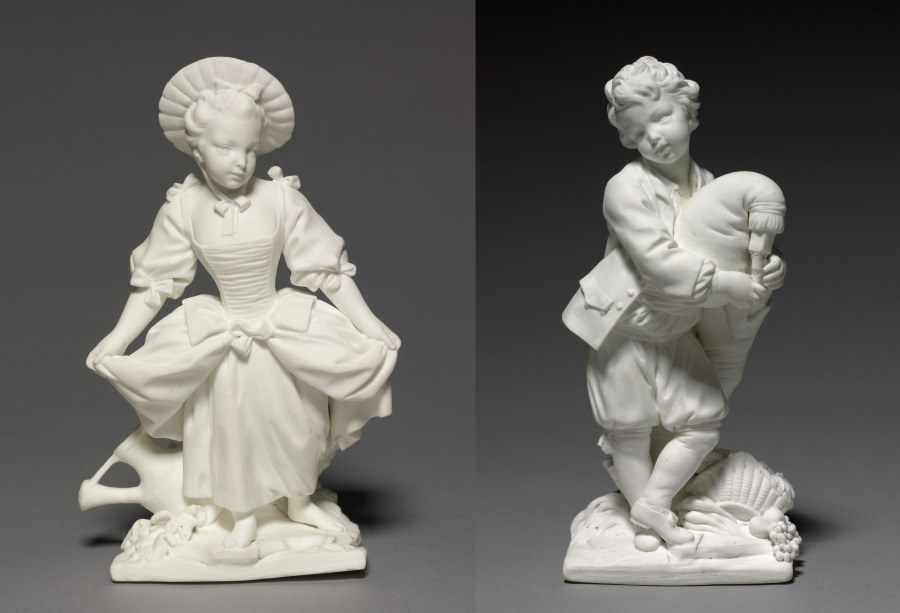
Figure Pair of the Dancer La Danseuse and the Bagpiper Le
Vincennes Porcelain Factory (France, 1740–56)
- Source:
- Cleveland Museum of Art
- Rights:
- Public domain — free to use, share and adapt.
- Recorded as:
- CC0 (Public Domain)
These figurines document how dance and musical entertainment were understood as social spectacle in the 18th century, and specifically how women's dress and deportment, and male musicianship and exoticism, were packaged as complementary decorative objects for the home. The bagpiper is a rare surviving representation of folk music in porcelain, marking the cultural moment when European aristocracy began to aestheticize rural and non-elite performers. For dance historians, the pair illuminates the wider contexts in which dance was embedded—court life, courtship, social comedy, and the visual culture of refinement.
What you are looking at
Two white porcelain figurines stand against neutral backgrounds, each representing a character from 18th-century entertainment culture. On the left, a woman in an elaborate gown with voluminous skirts held at the sides wears a distinctive headdress with wings or pleats folded outward in the fashion of the period. Her posture is demure, with the skirt gathered and lifted to display the rich drapery. On the right, a male figure in knee breeches and a jacket holds a bagpipe, standing in a more relaxed contrapposto pose. Both figures are rendered in the refined neoclassical style characteristic of porcelain sculpture, with careful attention to textile detail, facial features, and the play of light across white glazed surfaces. The pair appears to represent a courtship or social encounter between a lady of quality and a musician or entertainer—the bagpiper marking him as a figure of folk or exotic origin in the context of European court culture.
The dancing
The female figure stands with feet together in a formal upright posture, her weight centered and her body arranged for display; her arms draw the skirt outward and upward in a gesture of presentation or modesty. The male figure stands with weight shifted slightly, one leg bent, giving him a more naturalistic stance; he cradles the bagpipe at waist height with both hands. Neither figure is actively dancing—both are posed as if for conversation or mutual regard, a moment of social engagement rather than performance. The scale and formal arrangement suggest these are paired decorative objects meant to represent complementary social types.
The dance depicted
The image does not depict active dance, though both figures belong to the vocabulary of 18th-century court entertainment. The woman represents a lady of fashion; the man, identified by his bagpipe, represents a musician-entertainer or folk performer. Bagpiping was associated with both Scottish and continental European folk traditions and appeared in aristocratic settings as an exotic or rustic attraction. The pairing suggests the social comedy of the period—a contrast between refinement and exoticism that was a common theme in porcelain figurine series. While dance may be the implied context (balls, court festivities, or comedic social encounters), neither figure is shown in actual movement or dance position.
How it was made
These are porcelain figurines, likely Meissen or another major European manufactory of the 18th century, executed in white glazed porcelain with fine detail work on costume, facial features, and hair. The medium allowed for the creation of small, precious objects that could be mass-produced and exported across Europe, making them accessible to the wealthy middle class and nobility. Porcelain figurines of this type were often produced in pairs or as part of broader allegorical or comedic series representing social types, professions, and national characters. The smooth white surface and neoclassical refinement suggest manufacture in the mid-to-late 18th century.
About this work
This pair of porcelain figurines represents a moment in 18th-century European taste for chinoiserie, commedia dell'arte, and the picturesque collision of social classes. They are not depictions of actual dance but rather decorative objects that encode the period's fascination with exoticism, entertainment, and courtship. The series to which they belong—pairing refined ladies with musicians, soldiers, servants, and other social types—was a staple of porcelain manufacture. The bagpiper particularly marks the work as part of a tradition in which folk musicians and rural entertainers were romanticized as exotic figures for aristocratic consumption. As a pair, the figurines tell a visual narrative about society, taste, and the controlled encounter between different social worlds.
How to look at it
Attend first to the contrast between the two figures: the woman's formal uprightness and elaborate costume versus the man's relative ease and the humble bagpipe. The artist has chosen stillness and presentation rather than movement, allowing the viewer to read the pair as social types in a comedy of manners. Notice how the woman's skirt is held and lifted—this is a pose of display and propriety, not of motion. The man's stance and casual hold on the instrument mark him as a performer or entertainer, a figure whose music will animate the social scene the woman embodies. The pairing creates narrative: these are not individuals, but roles.
The period
European porcelain manufacture, particularly in Germany, France, and Italy, flourished in the 18th century as a luxury trade. Meissen, founded in 1710, pioneered the production of European hard-paste porcelain and established a tradition of figurine series representing social types, professions, national characters, and allegorical themes. These figurines were often modeled by skilled sculptors and cast in molds, allowing for serial production while maintaining individual artisanal refinement. The 'Commedia dell'arte' and character-pair traditions were especially popular, as were representations of exoticized figures—Turks, Chinamen, shepherdesses, musicians—that reflected European fascination with the world beyond its borders. The mid-18th century saw a boom in such decorative objects, and they were collected as status symbols and conversation pieces in the homes of the European elite.
Where it lives
The work is held in the Cleveland Museum of Art's collection. It is catalogued as a figurine pair but lacks recorded information on manufacture, artist, date, medium, or provenance. The museum's dance-related art collection includes representations of performers and entertainers across media and periods.
Questions about this work
Is this actually a dance scene?
No—both figures are posed in stillness, not in movement. However, they represent performers and entertainers in an 18th-century context where dance, music, and courtship were closely linked social practices. The pair encodes the visual language of court entertainment without depicting active dance.
What is the bagpiper doing here?
The bagpipe was a folk instrument associated with Scotland and rural Europe. In 18th-century porcelain, it was often used to represent exoticism, rusticity, or comic contrast. Here it marks the male figure as a musician or entertainer, likely of lower social status than the refined lady he faces.
What is the woman's headdress?
The distinctive winged or pleated headdress is typical of late 17th- and 18th-century fashion, particularly in Northern Europe. It signals her identity as a woman of fashion and refinement, and may also reference specific regional or theatrical conventions of dress.
Why are they a pair?
Porcelain figurine manufacturers produced figurines in complementary pairs or sets representing social types and character combinations—often reflecting courtship, social encounter, or comedy. These pairs were collected as decorative objects and conversation pieces.
More dance artwork