49 works in this view — arrow keys or swipe to move between them.
Dance in Art
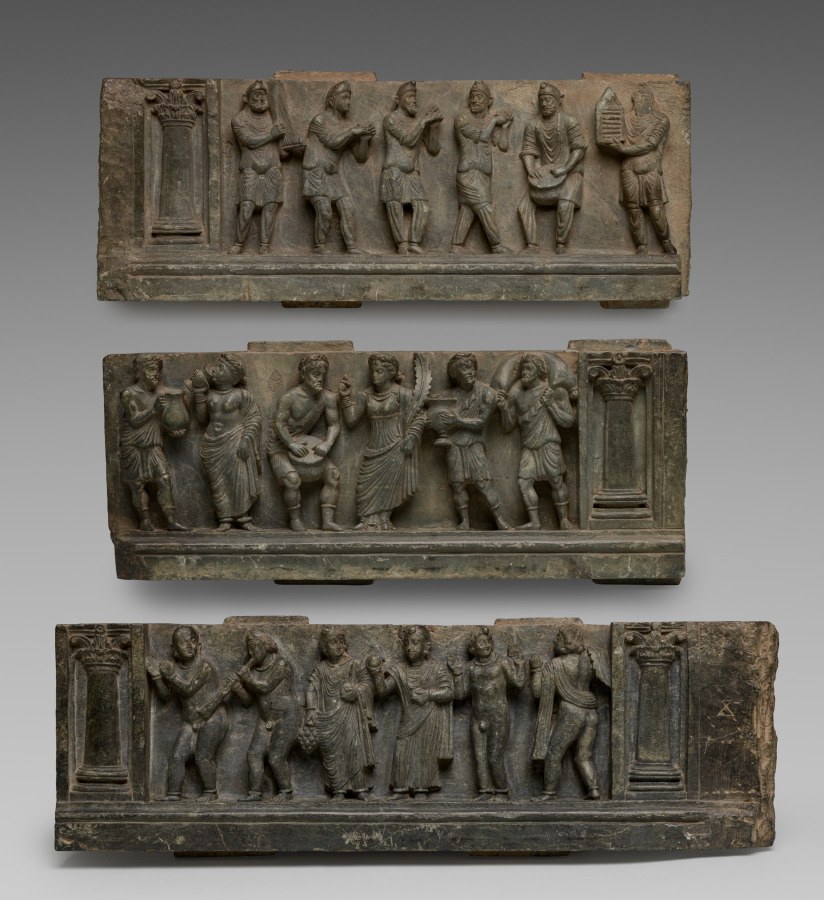
Foreigners and Non-Buddhists Drink Dance and Play Music f
Unknown artist
- Source:
- Cleveland Museum of Art
- Rights:
- Public domain — free to use, share and adapt.
- Recorded as:
- CC0 (Public Domain)
This work provides visual evidence of social dance and music-making in a period and cultural context where such documentation is rare. The deliberate choice to carve these scenes in stone indicates that the performance itself—the drinking, music, and movement—was significant enough to commemorate alongside sacred or political subjects.
What you are looking at
Three stone relief panels stacked vertically depict figures in various poses of social interaction, music-making, and movement. The title suggests these represent foreigners and non-Buddhists in scenes of revelry. Each panel contains multiple figures in shallow relief against a plain ground, with architectural elements—simplified columns or pilasters—marking the composition's divisions. The figures wear draped garments suggesting Greco-Roman or Central Asian dress. In the upper panel, six figures stand in a loose line; several appear to gesture or hold objects, with what may be a musical instrument visible at the far right. The middle panel shows figures in more varied poses—some standing, some in animated conversation or gesture, with an architectural element on the right. The lower panel presents the most dynamic arrangement, with figures distributed across the width in staggered positions, some with arms raised or extended, creating a sense of movement and celebration. The worn, weathered surface and uniform gray stone suggest these are ancient or medieval reliefs, possibly architectural ornaments.
The dancing
The figures are rendered in profile or three-quarter view with simplified musculature and drapery typical of relief carving conventions. Arms are variously extended, raised, or held at the body; several figures appear to be gesturing expressively or holding objects associated with music or drink. There is no clear couple structure or formal ballroom hold; instead, the composition suggests informal gathering and social interaction. The stance and posture vary considerably—some figures are upright and frontal, others lean or turn, and in the lower panels some raise their arms in what could suggest dancing, celebration, or musical performance.
The dance depicted
The title indicates these are scenes of non-Buddhist foreigners drinking, dancing, and making music—likely depicting a specific cultural or religious context where such activities were noteworthy enough to carve in stone. The gestures and arm positions in several figures, particularly in the lower panel, suggest energetic movement compatible with social dancing or celebratory display. However, the specific dance style cannot be identified from the image alone. The lack of distinctive costume, instrument detail, or narrative context makes it impossible to name a particular tradition. What is clear is that the artist understood human movement in celebration—the varied poses and raised arms convey liveliness rather than stillness.
How it was made
This is stone relief carving, likely created by subtractive sculpture—the figures modeled in relatively shallow relief against a recessed ground. The technique allowed fine detail in drapery and facial features while keeping the overall composition readable at a distance. The wear and patina suggest considerable age, possibly centuries. Relief carving was a standard technique for architectural decoration and narrative panels in many traditions, making such work widely visible to public audiences and serving didactic or commemorative purposes.
About this work
These three relief panels represent a rare sculptural documentation of social dance and music-making outside a formal or sacred context. The title signals that the subject—foreigners and non-Buddhists celebrating—was itself noteworthy enough to merit permanent representation in stone. The work testifies to ancient or medieval cross-cultural contact and to the artist's interest in recording how other peoples danced and made merry. The panels sit at the intersection of dance history, art history, and cultural contact studies, preserving evidence of performance practices that would otherwise be lost to time.
How to look at it
Attend to the variety of arm and body positions across the three panels: the figures are not arranged in formal couples or lines, but scattered and varied in their poses. Notice how the artist used raised arms, turned bodies, and open stances to suggest movement and celebration. The lower panel is the most dynamic, with figures at different depths and angles, creating a sense of simultaneous action rather than a single frozen moment. The architectural elements divide the space but do not constrain the action; the figures move freely across and around them.
The period
The style and subject matter suggest these panels may derive from a Buddhist artistic tradition, possibly from Central Asia, South Asia, or East Asia, where narrative relief panels decorated temples or monasteries. The depiction of non-Buddhists as a distinct social category, and the interest in recording their practices, reflects contexts where Buddhism coexisted with other religions and cultures. The Greco-Roman dress and simplified relief technique suggest a period of significant cultural exchange, possibly the first several centuries CE.
Where it lives
The work is in the collection of the Cleveland Museum of Art, catalogued as a dance-related artwork from the museum's holdings. No other provenance or acquisition information is recorded in the catalogue.
Dance in this work
Questions about this work
What culture or period do these reliefs come from?
The catalogue record does not specify era, artist, or origin. The style—shallow relief carving, Greco-Roman dress, and Buddhist-adjacent subject matter—suggests Central or South Asia, possibly the first centuries CE, but this is not established.
Why would someone carve a scene of non-Buddhists dancing and drinking into stone?
In some Buddhist artistic traditions, narrative reliefs decorated temple walls and taught through visual storytelling. The inclusion of non-Buddhists suggests either documentary interest in local practices or a didactic purpose—showing behavior to be transcended or contrasted with Buddhist life.
Can you identify what dance this is?
No. The image shows energetic social movement and gesture, but without costume detail, music, or narrative context, the specific tradition cannot be named. The work documents that dance and music happened, but not which dance.
Why is this in a dance collection?
The work explicitly depicts dancing, music-making, and celebration as central subjects. It is rare visual evidence of social performance in the ancient or medieval world, making it valuable for understanding how people danced outside formal or sacred venues.
More dance artwork