49 works in this view — arrow keys or swipe to move between them.
Dance in Art
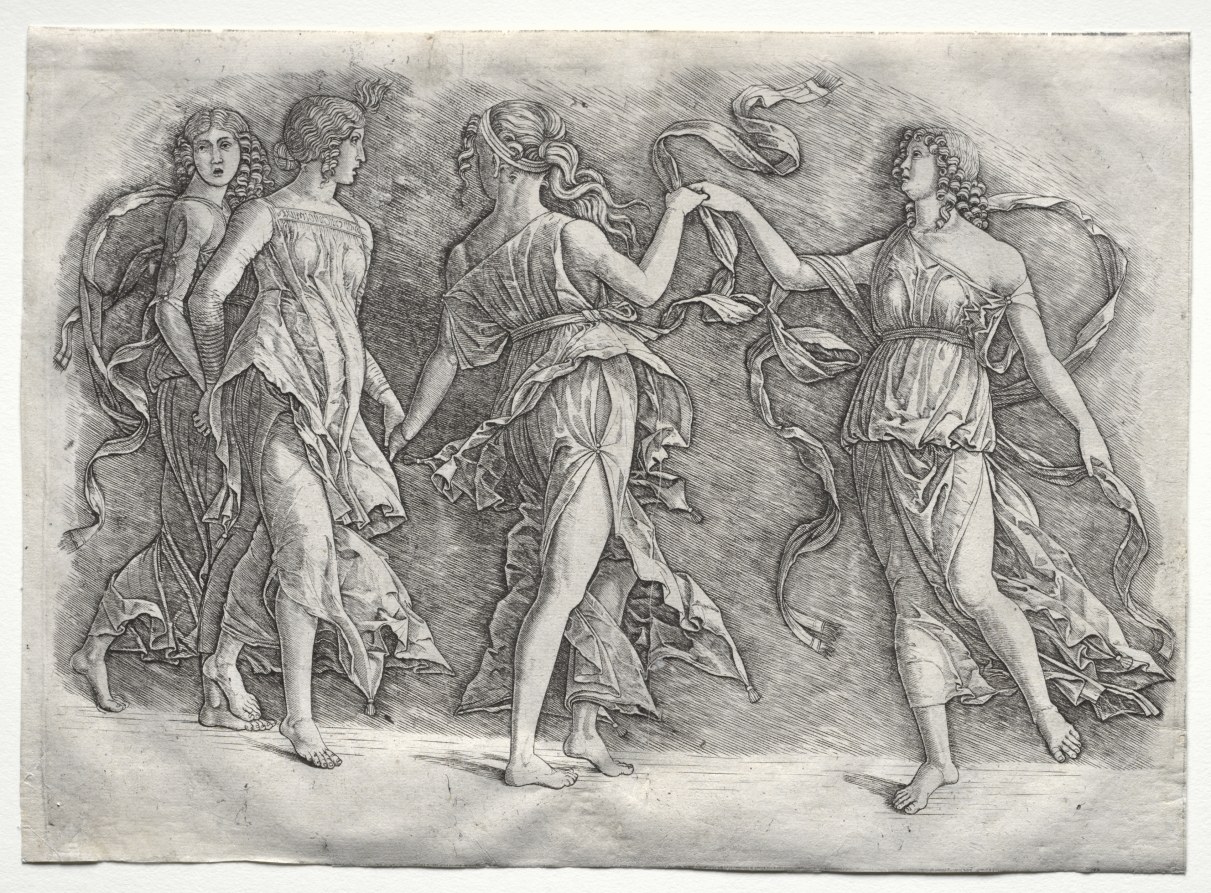
Four Dancing Muses
Premier Engraver (Italian, active about 1500)
- Source:
- Cleveland Museum of Art
- Rights:
- Public domain — free to use, share and adapt.
- Recorded as:
- CC0 (Public Domain)
This work shows how the moving female body was enlisted in neoclassical art to represent intellectual and spiritual ideals, not social dance or entertainment. For historians of dance imagery, it illustrates the gap between actual dance practice (ballroom, court, folk) and the classical or allegorical dance of fine art, where movement was abstracted and idealized rather than documented.
What you are looking at
Five female figures are arranged in a classical composition across the picture plane, set against a neutral background with hatching to suggest depth. All are lightly draped in flowing garments that expose limbs in the manner of antique or neoclassical convention. The figures occupy varied poses: some are in motion with bodies twisting and limbs extended, others are more static or transitional. The figure at left appears winged (suggesting an allegorical muse or similar), while the central figure holds what may be a wreath or crown. The poses suggest forward movement or procession across the space, with heads turned in profile or three-quarter view and drapery fluttering to emphasize the sense of motion. The engraving technique creates a linear, sculptural quality that emphasizes the musculature and anatomical structure beneath the cloth.
The dancing
The five figures vary in their relationship to each other—some isolated, some paired or grouped—but all are depicted as individuals rather than as couples in a unified hold. Most weight is carried on one leg, with the other extended or lifted, creating an unstable, sequential quality to the poses. Arms are raised, extended, or held at varied heights; some figures gesture outward or upward. The bodies show the contrapposto stance favored in classical revival art, with hips shifted and torsos twisted. These are not the tight frames and closed holds of ballroom dance, but the open, articulated postures of ballet or allegorical classical dance.
The dance depicted
This is most likely an allegorical representation of the Muses or a classical procession rather than documentation of actual dance practice. The style and composition suggest European neoclassical or Romantic-era imagery of mythological subjects, in which nymphs and muses were depicted in idealized, loosely classical poses that borrowed from sculpture and relief art. The title "Four Dancing Muses" (though five figures are shown) points to a literary or mythological source. The poses suggest movement but not a specific recognized dance form—this is dance as metaphor or decoration, using the figure in motion to evoke grace, muses, or classical culture rather than to teach or record a particular technique or social practice.
How it was made
This is an engraving or etching, recognizable from the parallel hatching lines that create tone and shadow, the linear definition of form, and the overall tonal quality typical of printmaking. The technique allows fine control of line and the creation of subtle modulations through cross-hatching. Engravings of this quality were laboriously produced and costly, indicating an audience of educated patrons and collectors. The print would have circulated in portfolios or as individual sheets; the subject matter—allegorical and classical—suggests it was intended as a model for artists, a collector's item, or both.
About this work
This engraving depicts five female figures in flowing drapery arranged in a classicizing composition that emphasizes motion, grace, and allegorical meaning. The work belongs to a tradition of neoclassical and Romantic printmaking that used the dancing or moving female form to represent abstract concepts (the Muses, the arts, inspiration) and to demonstrate skill in rendering the human figure in motion. The style, technique, and composition all point to a European origin, likely 18th or early 19th century, though the catalogue record does not confirm this. The work is significant not as a record of actual dance practice, but as evidence of how dance—or the image of dance—functioned in fine art as a vehicle for classical revival and humanistic ideals.
How to look at it
Pay attention to the variety of poses and the ways the artist has suggested forward motion without depicting a single, repeatable step or synchronized movement. Notice how the drapery responds to the implied motion of the bodies, creating a sense of wind or momentum. The engraving technique creates a linear, somewhat austere quality that emphasizes outline and the play of light and shadow rather than soft transitions. The classical references are embedded in the poses themselves—the contrapposto stance, the raised arms, the idealized proportions—rather than in any narrative or setting.
The period
The neoclassical revival of the late 18th and early 19th centuries drew heavily on antique sources—Roman coins, Greek sculpture, Renaissance engravings—to create an artistic language of order, proportion, and elevated subject matter. The dancing muse or nymph became a favored motif in this context, appearing in paintings, sculptures, and prints. Meanwhile, theatrical dance was undergoing its own transformation: classical ballet was being formalized, and the romantic era was beginning to emphasize the ethereal, weightless quality of the female dancer. The allegorical moving figure in neoclassical art and the emerging aesthetic of romantic ballet thus developed in parallel, both valuing lightness, grace, and a sense of transcendence.
Where it lives
The work is held in the Cleveland Museum of Art collection. The catalogue entry is sparse, lacking confirmed artist, date, and medium; the medium (engraving or etching) is inferred from the image itself.
Questions about this work
Is this a record of an actual dance people performed?
No. This is an allegorical or mythological composition, likely meant to represent the Muses or to demonstrate the artist's ability to render the human figure in motion. It belongs to fine art tradition rather than to documentation of social or theatrical dance practice. The poses are idealized and drawn from classical sculpture and Renaissance engravings rather than from observation of performers.
Why are there five figures when the title says 'Four Muses'?
The discrepancy between the title and the number of figures in the image is unclear. It is possible the title is incorrect, or that one figure (such as the winged figure at left) represents something other than a muse, or that the title refers to a lost or damaged version of the composition.
What does the winged figure at left represent?
The figure appears to have wings, suggesting it may represent a deity, an allegorical abstraction, or a classical figure such as Nike (Victory) or one of the Muses. Without additional context or inscription, the specific identity is uncertain.
What period and school of art does this belong to?
Based on the style, technique, and subject matter, this appears to be a product of the neoclassical or early Romantic movement, likely created in Europe in the late 18th or early 19th century. The print would have been intended for collectors and artists as a model of classical taste and refined execution.
More dance artwork