49 works in this view — arrow keys or swipe to move between them.
Dance in Art
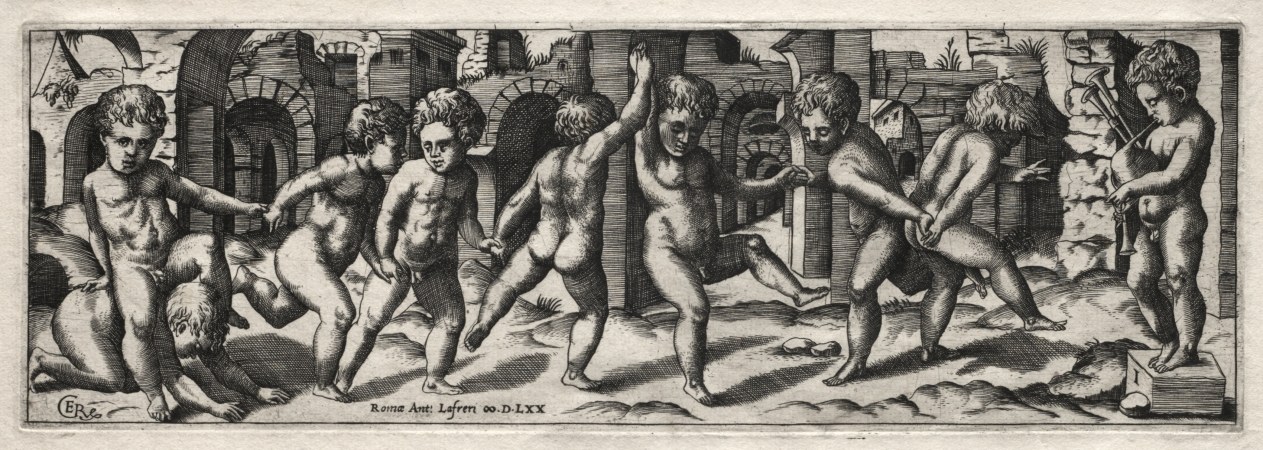
Frieze of Children Dancing to a Bag-pipe
Giorgio Reverdino (Italian, active c. 1531–1564/70)
- Source:
- Cleveland Museum of Art
- Rights:
- Public domain — free to use, share and adapt.
- Recorded as:
- CC0 (Public Domain)
The image is rare evidence of how music and informal, joyful movement were imagined and valued in the Renaissance—not as technique to be taught, but as expression of natural human joy. The work also demonstrates the reach of engraving as a medium for disseminating images of dance and celebration across Europe, shaping how people understood and aspired to move.
What you are looking at
A frieze of putti—nude or loosely draped children—cavort across a classical architectural setting rendered in dense crosshatching. The space is defined by arched doorways and rusticated stonework that recedes into the background. At least a dozen figures occupy the scene, distributed across the composition in varied poses of movement and play. Some leap or run with raised arms; others bend, gesture, or interact with neighbours. Two children on the left appear to engage with a goat or similar animal. The figures display the muscularity and anatomical precision characteristic of Renaissance and post-Renaissance printmaking, their bodies rendered with careful attention to foreshortening and mass. The bagpiper (implied by the title) is not clearly legible in the present image, though a figure to the right may hold the instrument. The overall effect is one of exuberant, almost chaotic vitality—a celebration of childhood motion and energy within a formally ordered architectural frame.
The dancing
The bodies move in a range of unpaired, ebullient gestures rather than in organized couples or lines. Some figures reach upward with extended arms; others have lowered, engaged postures. Several leap or stride with weight driving forward into space. The composition suggests spontaneous, unstructured play rather than the measured steps of a formal dance—the children respond to music and impulse rather than pattern. No consistent hold or frame unites them; instead, the eye travels across independent moments of motion, some energetic, some more contemplative or playful.
The dance depicted
This is most likely a depiction of child revels or celebratory games set to bagpipe music, rather than a specific named dance form. The title anchors the image to the bagpipe as the animating instrument, but the scene itself emphasizes spontaneous, joyful movement rather than technique or convention. Bagpipes were a common folk and popular instrument, and imagery of children dancing or playing to piped music appears in Renaissance and early modern prints as a motif of fertility, innocence, and natural joy. The lack of formal structure and the mingling of play, music, and physical exuberance suggest this captures the spirit of street or household celebration rather than court or theatrical dance.
How it was made
This is an engraving, identified by the signature 'ERG' at lower left (likely Erhard Schön or a follower, though the catalogue record does not confirm attribution). The technique is burin engraving on copper, evident from the precise parallel hatching that models form and shadow, the clean linear definition of architecture, and the even texture across the composition. Engravings of this type were widely circulated as prints and affordable to a broad audience; they served both as decoration and as source material for artists, patrons, and the educated public. The Latin inscription below ('Rome Ant: Lafren oo.D.LXX' or similar—the exact text is difficult to parse in reproduction) suggests learned or antiquarian framing, positioning the scene within classical or neoclassical artistic discourse.
About this work
This is a Renaissance or early modern engraving depicting children in joyful, uninhibited movement to bagpipe music, set within a dignified classical architectural interior. The work sits at the intersection of three traditions: the humanist fascination with classical subject matter (children, putti, the cult of innocence); the popular appetite for scenes of everyday or folk life rendered with Renaissance anatomical sophistication; and the engraver's craft as a vehicle for circulating images of grace, naturalism, and human vitality. The piece belongs in a dance collection because it documents an important if informal genre of early modern music and motion—the festive, unstructured celebration of children and music that underpinned much popular and courtly culture. It also exemplifies how dance and dancers (or near-dancers) were recorded in print before photography: not as instruction or formal documentation, but as evocation and sentiment.
How to look at it
Attend to the individual gestures rather than seeking unified choreography. Notice how the engraver has distributed the figures across the space and modulated their poses to suggest a flow of motion without rigid ordering—this is how unscripted celebration appears. The architectural setting grounds the scene in a recognizable, dignified space, elevating child's play from the street to the scale of a classical interior. The density of cross-hatching and the precision of anatomy convey Renaissance mastery while the subject matter celebrates a freedom and spontaneity that formal dance did not permit.
The artist
The signature 'ERG' is not definitively attributed in the catalogue record. Erhard Schön (c. 1491–1542), a prominent Nuremberg engraver, produced numerous prints of children, daily life, and classical themes; this work is consistent with that tradition, though attribution would require specialist assessment. The style and subject matter align with the Northern Renaissance engagement with both classical learning and popular life.
The period
The 16th century saw a flourishing of engraved prints in Northern Europe, particularly in Germany and the Low Countries. These works circulated widely and brought Renaissance ideas of anatomical accuracy, classical allusion, and humanist learning to a broad audience. Simultaneously, the period saw intense interest in folk music, bagpipes in particular, as markers of authentic rural or popular culture—a romantic valuation that would intensify in later centuries. The frieze format itself, borrowed from ancient and Renaissance architectural decoration, positioned vernacular subjects (children, music, play) within a dignified artistic framework.
Where it lives
The work is held in the Cleveland Museum of Art and catalogued as part of their dance-related art collection. It is reproduced from a source marked 'cma' (Cleveland Museum of Art). No further provenance information is recorded.
Dance in this work
Questions about this work
Is this actually dance, or just children playing?
The distinction is not sharp in the Renaissance. Children and putti capering to music are a stock motif in humanist art, and they occupy an ambiguous zone between play and performance. The artist has rendered the moment with enough formal grace and anatomical care to elevate it beyond mere anecdote—the title anchors it to music (bagpipe), and that combination of music and motion is the essence of dance.
Why is the bagpipe important?
The bagpipe was a folk and popular instrument, especially in Alpine and Northern European contexts. Its presence signals a vernacular musical tradition—not courtly, not liturgical, but public and communal. Bagpipe music was associated with celebration, carnival, and unstructured merriment.
What does the Latin inscription say?
The inscription is difficult to read with confidence in the available image. It appears to cite Rome and a date or reference ('Lafren' or similar), suggesting the print may be documenting or imitating a classical or Renaissance precedent. Specialist interpretation would be needed.
Who would have seen this print?
Engravings were affordable and widely distributed among educated and merchant classes, and were also collected by artists as reference material. This image would have circulated among people with some learning and disposable income—clergy, patrons, fellow artists, affluent households. It was a vehicle for ideas and taste, not a mass-market object.
More dance artwork