49 works in this view — arrow keys or swipe to move between them.
Dance in Art
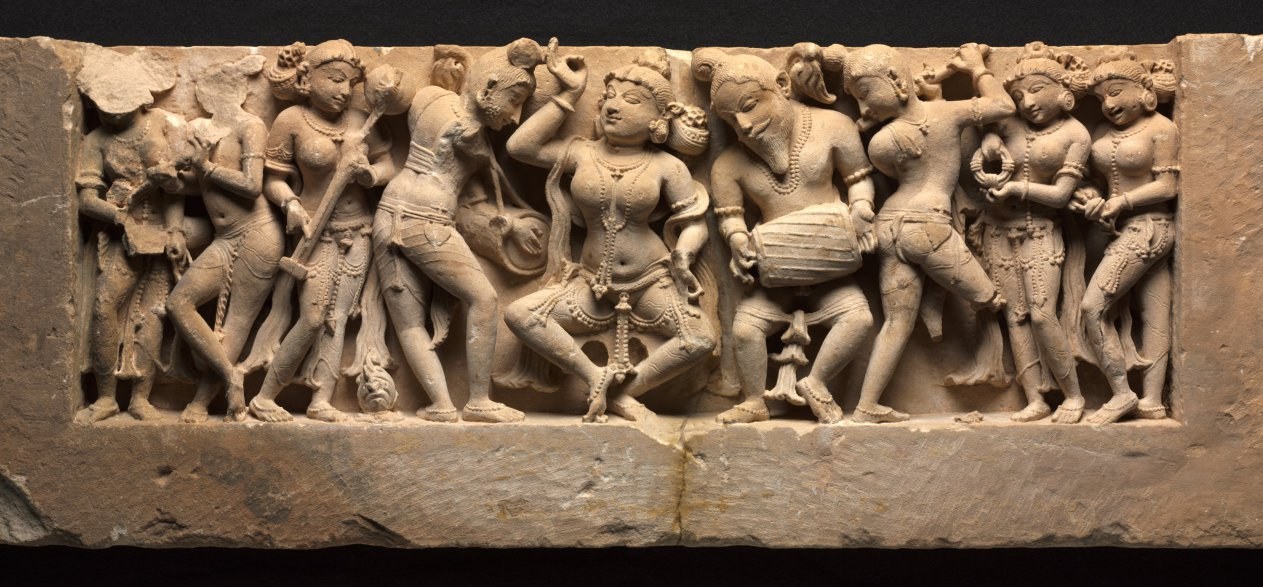
Frieze with Dancer and Musicians
Unknown artist
- Source:
- Cleveland Museum of Art
- Rights:
- Public domain — free to use, share and adapt.
- Recorded as:
- CC0 (Public Domain)
Relief friezes are among the oldest surviving evidence of human dance practice, often documenting ritual, ceremonial, or festive movement that would otherwise leave no archaeological trace. This work shows not a frozen instant but a sequence or multiplicity of poses, revealing how ancient artists understood and chose to represent the moving body in time.
What you are looking at
A stone frieze carved in relief shows a processional scene of multiple figures arranged across a continuous ground line. At least twelve figures occupy the composition, ranging from fully nude to partially draped, with elaborate ornaments including necklaces, bracelets, and headdresses. The figures are depicted in varied poses: some stand with arms raised or extended, some bend forward in active postures, and several appear to be in motion. In the center, a seated or crouching figure provides a compositional anchor. The carving is shallow but precise, with attention to individual physiognomy and costume detail. The stone surface shows areas of damage and weathering, particularly a vertical crack running through the center. The figures occupy most of the frieze's height, with little empty space, suggesting a densely populated moment rather than a sparse procession.
The dancing
The bodies are rendered with anatomical attention to musculature and pose variation. Several standing figures display raised or extended arms in what appears to be celebratory or ritual gesture; others bend or crouch with weight forward. The proximity of figures—some nearly touching—suggests choreographed proximity or social grouping rather than random gathering. Both male and female figures appear present, distinguished by secondary sexual characteristics and costume. The overall impression is of bodies actively engaging in movement and interaction rather than standing static, though no single unified dance hold or frame is evident across all figures.
The dance depicted
This frieze most likely depicts a ritual or ceremonial dance, possibly associated with fertility rites, celebration, or sacred observance given the temple or institutional context suggested by the stone medium and formal commissioning. The specific dance cannot be identified without archaeological context establishing the culture, date, and site of origin. The variety of poses—some figures appearing to leap, others to gesture, some to crouch—suggests either multiple simultaneous dancers, sequential movement captured in a single frame, or dancers moving through different phases of an established choreography. The presence of musicians or instrument-bearers cannot be clearly established from this image alone.
How it was made
This is a carved stone relief, likely from a temple, palace, or institutional wall. The medium indicates public or religious commission and display, suggesting the dance depicted held cultural or ceremonial significance worth memorializing in permanent form. Relief carving allowed the artist to create dramatic shadow and depth while maintaining the narrative frieze format; this technique was well-suited to processional subject matter and could be read from a distance. The damage pattern—the vertical crack and surface weathering—suggests outdoor exposure or considerable age, consistent with architectural ornament from an ancient or medieval site.
About this work
This frieze preserves evidence of historical dance practice in its most durable form: carved into stone as part of a monumental or institutional structure. The work documents a moment of collective movement, ritual observance, or celebration by showing multiple bodies in varied poses and states of dress across a continuous ground line. The formal carving technique and elaborate costume detail indicate this was no ephemeral social dance but an event or practice significant enough to record permanently, making the frieze both an artwork and a historical document of embodied culture.
How to look at it
Study the variety of poses across the frieze: note which figures have weight forward and which stand upright, where arms extend or gesture, and where bodies bend or crouch. The artist has not tried to show all figures in identical posture or formation; instead, the variety suggests either a sequence of movements or simultaneous performers at different stages of a choreography. The ornamental detail—necklaces, bracelets, headdresses—rewards close attention and may indicate costume conventions of the dance or social status of participants.
The period
Without secure dating or cultural attribution, the period context cannot be established. The style, material, and technique suggest an ancient or medieval Asian culture—the ornamental detail, figure types, and compositional convention are consistent with South or Southeast Asian temple sculpture, possibly Indian, Khmer, or related traditions—but this reading is provisional pending archaeological information. Relief carving as a medium for narrative and ceremonial scenes was a widespread practice across many cultures for conveying cultural memory and religious practice.
Where it lives
The work is held by the Cleveland Museum of Art. The catalogue record provides no information on the site of origin, date of carving, or archaeological context; the museum source is listed as 'cma' without further detail.
Dance in this work
Questions about this work
Where is this frieze from?
The record does not specify the archaeological site, culture, or date. Stylistic features suggest South or Southeast Asian temple sculpture, but this cannot be confirmed without additional information from the museum's accession record.
What dance is being shown?
The specific dance form cannot be identified from the image alone. The varied poses, ornamental dress, and relief format suggest a ritual, ceremonial, or festive dance significant enough to merit permanent monumental record, but the culture and context remain unknown.
Why are some figures nude and others clothed?
This likely reflects the costume conventions of the dance or the social status of participants in the original culture. The ornamental detail on some figures—jewelry, headdresses, wrapped garments—distinguishes them from less adorned figures, possibly indicating rank, gender role, or ritual function.
How old is this?
The record lists the date as unknown. The style and technique are consistent with ancient to medieval stone carving, but no firm chronology is provided.
More dance artwork