49 works in this view — arrow keys or swipe to move between them.
Dance in Art
Gnathian Ribbed Oinochoe Wine Jug Masks Dancer and Flut
Unknown artist
- Source:
- Cleveland Museum of Art
- Rights:
- Public domain — free to use, share and adapt.
- Recorded as:
- CC0 (Public Domain)
This vessel is one of relatively few visual records of how Greek comic actors actually moved and held their bodies on stage. The masks and poses give a rare glimpse into the physical vocabulary of ancient theater and the conventions performers and audiences understood. For anyone studying the history of dance, theatrical comedy, or the material culture of performance, this object is direct evidence from a performer's world.
What you are looking at
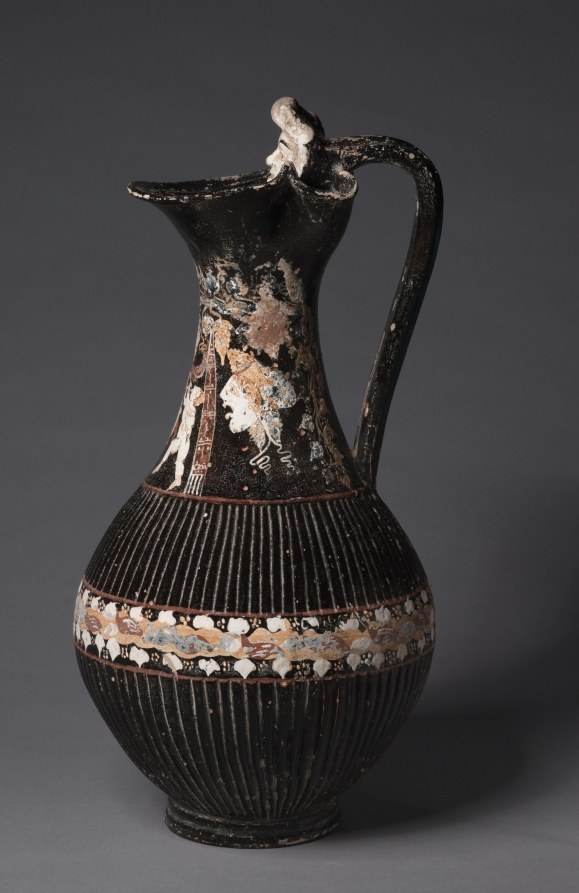
A black-figure Greek ceramic wine jug (oinochoe) with a flared mouth and high curved handle, decorated with figures in a golden-tan glaze against the black ground. The neck shows a figure in motion — a dancer or performer — rendered in profile with one arm raised and the body in an active pose. Below this runs a band of vertical striations in reserved clay. The bulbous body is dominated by a frieze of masks alternating with dancing figures, all rendered in the same contrasting glaze. The masks appear comic or theatrical in character, their expressions fixed and stylized. Between them move figures in animated poses, some with arms extended, others in attitudes suggesting rapid movement. The lower body features concentric ribbed patterns that give the vessel strong visual rhythm. The overall effect is of theatrical energy compressed onto a functional object — this is a wine server for a symposium, and its decoration transforms it into a record of performance.
The dancing
The primary dancer on the neck stands in profile with weight shifted, one arm raised in an open gesture, the body angled and energetic. The figures in the frieze below adopt varied poses: some with both arms extended, others with one arm high and the body twisted, suggesting the rapid, emphatic movement of comic performance. The poses are neither balletic nor formally restrained — they read as acrobatic, exaggerated, full of sharp articulation. The mask faces are frontal and fixed; the bodies flanking them are animated and three-quarter turned, creating a visual tension between the static and the moving.
The dance depicted
This is a Gnathian ware vessel, made in southern Italy in the 4th century BCE, depicting Greek theatrical dance — most likely the komoi (revel dances) of satyr play or old comedy, given the presence of masks and the exaggerated body attitudes. The masks suggest characters from comedy or burlesque theater, not tragedy. The dancers' poses — extended arms, twisted torsos, weight shifts — are consistent with the broad, athletic movement vocabulary of comic performance as opposed to the more contained movement of classical dance. The frieze format, repeating masks and dancers, suggests this imagery circulated widely and was recognizable to symposium guests who would have encountered these characters on stage.
How it was made
This is a ceramic vessel using the black-figure technique: the forms are reserved (left in the natural red-orange clay) and the ground is fired black. The details are added in a golden-tan glaze paint, likely applied before firing. The technique demands bold outlines and strong compositional clarity — the artist cannot render subtle transitions or complex overlapping. The black-figure method was declining by the time this vessel was made, but persisted in southern Italy (Apulia) longer than in Athens. The ribbed body and reserved frieze format suggest a high-status object made for a prosperous Greek colony, intended for display as well as use at a wine symposium.
About this work
This is a 4th-century BCE Greek ceramic wine jug, now in the Cleveland Museum of Art, decorated with theatrical imagery from Athenian comedy or satyr play. The vessel itself is Gnathian ware, produced in southern Italy but showing strong Greek cultural influence. It functions simultaneously as a practical object — a jug for serving wine — and as a portable record of performance, depicting dancing masked figures in poses that read as comic exaggeration and physical energy. The repetition of masks and dancers around the body suggests these were stock characters familiar to the symposium audience, theatrical types recognizable across the Greek world.
The work belongs to the long tradition of Greek vase painting as a historical document of movement and performance. Unlike painted theater scenes from later periods, this vessel records not a specific production but a type of performance and its physical vocabulary — the broad gestures, the twisted postures, the emphatic arm work that characterized comedy. The fact that such imagery was deemed appropriate for a drinking vessel suggests how deeply theatrical culture was embedded in the social life of educated Greeks, and how the dancing body — especially the comic body — was both entertainment and a fit subject for decoration in the home.
How to look at it
Attend first to the dancer on the neck and the moment the artist has chosen: the figure is caught mid-stride or mid-gesture, weight forward, one arm open. This is not a static pose but a snapshot of movement. Then look at the frieze of masks and dancers: notice how the masks are frontal, facing outward like characters confronting the viewer, while the dancers beside them are in profile and actively moving. This contrast between the fixed face and the mobile body is the essence of masked theater. The vertical ribbing on the body and the geometric precision of the design reflect the symmetry and formal control valued in Greek decorative art, but the figures themselves — twisted, extended, emphatic — embody the opposite: uncontrolled energy and physical exuberance.
The artist
The artist is unknown. Gnathian ware was produced in workshops in Apulia (southern Italy) in the 4th and early 3rd centuries BCE. These workshops were influenced by Athenian black-figure and red-figure traditions but developed their own regional style, often depicting theatrical scenes, comic figures, and burlesque characters. Gnathian vessels were typically luxury goods, exported across the Mediterranean. The painters worked in series, producing repeated designs that suggest a collaborative workshop practice and a standard repertoire of recognizable characters.
The period
This vessel was made in the 4th century BCE, a period when Greek comedy was at its height and Athenian theatrical culture was being disseminated throughout the Greek colonial world. By this time, the old Athenian comedy of Aristophanes had evolved into new comedy, with stock characters and domestic situations replacing political satire. The prevalence of theatrical imagery on Gnathian ware suggests that comedy and its physical language — the dancing, the masks, the exaggerated gestures — had become a form of popular entertainment that traveled and was instantly recognizable. The fact that a wine vessel from a provincial workshop reproduces these figures shows how thoroughly theatrical imagery had penetrated everyday material culture. This is the world just before the fully codified acting tradition of Hellenistic mime and pantomime.
Where it lives
The vessel is held by the Cleveland Museum of Art. It is catalogued as a Gnathian ware oinochoe and attributed to the unknown Greek (Apulian) workshop tradition of the 4th century BCE. It entered the museum's dance-related art collection, indicating that it was recognized as depicting performance and movement culture.
Questions about this work
What are the masks on this jug?
They are theatrical masks from Greek comedy or satyr play, depicting stock comic characters. The fixed, exaggerated expressions — grinning, leering, or grotesque — were typical of Old Comedy (Aristophanes) and evolved into the character types of New Comedy. In performance, actors wore these masks and moved with equally exaggerated physical gestures. The masks on this vessel likely represent characters an educated Greek would have recognized from contemporary theater.
How do we know these figures are dancers?
The body positions are unmistakably active: extended arms, twisted torsos, bent knees, and weight shifts that read as movement frozen mid-action. These are not standing poses but attitudes of motion. In Greek theater, dance and movement were integral to comedy — actors danced the komoi (revel scenes), and the physical exuberance shown here is consistent with what ancient writers describe as the broad, athletic movement of comic performance.
What is Gnathian ware?
Gnathian is a style of Greek ceramic ware produced in Apulia (southern Italy) from roughly 350 to 250 BCE. It uses a black-figure technique similar to earlier Athenian pottery but with added color (often the golden-tan glaze seen here). Gnathian vessels often depicted theatrical, mythological, or erotic scenes and were luxury goods traded throughout the Mediterranean. This workshop tradition shows how Greek cultural forms — especially theater and its imagery — spread through colonial networks.
Why would a wine jug be decorated with dancers?
A wine jug was a centerpiece at the Greek symposium, a social gathering where educated men drank, conversed, and entertained each other. Theatrical imagery was considered appropriate and desirable decoration for such occasions — it advertised the owner's cultural knowledge and taste. A guest would see the jug and immediately recognize the characters and movement styles from contemporary performances, making it a conversation piece as well as a practical vessel.
More dance artwork