49 works in this view — arrow keys or swipe to move between them.
Dance in Art
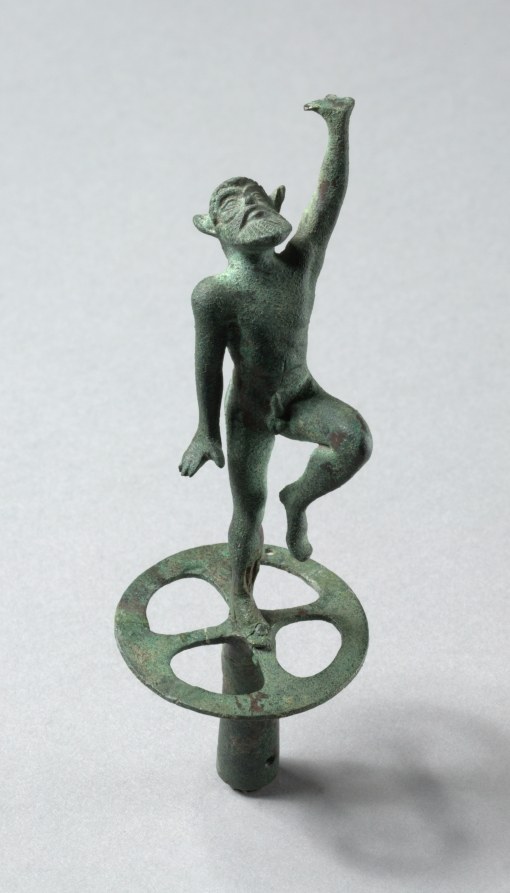
Kottabos Element of a Dancing Satyr
Unknown artist
- Source:
- Cleveland Museum of Art
- Rights:
- Public domain — free to use, share and adapt.
- Recorded as:
- CC0 (Public Domain)
The satyr's pose reveals how ancient Greek artists understood and valued ecstatic, uninhibited movement as a positive expression of ritual freedom—contrasting sharply with the formality of other Greek art. For historians of dance, it documents the aesthetics of abandon and the satyr's role as a figure of transgressive physicality in Greek culture. The object's integration into the kottabos game shows that movement and play were inseparable from symposium culture.
What you are looking at
A bronze or copper-alloy figurine depicts a youthful satyr in dynamic, celebratory motion atop a shallow circular platform with four large circular apertures. The satyr stands on one leg with the other raised and bent, his torso twisted upward, one arm stretched high overhead in an exultant gesture while the other extends to the side. His head tilts back, mouth open as if singing or shouting. The figure has prominent pointed ears and finely incised facial features. The patina is a deep green, characteristic of ancient bronze. The work is compact and designed to be viewed from multiple angles; the satyr's pose suggests a moment of ecstatic dance or celebration, possibly linked to Dionysian revelry. The base platform itself is a functional element—the apertures suggest this may have been a kottabos game piece, used in the drinking games of the ancient Greek symposium.
The dancing
A single figure, the satyr stands with weight shifted to one supporting leg while the other is raised high in a dynamic pose. His posture is asymmetrical and exuberant: the raised arm stretches vertically upward with hand extended, the opposite arm gestures outward, and his torso arches backward. The head is thrown back, expressing abandon and joy. The pose conveys momentum and freedom rather than formal technique—this is ecstatic movement, not balletic control. The slight twist of the torso and lift of the free leg suggest a moment captured mid-leap or mid-celebration.
The dance depicted
This is almost certainly kottabos-related imagery from ancient Greece, specifically a piece of the game apparatus itself. Kottabos was a symposium game where Greek men flicked wine dregs from their cups at a target; the satyr's ecstatic pose may represent the spirit of Dionysian abandon that governed such entertainments. The satyr as a figure embodies the licensed transgression and physical freedom of the symposium—a space where formal social rules were suspended. Whether this represents an actual dance form or serves as a decorative invocation of the revelrous ethos is unclear from the object alone, but satyrs were associated with wild, uncontrolled movement in Greek culture. The platform's functional design suggests this functioned as both ornament and game piece.
How it was made
This is a cast bronze or copper alloy, recognizable from the patina and surface finish. The satyr was likely cast solid or with minimal internal void, and details such as the facial features, pointed ears, and musculature were refined after casting through chasing and incision. The platform base with its regularized apertures shows careful geometric planning and suggests a mold-made or carved form. The technique allowed the maker to create a compact, three-dimensional form that could be held, rotated, and used as a functional object within the symposium context. The durability of bronze ensured these pieces survived and served as markers of the symposium's cultural importance.
About this work
This is a small-scale sculptural object from the ancient Greek world, likely Archaic or Classical period, serving a dual function as decorative art and functional game piece. The satyr figurine embodies the ecstatic, transgressive spirit of the Dionysian symposium—the male drinking and entertainment gathering where kottabos was played. The pose captures a moment of exuberant, uninhibited movement that reflects Greek attitudes toward the satyr as a being of appetitive freedom and wild physicality. The work belongs in a dance collection not because it depicts a codified dance form, but because it visualizes movement, abandon, and the ritual embodiment of licensed transgression that was central to Greek male social life.
How to look at it
Notice the asymmetry of the pose: one leg supports while the other swings free, the torso twists, and one arm reaches skyward while the other balances the composition. The head thrown back and the open mouth suggest vocalization—singing, shouting, or ecstatic utterance. The satyr's body is not idealized in the way human athletes were depicted; instead, it is rendered with the freedom and distortion that conveys movement and emotion. Observe how the artist used the small scale and three-dimensionality to make this figure feel alive and active despite its immobility.
The period
This work belongs to the ancient Greek tradition of bronze figurine production, likely dating to the Archaic or early Classical period (6th–5th century BCE or later). In Greek sculpture of this era, satyrs were increasingly depicted in dynamic, exuberant poses rather than static stance, reflecting growing artistic interest in capturing movement and emotion. The satyr as a figure emerged prominently in Dionysian imagery and was associated with theater, wine, and ritual transgression. Kottabos games were a fixture of the symposium from the Classical period onward, and decorative game pieces like this reflect the interplay between aesthetic refinement and ludic culture among the Greek elite. The work sits at the intersection of functional object and artistic expression.
Where it lives
This work is held in the Cleveland Museum of Art and is catalogued as a dance-related artwork. The object is identified as kottabos game apparatus—functional ware that was both decorative and interactive within ancient Greek symposium culture.
Dance in this work
Questions about this work
What is kottabos and why is this satyr part of it?
Kottabos was an ancient Greek drinking game played at the symposium (male drinking party) in which players flicked wine sediment from their cups at a target, often to the accompaniment of music and entertainment. This satyr figurine is mounted on a platform that likely served as a kottabos target. The satyr represents the spirit of Dionysian revelry and uninhibited pleasure that governed the symposium. The connection between the dance imagery and the game reflects the inseparability of movement, music, and ritual excess in Greek male social life.
Is this satyr actually dancing, or just posed?
The satyr is captured in a moment of ecstatic, exuberant movement that may represent dance, or may represent the broader physical abandon associated with Dionysian celebration. Ancient Greek culture did not clearly distinguish between 'dance' and other forms of rhythmic, celebratory movement. What matters here is that the artist has rendered the satyr's body in a pose that conveys freedom, momentum, and joy—values central to how Greeks understood transgressive, ritual physicality.
Why are satyrs associated with dance and revelry?
In Greek mythology and art, satyrs were followers of Dionysus, the god of wine, ecstasy, theater, and transformation. They embodied appetitive freedom, untamed sexuality, and the inversion of social norms—qualities that made them ideal figures for representing the licensed transgression of the symposium. Their pointed ears, sometimes depicted with animal features, marked them as beings outside human civilization and its restraints. Dance and music were essential to their character, and they appear frequently in depictions of Dionysian processions (thiasoi) and theatrical contexts.
More dance artwork