49 works in this view — arrow keys or swipe to move between them.
Dance in Art
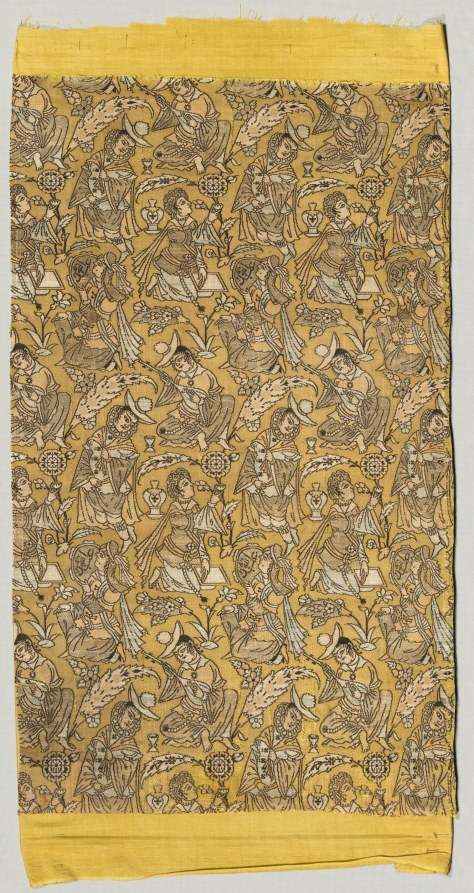
Lampas with dancers and musicians
Unknown artist
- Source:
- Cleveland Museum of Art
- Rights:
- Public domain — free to use, share and adapt.
- Recorded as:
- CC0 (Public Domain)
This textile documents courtly dance practices in a non-Western tradition at a time when such visual records are rare. For historians of dance, it shows how musicians and dancers were positioned together in formal court entertainment, and it preserves the silhouettes and gestures of a dance practice now lost to living memory. For textile historians and art historians, it exemplifies the lampas technique and the way narrative content—here, the representation of elite leisure—was integrated into decorative design.
What you are looking at
A dense, repeating pattern of musicians and dancers fills the entire composition of this textile. The figures are rendered in brown line-work on a golden-yellow ground, arranged in a symmetrical, interlocking grid that repeats across the fabric. Pairs and groups of elaborately dressed figures occupy the space: musicians play wind and stringed instruments while dancers gesture and move in rhythmic relation to them. The figures wear elaborate costumes with complex drapery, suggesting court dress or theatrical costume. Architectural elements — arches, geometric frames, and decorative cartouches — organise the composition into neat compartments. The style is graphic and linear, with no modelling or shadow; the pattern reads as a unified textile design in which narrative content and decorative order are equally important.
The dancing
Individual dancers appear in pairs and small groups, often facing one another or arranged in mirror-image poses. Arms are raised, curved, and expressively positioned; bodies sway or turn within the confines of the compartments. The poses suggest courtly dance conventions: dancers maintain formal posture while their limbs create fluid, curved lines. Musicians are interspersed throughout, some seated, others standing, holding instruments to their mouths or chests. The density of the composition means individual dancers do not occupy much space, yet each figure is anatomically complete and individually characterised.
The dance depicted
This textile depicts a scene of courtly music-making and dance, most likely from the Islamic world or a region under Islamic cultural influence, given the style of costume, instrument types, and the integration of musicians and dancers in what appears to be a court or ceremonial context. The presence of both instrumental musicians and dancers together suggests a formal entertainment or celebration. The repeating pattern implies this is a standard design for luxury textiles, recording a conventional scene of courtly leisure and artistic performance rather than a specific historical event. Without additional documentation, the precise dance form cannot be identified, but the formal posture and rhythmic pairing suggest a structured, courtly dance practice.
How it was made
This is a lampas, a complex woven textile in which patterned areas are created by supplementary weft threads that float across the surface. The technique allows fine linear detail and sharp colour contrast—here, brown and gold—without requiring the labour of embroidery. The linear, almost calligraphic quality of the design reflects the constraints and possibilities of the loom: figures can be rendered with precision of outline but minimal internal modelling. This is a luxury textile, expensive to produce and intended for the elite market. The use of lampas indicates circulation among wealthy patrons who could afford such technically demanding work.
About this work
This is a woven textile in the lampas technique, depicting a repeating courtly scene of musicians and dancers in elaborate dress. The work is undated and unattributed, but the style, costume, and iconography suggest production in the Islamic world or a region under Islamic cultural influence, possibly the Ottoman court or a major textile centre in Persia or Central Asia. The textile preserves a visual record of formal courtly entertainment—a context in which music, dance, and visual spectacle were inseparable. Its survival in a major museum collection reflects the value such textiles held both at their time of production and in later European collecting of 'Oriental' luxury goods.
How to look at it
Look first at the overall pattern and its geometry: the composition is designed to repeat seamlessly, so each compartment is a complete microcosm of courtly entertainment. Then examine individual figures: notice how the artist has differentiated dancers from musicians by pose and attribute (instruments), and how the costumes—with their flowing drapery and elaborate detail—signal the elite status of the figures. The linear quality of the drawing means that gesture is expressed through the contours of the body and the curves of the arms and fabric rather than through modelling or spatial depth. The repetition itself is meaningful: it suggests that this scene of musical and terpsichorean pleasure was understood as a timeless, formally perfect ideal of courtly life.
The period
The style and technique of this textile place it within a tradition of courtly luxury goods that flourished in the Islamic world from at least the medieval period through the early modern era. Major centres of textile production—including the Ottoman court workshops, Safavid Persia, and Central Asian khanates—produced elaborate silks and other textiles depicting courtly scenes, musicians, and dancers. These textiles served both functional and symbolic purposes: they were used for clothing, furnishings, and gifts, and they advertised the patron's wealth, taste, and connection to refined courtly culture. The tradition of representing musicians and dancers together on textiles reflects the close integration of these arts in courtly entertainment.
Where it lives
The textile is held by the Cleveland Museum of Art. It is recorded as a lampas with dancers and musicians, but no further attribution, date, or provenance information is available in the catalogue record.
Questions about this work
What is a lampas?
A lampas is a complex woven textile in which a patterned design is created by supplementary weft threads that float across the surface of a base weave. The technique allows fine linear detail and sharp colour contrast. Lampas fabrics were labour-intensive and expensive to produce, and were typically created for wealthy patrons. They were especially popular in the Islamic world and Europe during the medieval and early modern periods.
Where and when was this textile made?
The catalogue record does not provide a date, location, or maker's attribution. The style of the costume, the types of instruments depicted, and the formal arrangement of musicians and dancers suggest production in the Islamic world—possibly the Ottoman court, Safavid Persia, or a Central Asian textile centre—but this cannot be confirmed without additional research or documentation.
What dance is this?
The specific dance form cannot be identified from the image alone. The formal posture, paired arrangements, and integration with live musicians suggest a courtly dance practice, but the textile does not preserve enough detail of footwork or specific movement vocabulary to name it. The design reflects a general ideal of courtly entertainment rather than a particular dance tradition.
How was this textile used?
Lampas textiles of this quality were typically used for luxury items: wall hangings, furnishings, or clothing for members of the court and elite. The repeating pattern of courtly scenes would have decorated the interior spaces of a palace or the garments of a high-status patron, advertising both the wearer's or owner's wealth and their access to refined artistic culture.
More dance artwork