49 works in this view — arrow keys or swipe to move between them.
Dance in Art
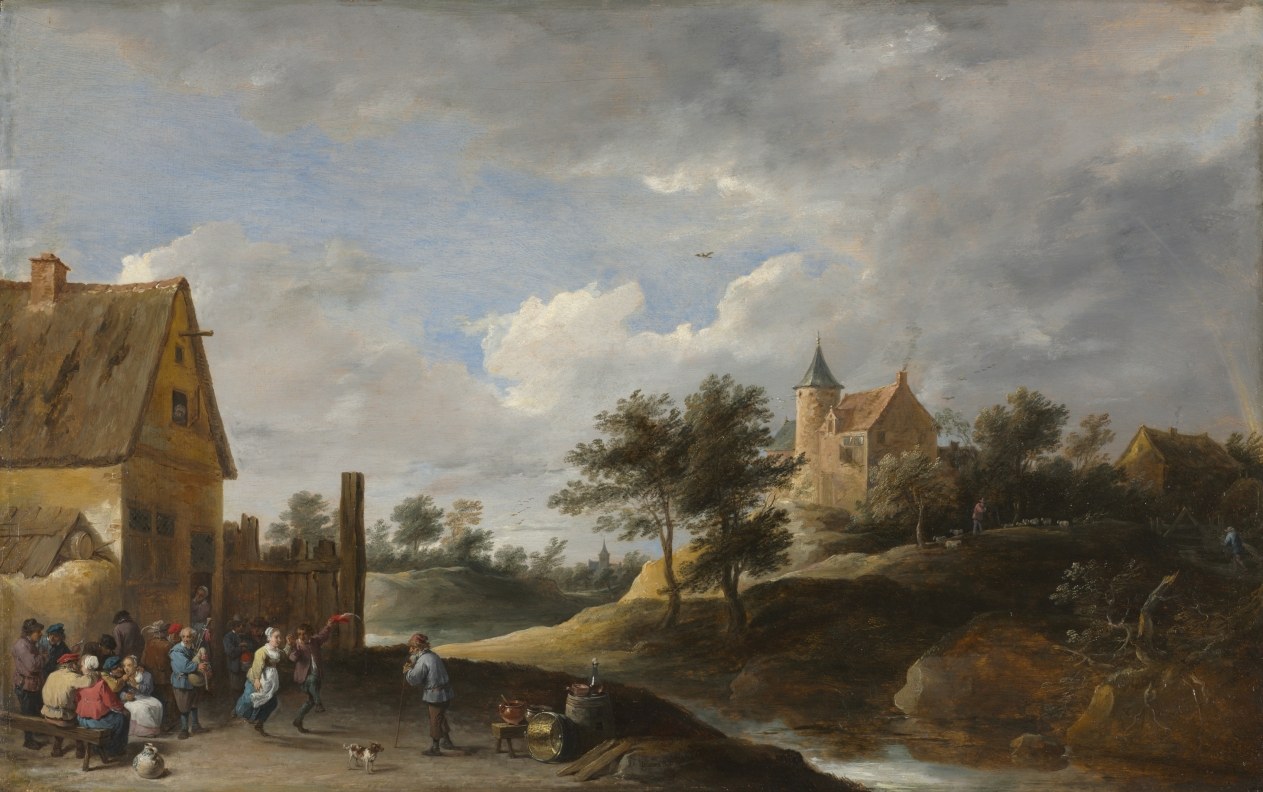
Landscape with Peasants Dancing
David Teniers (Flemish, 1610–1690)
- Source:
- Cleveland Museum of Art
- Rights:
- Public domain — free to use, share and adapt.
- Recorded as:
- CC0 (Public Domain)
This painting is one of a large class of Northern European village festival paintings that constitute almost our only visual record of non-courtly dance in the 16th and 17th centuries. For historians of folk dance and social history, such works are primary documents: they show how people actually moved together in celebration, what they wore, and how dance functioned in communal life. The painting demonstrates that dance was understood as a core element of peasant festivity worthy of large-scale artistic representation.
What you are looking at
A Flemish or Dutch village landscape, painted in the 17th century, depicts a festive gathering around a modest house on the left. A large group of villagers—perhaps thirty to forty figures in total—cluster in the middle ground, their bright clothing (reds, blues, yellows, whites) creating pools of colour against the earthen foreground. Some stand, some sit on benches or the ground; a few are clearly dancing or in motion. To the right, a small stream winds past rocky outcrops, and beyond it a hillside rises toward a castle or fortified church in the distance, rendered in warm ochre and brown. The sky is dramatic: large white clouds lit from beneath, with patches of grey and blue, creating the atmospheric depth characteristic of Northern European landscape painting. The whole scene has the character of a village celebration or kermis—a rustic festival—with figures engaged in socialising, eating, drinking, and dancing. The foreground is relatively bare and sandy, with a few small dogs and scattered vessels; the middle distance is crowded with activity; the background recedes through carefully managed perspective toward the architectural focal points and sky.
The dancing
The dancers are not isolated as formal pairs or lines but distributed informally through the crowd, their bodies suggesting movement and gaiety rather than technical precision. Several figures appear to be in motion—arms raised or extended, bodies angled—though at this scale and in this mode of representation it is difficult to discern exact footwork or holds. The costumes are those of prosperous peasants or villagers: the women wear long skirts and white linen caps or headdresses; the men wear breeches, hose, and hats. The overall impression is one of spontaneous, social dancing rather than choreographed performance, with the dancers integrated into a broader scene of feasting and leisure.
The dance depicted
This is almost certainly a depiction of folk or peasant dancing at a village kermis or festival—a deeply popular subject in Flemish and Dutch art from the 16th to 17th centuries. The dancing is embedded in a landscape setting rather than isolated in an interior, and the participants are rustic figures engaged in customary celebration. The style appears to be a group or communal dance, likely a branle, ronde, or similar circle or line dance familiar to Northern European villages. The image documents not the technical mastery of court dance but the social function of dance as a marker of communal festivity and seasonal or religious celebration. Without closer detail or inscriptions, the precise dance type cannot be named with certainty.
How it was made
This is an oil painting on canvas, executed with considerable atmospheric sophistication. The artist demonstrates mastery of light and colour, particularly in the rendering of sky and distant architecture, and has used a relatively high viewpoint to allow the crowd of figures to be legible across the middle distance. The brushwork is detailed but not minute; the scale of the figures is small enough that individual facial features are generalised rather than portrayed. The technique is consistent with Northern European landscape painting of the 17th century, when such village festival scenes had become established as a distinct genre. The painting would have been accessible to a cultivated urban audience with nostalgia for or curiosity about rural life.
About this work
This is a village kermis scene—a type of painting that became especially popular in Flanders and the Dutch Golden Age. It captures a moment of communal celebration in which dancing is one element among eating, drinking, socialising, and courtship. The painting is not primarily about dance technique or courtly refinement; rather, it documents dancing as a social practice embedded in rural calendar custom and celebration. The work belongs in a dance collection because it preserves visual evidence of how ordinary people danced in the period—their dress, their groupings, their integration of dance into the rhythms of village life. Such scenes were also, in some cases, vehicles for moral commentary (on peasant excess, disorder, or lewdness), a context worth noting when interpreting the artist's viewpoint.
How to look at it
Attend first to the composition: the artist has used atmospheric perspective and the crowd itself to guide the eye from foreground through middle distance to the architectural landmarks beyond. Notice how the dancers are distributed through the scene rather than grouped as a formal ensemble—they are embedded in the social fabric. Look at the variety of poses and postures: some figures face the viewer, others turn away or bend; a few have their arms raised. The artist has chosen a moment not of climactic spectacle but of ongoing, distributed activity—the dance is happening but is not the sole focus. The bright colours in the costumes—the red, blue, and yellow garments—create visual excitement against the muted landscape, suggesting the liveliness and colour that the artist associated with festive celebration.
The period
The kermis or village festival painting emerged as a recognisable genre in Flemish art in the 16th century and flourished in the 17th, particularly in the work of artists such as Pieter Bruegel the Elder and his successors, David Teniers, and others. These paintings often depicted seasonal celebrations, religious festivals, or pastoral leisure. Dancing was always a prominent element, and the scenes served both as records of rural custom and, often, as occasions for satirical or moralistic commentary on peasant behaviour. In the same period, court dance was becoming increasingly formalised and codified (the ballet de cour in France, masque in England), making the village festival painting a striking counterpoint: a celebration of communal, unscripted movement in marked contrast to the geometry and order of courtly dance.
Where it lives
The work is held by the Cleveland Museum of Art and is catalogued as part of the museum's dance-related art collection. Beyond this, the record provides no information on provenance, date, or artist attribution.
Dance in this work
Questions about this work
Is this a real village or an imaginary one?
Likely both: the artist may have worked from knowledge of actual Flemish or Dutch villages and festivals, but the composition is carefully arranged for aesthetic effect. The distant castle and church are rendered in an idealised manner, and the crowd is arranged to be legible rather than chaotic. These paintings are documents of a real social practice—the village festival—but they are artistic compositions, not literal records.
What can we tell about the dancing from this painting?
The dancing appears to be informal, communal, and social rather than formally choreographed. The dancers are in everyday village dress, and they are integrated into a broader scene of eating and socialising. The postures suggest liveliness and movement, but the scale and medium make it impossible to discern specific steps or figures. The image records that dancing happened, that it involved both men and women, and that it was central to festival celebration.
Why did artists paint these scenes?
Village festival paintings served multiple purposes: they appealed to urban collectors' nostalgia for or curiosity about rural life; they provided occasions for depicting costume, landscape, and human activity; and in many cases they offered opportunities for moral or satirical commentary on peasant behaviour, excess, or disorder. Some were executed as straightforward celebrations of rural custom; others carried a more critical or condescending tone.
More dance artwork