49 works in this view — arrow keys or swipe to move between them.
Dance in Art
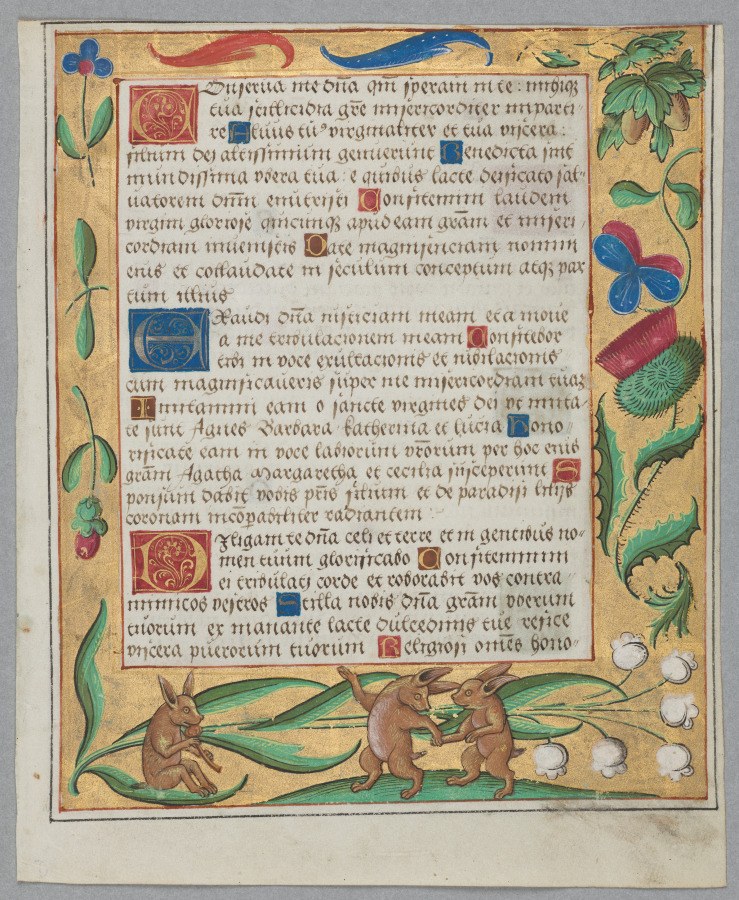
Leaf from a Psalter and Prayerbook Rabbits Dancing recto
Unknown artist
- Source:
- Cleveland Museum of Art
- Rights:
- Public domain — free to use, share and adapt.
- Recorded as:
- CC0 (Public Domain)
Medieval marginal animals offer rare evidence of how motion and partnership were depicted before the codification of formal dance notation. The artist's choice to render the rabbits in mirrored, synchronized posture shows an understanding of coupled movement and visual balance that resonates with human dance composition. As evidence of how medieval artists perceived and represented animal courtship and play, the image connects natural observation to artistic convention.
What you are looking at
This is a page from a medieval psalter or prayerbook, a manuscript leaf on vellum decorated in the tradition of Northern European illumination, probably from the 15th century. The text occupies most of the page in two columns of Gothic script, framed by a decorative border of vines, flowers, and foliage rendered in green, gold, and bright mineral pigments. Along the bottom margin, beneath the main text block, two rabbits or hares are depicted in lively interaction against a green ground scattered with white flowers or seed pods. The rabbits appear to be dancing or playing together—their bodies are in animated poses, with one reared or leaping and the other in a complementary stance. The border design includes naturalistic botanical elements (a pink flower on the right, bell-shaped flowers on the left) typical of the International Gothic style.
The dancing
Two lagomorphs (rabbits or hares) occupy the lower margin. Their bodies are rendered in profile or three-quarter view, with articulated limbs suggesting energetic movement. The animals appear to be in mid-leap or mid-dance, with elongated hindlegs extended or bent in springing motion. Their postures are mirrored or reciprocal—the compositional balance suggests courtship display, play-fighting, or ritual paired movement. The artist has captured a moment of animation and liveliness rather than static repose.
The dance depicted
This is not human dance but rather an anthropomorphic or naturalistic representation of animal movement, most likely rabbits or hares in a mating or courtship display. Medieval manuscripts frequently included such marginal scenes (marginalia) as both decorative and moral commentary. The paired, synchronized movement of the animals suggests a courtship ritual or jeu (game), which may be read metaphorically as a dance. Whether this is intended as allegory for human courtship or simply as a lively naturalistic observation is uncertain, but the formal balance and liveliness of the pose invite comparison to human paired movement.
How it was made
This is a manuscript leaf on vellum (calfskin), executed in watercolor and gold leaf in the Northern European tradition of the 15th century. The text is written in brown ink in a formal Gothic (textura) script. The illuminated border and marginal figures are painted in gouache and shell gold, with detailed brushwork defining the animals' fur and musculature. The technique of marginal decoration allowed artists freedom to depict playful, sometimes satirical or crude scenes beneath the sacred text—a common medieval practice that gave rabbits, monkeys, and other creatures particular prominence as symbols of lust, folly, or spring renewal.
About this work
This is a page from a psalter or prayerbook in the Northern European tradition, dating to approximately the 15th century. The main text is a prayer or psalm in Latin, in two columns of formal Gothic script, surrounded by a lush illuminated border of vines, flowers, and foliage. In the lower margin—a common location for such scenes in medieval manuscripts—two rabbits or hares are depicted in animated, partnered movement that resembles a dance or courtship display. The work exemplifies the medieval manuscript tradition in which high devotional text was accompanied by naturalistic or whimsical observations of animals and the natural world. The pairing and synchronization of the animals' movement invites metaphorical reading as a form of paired animation or play-dance.
How to look at it
Attend to the posture and weight distribution of the rabbits: note how their hindlegs are extended or flexed, how their bodies are angled toward one another, and how the artist has balanced the composition to suggest reciprocal or mirrored movement. The synchronized positioning suggests the artist understood paired motion as a visual principle—the rabbits are not randomly scattered but deliberately composed as a couple. The margin itself is worth study: medieval manuscripts often used marginal space to permit playfulness and naturalism that would be inappropriate in the main text, allowing artists to observe and depict animals with both accuracy and invention.
The period
In the 15th century, the art of manuscript illumination in Northern Europe (Flanders, Germany, France) reached its apogee. This period saw the development of increasingly naturalistic border decorations (drolleries and marginalia) that often depicted animals, everyday scenes, and comic or erotic vignettes. Rabbits and hares held particular symbolic weight in medieval and Renaissance art: they were associated with spring, fertility, lust, and the Resurrection (in the Passover tradition). The inclusion of such playful animal scenes in devotional manuscripts reflects both the artist's delight in observation and the acceptance of such marginal humor as a counterpoint to sacred text. The same period saw growing attention to naturalism in panel painting and tapestry, which influenced manuscript practice.
Where it lives
The work is held in the Cleveland Museum of Art collection. It is catalogued as a leaf from a psalter and prayerbook, a common form of devotional manuscript in the medieval and early Renaissance period. Such leaves often circulated separately after the binding was broken or the volume was dispersed.
Questions about this work
Why are there rabbits in the margin of a prayer book?
Medieval manuscripts frequently included marginal decorations (called drolleries or marginalia) that depicted animals, scenes of daily life, and playful or satirical vignettes. These served both aesthetic and symbolic purposes: they entertained the reader, provided moral commentary or allegory, and created a visual counterpoint to the sacred text. Rabbits in particular were associated with spring, fertility, and courtship, making them apt subjects for depictions of playful paired movement.
Is this dance?
Not human dance, but the synchronized, mirrored posture of the two rabbits suggests a courtship display or play-ritual that can be read as a form of non-human movement. Medieval artists often depicted animal behavior in ways that invited metaphorical reading as dance or play. The formal balance and coupled movement show that the artist understood symmetry and reciprocal motion as organizing principles.
How was this made?
This is a page from a hand-painted manuscript on vellum (calfskin). The text was written in brown ink in Gothic script, and the decorative border and marginal figures were painted in watercolor and gold leaf. The technique allowed the artist to include fine naturalistic detail—the rabbits' fur, the veins of the leaves—while maintaining the glowing, precious quality valued in medieval devotional art.
What period is this from?
Based on the style of the script, the character of the border decoration, and the painting technique, this appears to be a 15th-century Northern European manuscript, likely from Flanders, Germany, or France. The International Gothic style and the naturalism of the marginal figures are consistent with late medieval manuscript practice at its most refined.
More dance artwork