49 works in this view — arrow keys or swipe to move between them.
Dance in Art
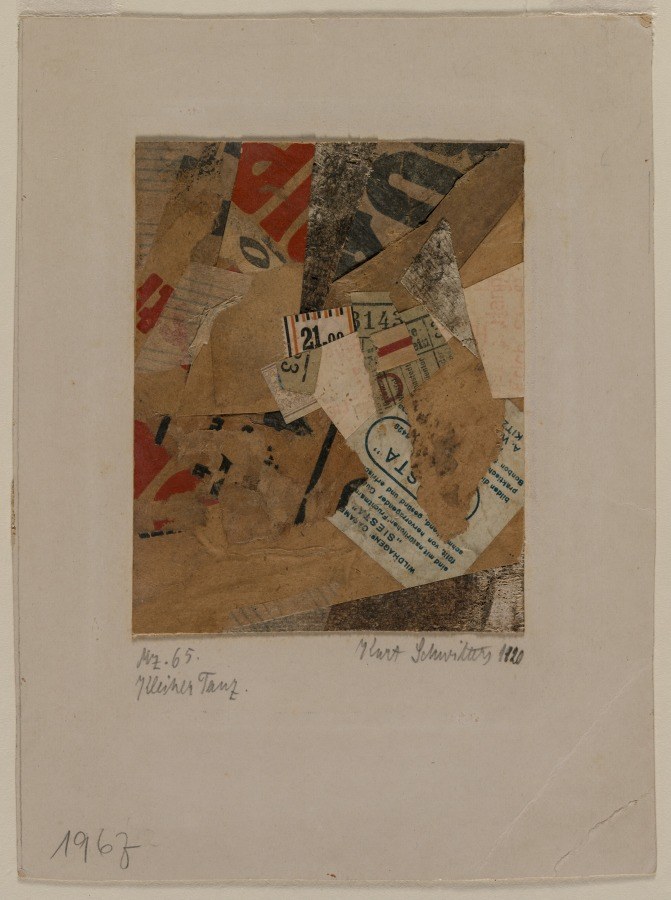
Little Dance
Kurt Schwitters (German, 1887–1948)
- Source:
- Cleveland Museum of Art
- Rights:
- Public domain — free to use, share and adapt.
- Recorded as:
- CC0 (Public Domain)
The attribution of this work to a dance collection and the suggestive title raise questions about how mid-to-late modernist collage engages with abstraction, materiality, and the boundaries between visual, textual, and kinetic language. The work merits closer study to determine whether the title reflects an intentional conceptual link to dance or represents a cataloguing decision based on lost or obscure provenance.
What you are looking at
This is a collage composed of layered fragments of paper, printed text, and what appear to be cut or torn pieces arranged on a neutral background. The visible materials include portions of printed text in multiple languages (possibly including Cyrillic script), numerical stamps or markings ("21", "614"), red and black printed letterforms or decorative elements, and weathered or aged paper surfaces in tan and brown tones. The composition creates a palimpsest effect, with overlapping rectangular and angular shapes suggesting a deconstructed or reassembled document. The materials appear archival or administrative in origin—possible fragments of postcards, labels, or printed sheets. Handwritten annotations appear in the lower margin in what looks like ink or pencil.
The dancing
No human figures are visible in this work. The composition is entirely abstract and material, composed of paper, printed elements, and typographic fragments without representation of bodies or gesture.
The dance depicted
The title 'Little Dance' does not appear to be supported by the visual content. No dance, dancers, or choreographic notation is evident in the image. This may be a collage titled evocatively without literal narrative, or the relationship between title and image may require additional context not visible here.
How it was made
This appears to be a mixed-media collage created by layering cut and torn papers, printed fragments, and possibly stamps or transferred text onto a backing sheet. The weathered appearance of the papers, the visible creases and edges, and the heterogeneous sources of the printed material suggest assembly and arrangement rather than drawing or painting. The technique allows for a richly textured surface with visible materiality and evidence of handling—a modernist strategy common in early 20th-century collage practices.
About this work
This is an abstract collage composed of layered fragments of aged or archival papers, printed text, and typographic elements. Without clear figural or narrative content, it resists straightforward interpretation. The work appears to foreground the material and textual qualities of found or recycled paper rather than to depict a subject. The title 'Little Dance' may invoke movement or rhythm metaphorically through the visual arrangement of fragments, or it may be applied enigmatically.
How to look at it
Attend to the layering and overlap of the paper fragments and how they create visual rhythm and movement across the surface, even in the absence of figurative content. The composition creates spatial ambiguity—it is unclear whether the image is meant to be read as a flat, flattened surface or as shallow depth created by overlapping planes. The weathered quality of the papers and the visibility of creases, tears, and edges emphasize the material reality of the work over any representational content.
The artist
The artist is not recorded. The handwritten annotations at lower left (possibly a date or signature) are not clearly legible in reproduction. Without confirmed attribution, the artist's practice and historical context cannot be established.
The period
The aesthetic and material approach suggest a modernist collage practice, possibly from the early-to-mid 20th century, a period in which collage—pioneered by Cubism and Dada—was being explored as a means of disrupting illusionistic representation and incorporating the textual, archival, and commercial vernacular into fine art. The use of fragmented text and aged papers aligns with Dadaist and Constructivist experiments with materiality and chance.
Where it lives
This work is held in the Cleveland Museum of Art and is part of their dance-related art collection. It is documented as part of the cma collection. The sparse catalogue record and lack of confirmed artist attribution suggest it may be a gift or an unattributed acquisition.
Questions about this work
Is there actually a dance depicted in this work?
Not literally. The composition contains no figures or representations of movement. The title 'Little Dance' is likely metaphorical or refers to a conceptual quality—perhaps the rhythm and movement created by the arrangement of abstract elements—rather than a direct subject.
What are the printed texts visible in the collage?
The visible fragments include numbers (21, 614), letterforms in red and black, what may be Cyrillic characters, and portions of printed documents whose original context is unclear. They appear to be administrative or postal in origin, possibly from European sources given the script diversity.
Why is this in a dance art collection?
The reason is not documented. The title suggests a conceptual or metaphorical connection to dance, or the work may have entered the collection through a donation or acquisition with a dance-themed gift, without a clear curatorial rationale.
More dance artwork