49 works in this view — arrow keys or swipe to move between them.
Dance in Art
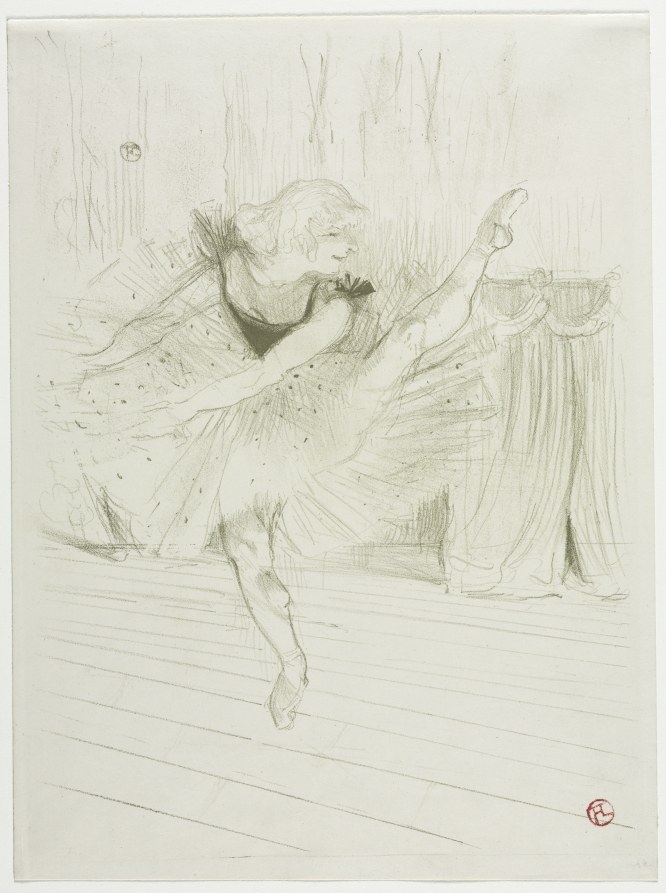
Miss Ida Heath English Dancer
Henri de Toulouse-Lautrec (French, 1864–1901)
- Source:
- Cleveland Museum of Art
- Rights:
- Public domain — free to use, share and adapt.
- Recorded as:
- CC0 (Public Domain)
Ida Heath is otherwise undocumented in major dance histories; this drawing may be one of the only visual records of her as a performer. More broadly, the work exemplifies how early 20th-century artists grappled with capturing the energy and individuality of dancers outside the classical ballet establishment—a window into the diverse landscape of theatrical and social dance in the Edwardian era.
What you are looking at
A young woman in an elegant early 20th-century dress performs a spirited leap or jump, her body captured mid-motion against a loosely indicated interior setting. She wears a dark velvet or silk bodice with a high neckline and a light, billowing skirt that swirls around her legs, the fabric rendered with energetic, directional lines that emphasise the momentum of her movement. Her posture is exuberant: one leg extended sharply behind her, the other bent beneath her, her torso lifted and torqued, one arm raised expressively. The setting is sketched with minimal detail—vertical lines suggest drapery or panelling on the walls, and horizontal lines indicate a wooden floor. The drawing is executed in fine pencil lines with selective heavier shading on the bodice and face, creating a sense of immediacy and spontaneity. Her hair is arranged in the upswept style of the 1900s-1910s, and her face is rendered in profile, turned slightly upward in what appears to be a moment of joyful abandon.
The dancing
A single female dancer occupies the composition. Her weight appears to be on her lower leg, with the other leg thrust upward and backward in a high extension. Her upper body is pitched forward and twisted, creating a diagonal line of energy across the frame. One arm is raised and extended; the other is positioned lower. The pose suggests neither classical ballet technique nor rigid ballroom frame—instead, it conveys a looser, more naturalistic physicality, with emphasis on the exuberance and lightness of the jump rather than formal line. The artist has prioritised capturing the moment of suspension and the sense of buoyant movement.
The dance depicted
This cannot be identified as a specific named dance style from the image alone. The figure's dress, posture, and the period in which it was drawn (early 20th century, based on fashion) suggest social or theatrical dance of that era, but the informal, playful quality of the pose—a joyful leap without codified technique—resists precise categorisation. The work may document a moment of improvised movement, a theatrical turn, or a spirit of dance rather than a formal technique. The title identifies the sitter as 'Ida Heath, English Dancer,' suggesting she was a performer of some note, though without additional documentation her specific speciality is unclear.
How it was made
This is a pencil drawing executed with considerable refinement. The artist has used fine, controlled lines to establish form and movement, with areas of heavier shading (particularly in the bodice and facial features) to create volume and focus. The loose, directional hatching—especially in the skirt and background—conveys motion and energy without abandoning draughtsmanship. The technique is economical: the artist suggests rather than describes much of the setting, allowing the figure to dominate. This is the work of someone fluent in figure drawing, capable of both precision and expressive abbreviation. Pencil drawing of this quality was typically made as a study, finished work for a collector, or preparation for publication (in journals, newspapers, or illustrated books).
About this work
This pencil study documents an English dancer named Ida Heath at a moment of joyful, energetic movement—a leap executed with the lightness and informal grace characteristic of early 20th-century theatrical or social dance. The drawing itself is a skilled piece of observational work, capturing not just the pose but the sense of suspended motion and buoyancy. The work sits at the intersection of figure drawing and dance documentation: it is as much a study of the human body in motion as it is a record of a specific performer. For a gallery examining dance in visual art, it represents how artists of the period approached the challenge of freezing ephemeral movement on paper, and it documents a moment in the history of English dance and its performers.
How to look at it
Attend to the moment the artist has chosen: the peak of the leap, when the dancer's weight is suspended and her energy is most visible. Notice how the artist uses line direction—the long, sweeping strokes in the skirt, the upward thrust of the extended leg and raised arm—to convey motion itself, not just pose. The profile view and the slight upward tilt of the head suggest joy and abandon rather than technical perfection. Look at how lightly the background is sketched: the artist's interest is entirely in the body and its movement, not in context.
The period
This drawing dates to a period (approximately 1900–1920) when dance in Britain was undergoing significant change. Classical ballet was being revived and professionalised through companies like the Ballets Russes (which toured London from 1911 onward), while simultaneously a diversity of theatrical forms—music hall, revue, classical Greek-inspired movement—flourished. English dancers and choreographers were experimenting with new forms that moved away from strict Victorian convention. The sketch captures this moment of experimentation: the pose is neither strictly balletic nor ballroom, but rather celebrates individual expressiveness and the lightness of the body in motion. In the visual arts, drawing remained the primary medium for capturing dancers, as photography was still relatively limited in its ability to freeze rapid movement.
Where it lives
The work is held at the Cleveland Museum of Art. It appears as part of the museum's dance-related art collection, which encompasses visual documentation of dance and dancers across periods and styles.
Questions about this work
Who was Ida Heath?
Ida Heath was an English dancer active in the early 20th century. This drawing is believed to be one of the few surviving visual records of her. Beyond this image, little is documented about her career, training, or speciality in standard dance histories.
What dance style is she performing?
The pose does not correspond to a named, codified style visible in the image. The informal, exuberant leap suggests either improvised movement, a moment from theatrical performance, or a style of social or character dance that valued individual expression over strict technique.
Why is this drawing significant?
It documents a dancer and a moment in early 20th-century English dance performance, a period when diverse theatrical forms coexisted outside the classical ballet establishment. It is also a skilled example of how artists captured ephemeral movement through pencil drawing.
More dance artwork