49 works in this view — arrow keys or swipe to move between them.
Dance in Art
Music and Dance
François Boucher (French, 1703–1770)
- Source:
- Cleveland Museum of Art
- Rights:
- Public domain — free to use, share and adapt.
- Recorded as:
- CC0 (Public Domain)
This work represents an important tradition of visual thinking about dance as abstract value rather than bodily technique—a perspective that shaped how dance was discussed, patronized, and understood in early modern Europe. The equation of dance with music and the depiction of both as sources of civilized pleasure illuminates the ideological position of dance in courtly society, where it was ranked among the accomplishments essential to aristocratic identity. Understanding how dance appeared in allegorical and mythological art is crucial for historians reconstructing the cultural status of dance before the modern era.
What you are looking at
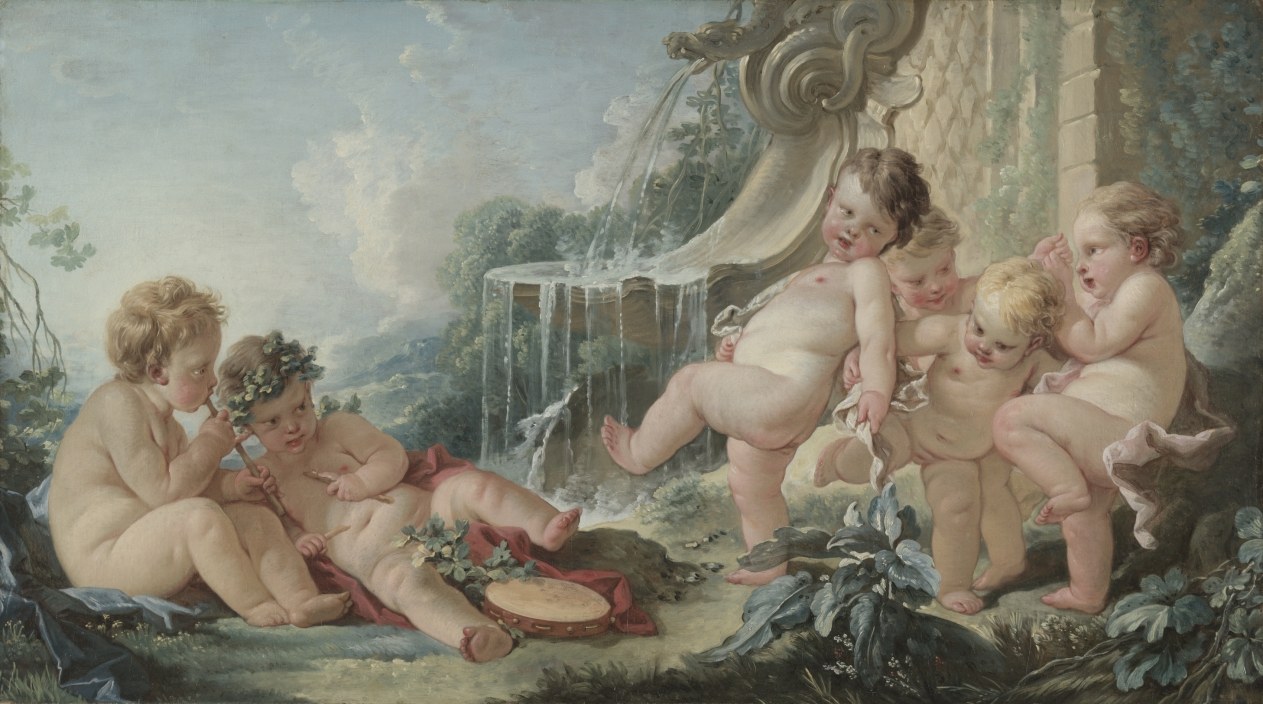
A Rococo or Baroque mythological scene depicts a gathering of putti (cherubic infant figures) in a lush outdoor setting. On the left, three putti sit on the ground amid floral garlands and drapery, their bodies relaxed and entwined; one holds what appears to be a musical instrument or pastoral pipe. On the right, four standing putti gesture animatedly toward the seated group, their bodies leaning and reaching in gestures of invitation or play. The scene is set against architectural ruins—a large carved stone scroll or volute and weathered stonework—framed by verdant foliage and trees visible in the atmospheric background. The lighting is soft and golden, typical of the period; flesh tones are pale and luminous, and the composition suggests a moment of playful musical or choreographic exchange. The title "Music and Dance" appears deliberate: the pipe-bearing figure on the left and the dynamic postures of the standing figures on the right suggest these are the two themes being enacted.
The dancing
The putti display the unburdened physicality characteristic of Rococo allegorical representation: rounded, plump bodies in asymmetrical, naturalistic poses rather than formal arrangement. The seated figures on the left are intertwined and relaxed, suggesting rest or companionship; the standing figures on the right adopt reaching, gesturing postures with raised arms and forward-leaning torsos, directed toward the seated group. There is no rigid line formation or closed ballroom hold; instead, the bodies move in an open, conversational space. The poses suggest invitation, play, and social interaction rather than structured partnering, with weight distributed fluidly across the composition.
The dance depicted
This is not a depiction of a specific recognizable historical dance form, but rather an allegorical representation of the abstract concepts of Music and Dance in the classical or Rococo tradition. The image belongs to a long tradition of ceiling frescoes, tapestries, and paintings that personify the liberal arts or divine pleasures as mythological or allegorical figures. The putti are the actors, not human dancers, and their poses suggest play, celebration, and the union of music (represented by the pipe) and movement rather than any codified dance technique. The work celebrates the harmony of the two arts—one auditory, one kinetic—as they were understood in the 17th or 18th century.
How it was made
This appears to be an oil painting on canvas, executed in the Rococo style with the characteristic soft modeling, warm palette, and feathered brushwork of that period. The handling of flesh, the atmospheric treatment of the background landscape, and the luminosity of the drapery are consistent with Rococo court painting practice. The work was likely intended for a private collection or palatial interior, given its mythological subject and refined scale; such works were often part of a broader decorative program. The medium and style suggest a Northern European or Continental production, possibly Flemish or French, from the 17th or 18th century.
About this work
This painting is an allegorical representation of Music and Dance as abstract virtues or pleasures, rendered through the Rococo convention of putti at play in a pastoral setting. Rather than documenting a historical dance or a social dancing scene, it uses the interplay of musical instrument and gesture to evoke the harmony between auditory and kinetic arts. The work belongs to a rich European tradition of allegorical representation that extends from Renaissance emblem books through the Baroque and into the Rococo, where putti frequently appear as agents of pleasure, virtue, or aesthetic experience. For a dance history collection, it is valuable not as evidence of dance practice but as testimony to how dance was conceptualized and valued in courtly and aristocratic culture: as one of the liberal arts, a source of refinement, and an inseparable companion to music.
How to look at it
Attend to the structural contrast between the two groups: the seated, musical figures on the left embody listening and stillness (music as auditory experience), while the standing, gesturing figures on the right embody movement and expression (dance as kinetic expression). The architectural framing—the carved stone scroll—suggests that this scene is a kind of performance or display, framed for viewing as one might frame a painting or a theatrical spectacle. Note the absence of an orchestra, an audience, or a defined stage; instead, the landscape itself becomes the arena for play. The soft light and atmospheric perspective invite the viewer to imaginatively enter this realm of pleasure rather than observe a documentary moment.
The period
This painting belongs to the Rococo tradition of the 17th and 18th centuries, when mythological and allegorical subjects dominated courtly and aristocratic art. During this period, dance was one of the four liberal arts (along with music, poetry, and painting) in classical hierarchies, and its visual representation often took allegorical or symbolic form rather than documentary form. In the actual practice of court, dance remained central to aristocratic social life—the minuet, the courante, and other Baroque dances were the grammar of court behavior—yet in high art, dance was more often evoked than literally depicted. The use of putti to represent abstract concepts was widespread in Baroque and Rococo painting, inherited from earlier Renaissance and classical sources. The composition suggests a world of leisure, refinement, and sensory pleasure characteristic of Rococo aesthetic ideology.
Where it lives
This work is held in the collection of the Cleveland Museum of Art. The catalogue record provides minimal information beyond title and source attribution, and neither artist, date, nor medium is recorded in the available metadata.
Questions about this work
Is this a depiction of an actual dance from the period?
No. This is an allegorical representation of Dance and Music as abstract concepts or virtues, not a record of how people actually danced. The figures are putti (cherubic infants), not human dancers, and they are arranged to illustrate the harmony between the two arts rather than to demonstrate a specific dance form or technique. For evidence of actual Rococo and Baroque dance forms—the minuet, the courante, the gavotte—one must look to other sources, such as dance manuals, portraits, or theatrical designs.
Why are there putti instead of human figures?
The use of putti to represent abstract concepts was a long-established convention in European art, inherited from classical and Renaissance sources. Putti were understood as timeless, universal figures capable of embodying ideas beyond the human—pleasure, virtue, the arts themselves. By rendering Dance and Music as putti, the artist elevates them from the merely social or practical to the realm of aesthetic and spiritual value.
What does the musical instrument tell us?
The pipe or pastoral instrument in the left group's hands identifies that group as the embodiment of Music, anchoring the allegorical meaning of the composition. The pairing of this recognizable symbol of music with the dynamic gestures of the right group (Dance) creates a visual equation: these two arts are partners, equally essential to refined living.
More dance artwork