49 works in this view — arrow keys or swipe to move between them.
Dance in Art
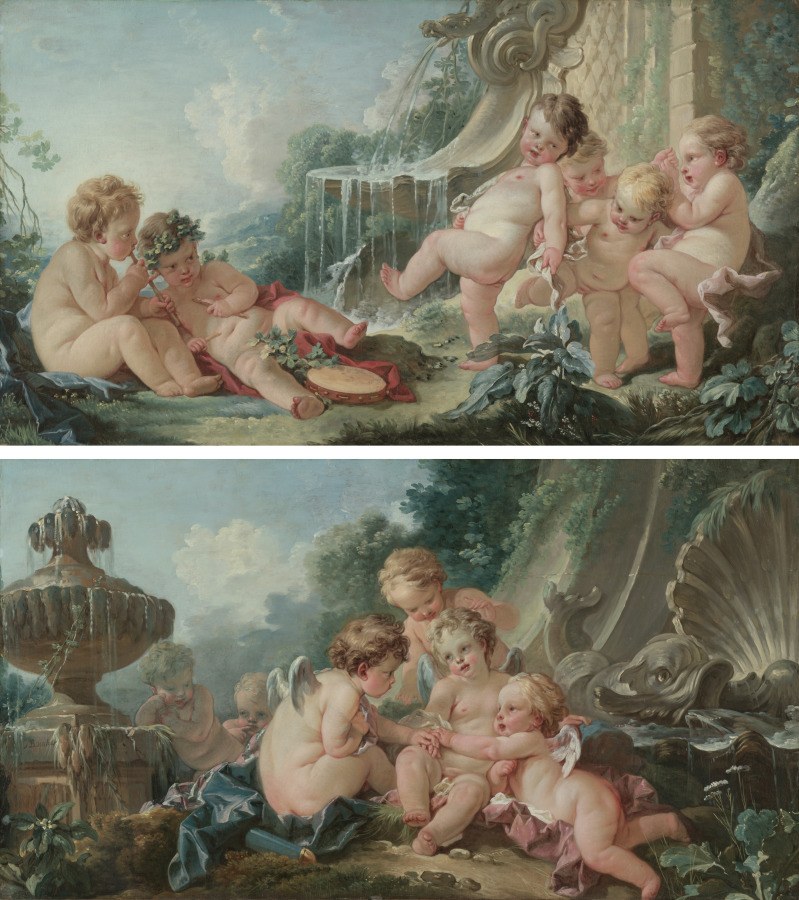
Music and Dance and Cupids in Conspiracy
François Boucher (French, 1703–1770)
- Source:
- Cleveland Museum of Art
- Rights:
- Public domain — free to use, share and adapt.
- Recorded as:
- CC0 (Public Domain)
These works testify to the symbolic power of dance in Baroque thought: dance as an expression of divine harmony, erotic pleasure, and cultivated leisure. For a historian studying how dance was understood and valued in court culture—rather than how it was technically practiced—such allegorical images are primary sources. They show what dance *meant* to educated viewers, even if they tell us nothing about how dancers actually moved.
What you are looking at
Two paintings appear to be variants or related works showing putti (cherubic figures) in Arcadian landscapes. In both compositions, between four and six plump nude or semi-draped children occupy rocky grottos and terraces overlooking distant valleys. The upper painting shows the figures arranged loosely on a ground plane, some seated, some standing, with swags of fabric—red, blue, and pink—draped around them. One figure holds what appears to be a wreath or garland. The lower painting presents a more formal arrangement around architectural elements: a stone fountain or urn on the left, and a large shell-form grotto or niche on the right. The children cluster in the center and right foreground, some gesturing toward each other, their poses more deliberately composed. Both scenes are bathed in soft golden light; the distant landscape recedes through misty blues and greens, with classical ruins visible in some areas. The overall tone is playful, sensual, and allegorical rather than narrative—these are celebrations of abundance, innocence, and divine play rather than scenes of specific action.
The dancing
The bodies are uniformly fleshy, with pronounced rounded bellies and soft limbs—the canonical Baroque putto form. None of the figures displays the musculature or trained bearing of human dancers. Their poses are varied but without clear synchronization: some lean, some recline, some stand with arms extended or crossed. The groupings suggest interaction—playful touch, shared gaze, occasional hand-holding—but no unified movement or formation. Weight is distributed casually across the composition; there is no sense of counted steps, partnered hold, or directional intent. These are not dancers arranged in a dance; they are figures arranged to suggest idle pleasure and mythological leisure.
The dance depicted
Neither composition depicts recognizable dance in any historical or technical sense. The putti are not performing; they are disporting—engaged in play, flirtation, and the aesthetic display of the body in idealized leisure. In Baroque allegorical painting, such scenes were coded as celebrations of music, love, fertility, and sensory pleasure, and music and dance were often associated attributes. The title 'Music and Dance and Cupids in Conspiracy' suggests that dance is *thematic* rather than *depicted*—the cupids conspire *toward* music and dance as ideals, not as activities. The casual posing, the absence of any formal step or technique, and the emphasis on flesh and fabric rather than movement place this firmly in the tradition of allegorical still life in motion rather than dance documentation.
How it was made
Both images appear to be oil paintings on canvas, characteristic of Baroque court art of the 17th or early 18th century. The soft modeling of flesh, the luminous treatment of drapery, the atmospheric perspective of the landscape, and the fluid brushwork throughout are consistent with Flemish or French Baroque painting. The technique allows for rich tonal variation and sensuous surface—the whole point of the medium in this period. No engraving or print process could reproduce these effects; these are paintings made for private or court collections, objects of sustained contemplation and luxury. The scale and finish suggest commission for a wealthy patron.
About this work
This pair of paintings (or variant versions) belongs to the Baroque tradition of allegorical landscape populated by putti—the cherubic attendants of Venus and Cupid who appear in hundreds of works across 17th-century European court culture. The works are not about dance as technique or practice; they are about dance as aesthetic ideal and theme within a fantasy of erotic leisure and divine play. They sit on the boundary of the gallery's scope: they invoke dance as a cultural value and associate it with music, beauty, and sensory pleasure, but they do not depict actual dancers or choreography. The composition is closer to mythological still life than to the documentary or participatory dance scenes that dominate dance art history. They are important precisely because they show how dance functioned as a metaphor and ideal in elite visual culture, even when no dance was being performed.
How to look at it
Look first at the poses: no two putti adopt the identical stance or gesture, and none exhibits the formal carriage or alignment of a trained dancer. The artist has avoided the regular line and symmetry that would suggest choreography; instead, bodies are shown in casual, overlapping attitudes. Second, attend to the spatial arrangement: rather than gathering in a line or circle as dancers would, the figures are scattered across rocks and terraces, with no clear front or back to the 'performance.' Finally, notice what the artist has chosen to emphasize—the flesh, the drapery, the landscape, the light—rather than the articulation of limbs or the clarity of steps. This is how you know these are not dancers but allegories.
The period
The Baroque period (roughly 1600–1750) saw an explosion of allegorical imagery involving putti, especially in the decorative programs of palaces and the private collections of European nobility. This imagery drew on Renaissance Neoplatonism and the cult of beauty, and on Counter-Reformation theology, which permitted sensuous representation of divine love through the metaphor of erotic play. Dance was a central metaphor in courtly aesthetics: the court ballet, codified in France under Louis XIV, celebrated the king's body and will through precisely ordered movement, while allegorical painting celebrated the body's natural grace and the pleasures of aesthetic contemplation. By the early 18th century, such scenes were widespread in rococo decoration. The paintings also coincide with the emergence of ballet d'action—narrative ballet with emotional and dramatic content—though these images predate or run parallel to that development and belong to an older allegorical vocabulary.
Where it lives
The work is recorded in the Cleveland Museum of Art, part of its collection of dance-related art. The catalogue record is sparse, with neither artist, date, medium, nor dimensions securely documented. The presence of two compositions suggests either variants by the same hand or copies of a single work.
Questions about this work
Is this a depiction of an actual ballet or court dance?
No. These are allegorical fantasies without reference to specific choreography or technique. The title invokes music and dance as themes or ideals, not as activities being performed. The poses are naturalistic and varied, without the formal geometry or synchronized movement that would indicate a real dance.
Why are there two versions?
Without full documentation, it is unclear whether these are original variants by the artist, studio copies, later copies, or works by different hands. Both show the same composition with minor variations in detail and finish. Such repetition was common in Baroque workshop practice, especially for successful allegorical subjects.
What do the architectural elements in the lower painting mean?
The fountain and shell grotto are classical references and luxury garden ornaments typical of allegorical landscapes. They situate the scene in an Arcadian or divine realm, not a real place. They are part of the fantasy of refined leisure.
Why are the putti fat?
Plumpness in Baroque art signified youth, innocence, divine nature, and erotic charm. A soft, rounded body was the aesthetic ideal for putti and was associated with fertility and sensuality. The fleshiness is deliberate and valued, not accidental.
More dance artwork