49 works in this view — arrow keys or swipe to move between them.
Dance in Art
Nude Female Dancers from a Tunic
Unknown artist
- Source:
- Cleveland Museum of Art
- Rights:
- Public domain — free to use, share and adapt.
- Recorded as:
- CC0 (Public Domain)
Textiles depicting human figures, particularly female figures, are rare survivors from antiquity and the early medieval period, making this fragment valuable for understanding how communities commemorated bodies and performance in their material culture. If these are indeed dancers, the work documents a tradition of depicting dance subjects in high-status media across millennia, revealing which dance forms or dancers were considered worthy of permanent record.
What you are looking at
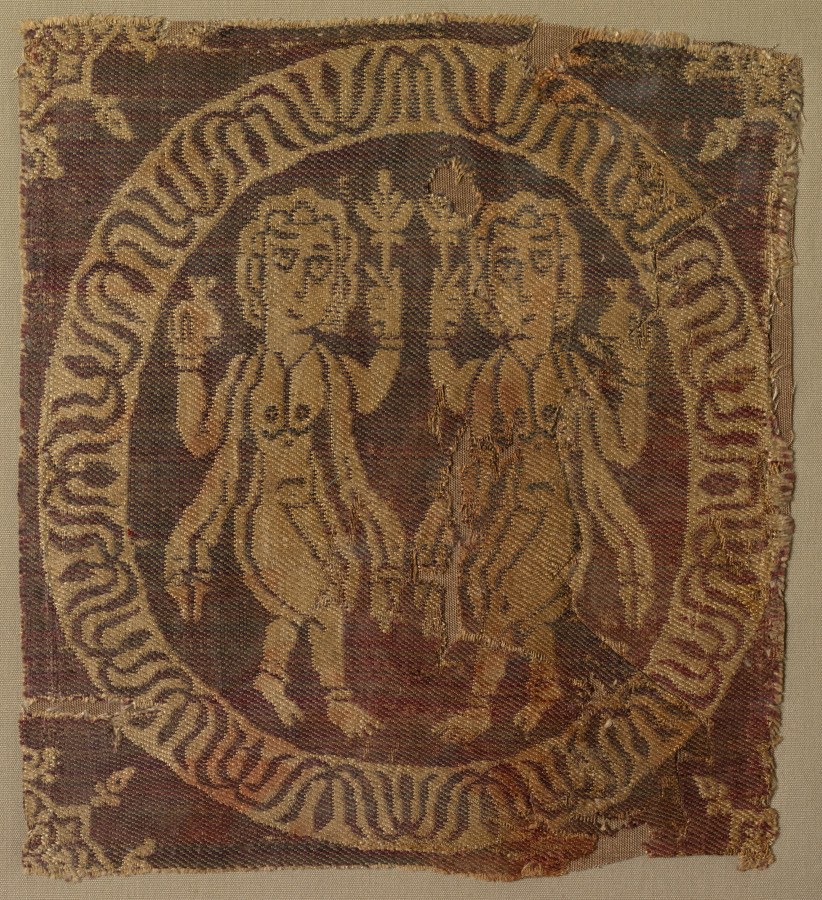
This is a fragmentary textile depicting two female figures rendered in a warm gold palette against a darker reddish-brown ground. The figures stand close together, facing forward, their bodies depicted with linear hatching that creates volume and definition. Both wear what appears to be classical or mythological dress—simple draped garments that fall to below the knee. The composition is framed by an ornamental border featuring a repeating wavy or undulating pattern in gold, characteristic of ancient or classical design. The textile itself shows significant age and wear; the edges are frayed and incomplete, and the weave is visible throughout, suggesting this is a fragment of a larger woven or embroidered work. The overall impression is of a classical subject treated with the technical sophistication of Roman or late antique textile work, though the current condition makes complete assessment difficult.
The dancing
The two figures stand in a relaxed, frontal pose with minimal spatial depth between them. Their bodies are rendered with parallel hatching lines that follow the contours of their forms, giving them a sculptural quality. The arms appear to hang naturally at their sides or rest across their bodies. There is no indication of active movement, partnering, or dynamic physical interaction between the figures—they are presented as static, observational subjects rather than performers captured mid-motion. The scale and proportions suggest mature female bodies rather than idealized dancers' frames.
The dance depicted
The title suggests these are dancers, but the image shows no clear evidence of dance movement or performance context. The figures are posed rather than captured in motion. If this does represent dancers, they are depicted in a moment of stillness rather than action—possibly during a pause or in a formal, structured dance tradition where standing posture and frontal presentation were central. The classical dress and formal composition suggest an ancient or classical dance tradition, possibly from Roman, Greek, or Etruscan contexts, but without additional context or inscription the specific dance form cannot be identified. The figures' passivity and the commemorative nature of the textile work against a dark ground suggests this may be a historical or mythological reference rather than a depiction of actual dance practice.
How it was made
This is a woven textile, likely produced through tapestry weaving or an embroidery technique, using metallic thread (gold or gilt) against a darker wool or silk ground. The linear hatching visible in the figures' rendering is characteristic of the way woven textiles create tonal variation through the density and direction of threads. The ornamental border employs a repeated geometric pattern typical of classical and late antique design. The fragmentation and wear suggest this is either a recovered archaeological textile or a historical piece that has survived centuries. The technical sophistication required—particularly the control of fine metallic thread and the precise rendering of human anatomy—indicates this was a costly, high-status object, likely created for a patron of substantial means.
About this work
This fragmentary woven textile depicts two female figures in classical dress, their bodies rendered in gold thread against a reddish-brown ground. Whether these figures represent mythological subjects, historical figures, or dancers proper is unclear from the image alone, though the formal compositional treatment and commemorative quality suggest a classical or late antique date. The textile preserves a moment of stillness rather than active movement, presenting the figures as subjects for contemplation rather than performers in motion. The work's survival as a fragment speaks to the fragility of textile-based art and its variable preservation in museum collections. It belongs in a dance-focused collection only if the figures are indeed dancers, but their formal pose and static presentation distinguish them from most dance documentation.
How to look at it
Begin with the ornamental border, which frames the scene and suggests this was a carefully composed, high-value object. Notice how the artist used linear hatching—the parallel lines running across the figures' bodies—to create the illusion of volume and cloth folds, a technique borrowed from engraving and printmaking but here rendered entirely in thread. Examine the figures' faces and hands, which are rendered with less detail than their bodies, a common classical convention. Finally, consider what the artist chose not to show: these figures are not in motion, not partnering with each other, not captured mid-gesture. The stillness is deliberate and carries meaning.
The period
The textile technique, the classical ornamental border, and the rendering style suggest a date somewhere in the late Roman, Byzantine, or early medieval period (roughly 2nd–8th centuries CE). During this era, textiles were among the most valuable and widely circulated artworks, serving both as functional objects and as vehicles for religious, mythological, and commemorative imagery. The depiction of female figures in formal dress reflects broader classical conventions that persisted across the Mediterranean world even as political and religious contexts shifted.
Where it lives
This work is held in the Cleveland Museum of Art as part of their textile and decorative arts collection. It is catalogued as coming from an unrecorded era and an unspecified source, with the museum's own record labeling it as 'General Dance.' The attribution to 'cma' likely refers to the museum itself as the source of this catalog entry.
Questions about this work
Are these women actually dancing?
The title identifies them as dancers, but the image shows them standing still, not moving. They may represent dancer-figures from mythology or history, or they may be depicted in a pose associated with a formal dance tradition where standing posture was central. Without additional documentation, their status as 'dancers' remains an assertion of the catalog rather than something clearly visible in the image itself.
How old is this textile?
The record does not provide a date. Based on the technique, materials, and ornamental style visible in the fragment, it likely dates to the late Roman, Byzantine, or early medieval period (roughly 2nd–8th centuries CE), but this is an estimate based on visual analysis alone. Conservators and textile historians at the Cleveland Museum of Art would have more precise information.
Is this a complete artwork or a fragment?
It is clearly a fragment. The edges are ragged and incomplete, the weave is visible and worn, and the composition appears to have been cut or has survived only in part. This was once part of a larger textile, and what we see now is what remained after centuries of handling, storage, and deterioration.
What technique was used to make this?
This is woven textile, most likely a tapestry or embroidery using metallic thread (gold or gilt) on a wool or silk base. The gold figures and borders were created by arranging and interlacing fine threads, not by painting or embroidering onto a finished surface. This labor-intensive process made such textiles extremely valuable.
More dance artwork