49 works in this view — arrow keys or swipe to move between them.
Dance in Art
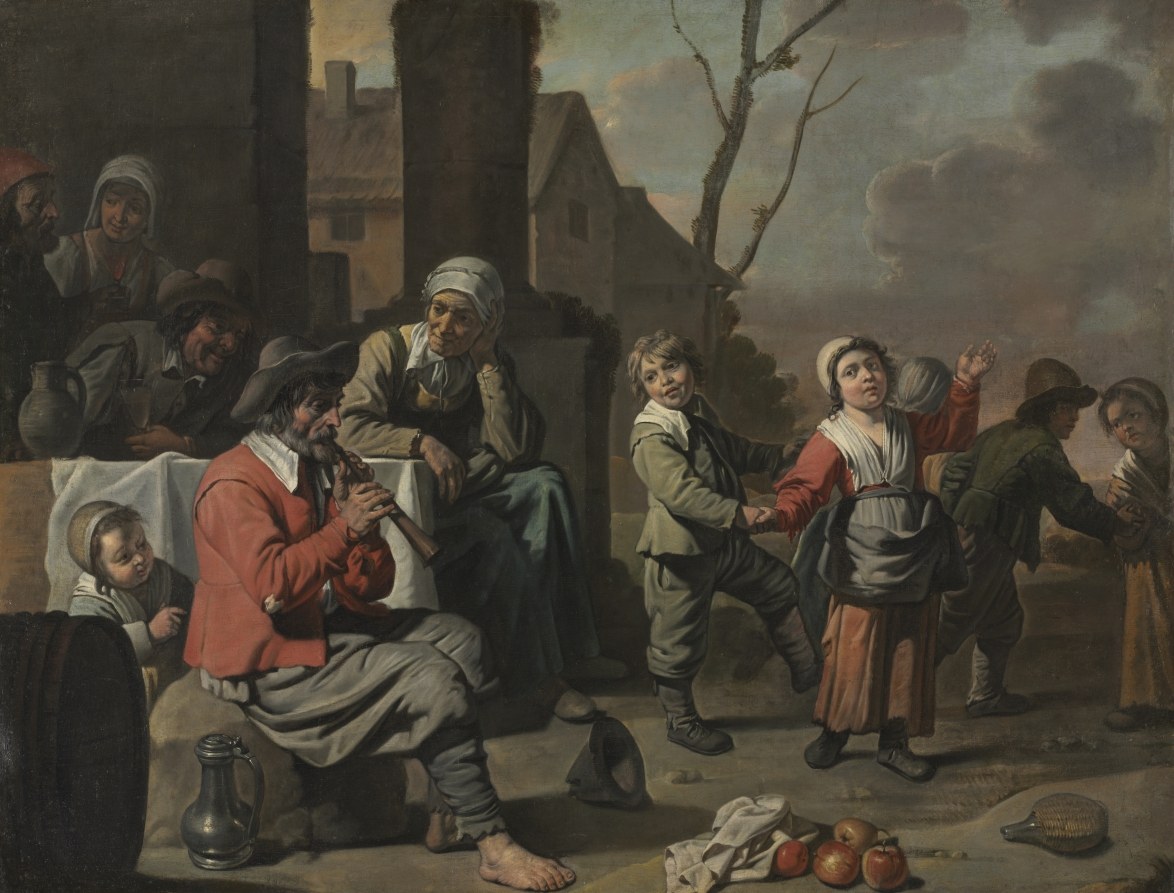
Peasant Children Dancing
Le Nain (French)
- Source:
- Cleveland Museum of Art
- Rights:
- Public domain — free to use, share and adapt.
- Recorded as:
- CC0 (Public Domain)
This painting is one of the few surviving visual records of how peasant children actually moved and danced in the early modern period, unconstrained by courtly etiquette or dance masters' rules. It shows us folk dance as lived practice rather than as codified steps, and it reveals the centrality of music and community witness to social dancing in village life. For historians of dance, gender, and childhood, the image offers concrete evidence about movement, play, and social organization in pre-industrial Europe.
What you are looking at
A village scene in what appears to be northern Europe, possibly the Dutch or Flemish lands, shows a group of peasant children dancing outdoors in a dirt square before modest stone buildings. The composition is crowded and lively: a central group of three or four children move in the middle ground, while seated adults and standing onlookers ring them. The light is cool and overcast, with heavy cloud above. In the foreground, a man in a rust-red jacket sits on a bench beside a woman and small child; he holds a pipe or musical instrument to his mouth. Scattered on the ground near them are apples and a woven basket. Behind the dancing children, more figures cluster—women in white linen head-coverings, men in earth tones, and other children at various distances. The architecture is humble: steep-roofed farmhouses with small windows, one bare tree visible at right. The overall mood is observational rather than romantic—this is a record of how children of the poor actually moved and played, not an idealized vision.
The dancing
The dancers themselves are small and spread across the canvas. Two or three children in the middle distance appear to be moving with raised arms and bent knees in a hopping or skipping motion; one wears a greenish jacket, another tan or cream. Their posture is loose and undisciplined compared to court dance—no closed holds, no formal frame, no symmetry. A boy in the center-right gestures with one arm lifted. The watching adults are seated on benches or standing in clusters, their own bodies at rest, forming a natural frame for the activity. The man with the pipe dominates the foreground, positioned as the musician and social anchor of the scene.
The dance depicted
This appears to be a peasant or village round dance or reel of northern Europe, likely 17th-century Dutch or Flemish. The children's loose, bouncy movements and raised arms suggest a social dance learned by imitation and tradition rather than instruction—the kind danced at village gatherings, fairs, or seasonal celebrations. The presence of a musician (the pipe player) indicates music was live and integral. No specific named dance is identifiable from the footwork or formation, but the energy and informality point to folk tradition: possibly an ancestor of the Dutch 'dans' or Flemish village reel. What makes this image valuable is that it captures children dancing without pretense—their bent knees, high spirits, and lack of any courtly refinement—offering a glimpse into how the lower classes actually danced, not how they were *expected* to dance.
How it was made
This is an oil painting, evidenced by the handling of light and shadow, the opacity of pigment, and the fluid brushwork particularly visible in the sky and distant architecture. The painting technique allows for the subtle modeling of fabric (the white linens catch light realistically), the depth of field from foreground figures to distant buildings, and the warm-cool color relationships that give the scene naturalism. Oil was the medium of serious artistic investigation in the 17th century, signaling that this village scene was not a casual sketch but a considered composition worthy of the painter's sustained effort. The medium also implies this was likely a commissioned work or a painting made for a patron who valued genre scenes of rural life—a growing market in the Dutch Golden Age.
About this work
This is a peasant genre painting of the 17th century, most likely Flemish or Dutch, that documents children dancing at a village gathering. The artist has positioned the viewer as a careful observer of rural life, showing us the actual bodies and expressions of poor children at play, the musician who accompanies them, and the adults who watch. The painting belongs in a collection of dance in art because it provides rare visual evidence of how ordinary people—those below the level of courtly or elite society—actually danced. It is not a dance instruction manual or a celebration of refined technique; it is a record of social practice, of childhood, of music-making and movement in a community setting.
The work sits at the intersection of social observation and artistic ambition. The painter has taken a subject that might have seemed marginal—children dancing in mud before farmhouses—and rendered it with the care and technique normally reserved for religious narrative, portraiture, or history painting. This signals a shift in how European art valued the lives of ordinary people, even as it maintained clear hierarchies of subject matter. For dancers and historians, the image is invaluable because it shows us folk movement in its original context, unmarked by later romanticism or stage conventions.
How to look at it
Notice first the positioning of the musician in the foreground left—he is the still center from which the children's motion radiates. Watch how the artist has painted the children's bodies in mid-movement: bent knees, arms raised, one foot leaving the ground. There is no perfect symmetry, no turnout, no careful spacing. Look at the faces of the watching adults, which show concentration and pleasure rather than judgment. The composition pulls your eye into the crowd, mixing dancers, musicians, and witnesses so that you understand this was a communal act, not a performance for an outside gaze. The cool northern light and the humble architecture are essential—this is not a fairytale village but a real one, economically and visually poor. The painting is asking you to attend to the movement and joy of children who have no dance teacher.
The period
This work was painted at a time when northern European artists, particularly in the Dutch Golden Age and in Flanders, were developing a new interest in the lives of peasants and the rural poor. Artists like David Teniers the Younger, Adriaen Brouwer, and Jan Steen were creating large bodies of work depicting kermesse (village fair) scenes, peasant dances, and rural gathering. These paintings reflected both a genuine curiosity about how others lived and a satirical or moralistic stance toward peasant behavior—the lower classes were often depicted as crude, drunken, lustful, but also energetic and vital. Concurrently, the codification of court dance was reaching its height in the baroque period; the contrast between the formal, controlled movement of the aristocracy and the uninhibited motion of peasant children would have been stark and deliberate. This painting documents that contrast.
Where it lives
The work is held in the Cleveland Museum of Art and is recorded in their collection as a genre scene of unknown artist and date. The museum's classification as 'dance-related art' suggests its entry into their collection was deliberate, though the original acquisition details are not included in the available record.
Dance in this work
Questions about this work
Who is the musician in the foreground?
We cannot identify him from the painting alone, but his position and instrument (likely a pipe or simple wind instrument) mark him as essential to the scene—he is the source of the music that drives the children's movement. In peasant communities, musicians were often semi-professional or part-time, drawn from the village itself. His prominent placement suggests the artist understood that music and dance were inseparable.
What is the dance being performed?
We cannot name it with certainty. The loose, hopping movement and raised arms suggest a round dance, reel, or other participatory social dance common in northern Europe. Children would have learned it by watching and imitating, not from instruction. It belongs to the tradition of folk or village dance, distinct from the courtly dances documented in contemporary dance manuals.
When and where was this painted?
The style, costume, and architecture suggest northern Europe (probably the Dutch or Flemish lands) in the 17th century, but neither date nor artist is recorded. The painting's provenance and technical characteristics would be needed to narrow this further. The Cleveland Museum of Art may hold archival information not included in this description.
What do the scattered apples and basket tell us?
They suggest this gathering may have coincided with harvest season or a village fair, when food was available and celebration natural. Kermesse paintings often show eating, drinking, and dancing together as part of seasonal festivity. The humble food also emphasizes the poverty of the setting—these are the resources of working peasants.
More dance artwork