49 works in this view — arrow keys or swipe to move between them.
Dance in Art
Peasant Couple Dancing
Albrecht Dürer (German, 1471–1528)
- Source:
- Cleveland Museum of Art
- Rights:
- Public domain — free to use, share and adapt.
- Recorded as:
- CC0 (Public Domain)
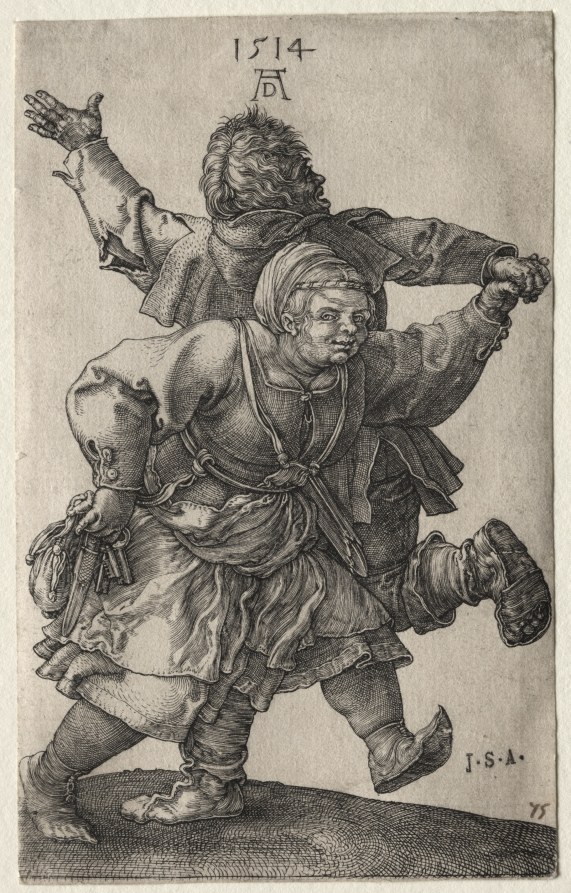
This engraving is evidence that early 16th-century artists recognized peasant dance as a subject worthy of skilled representation. It captures a moment before the formalization and codification of social dance, showing bodies in motion with a directness and physicality that court dance images rarely permit. For historians of dance, it documents the energy, embrace, and dynamic quality of non-courtly movement at a specific historical moment.
What you are looking at
Two figures dance together in a vigorous, uninhibited pose against a plain background. The figure at left is a young man in dark breeches, a light shirt, and a short dark jacket, his body arched backward with his weight thrown into the movement. The figure at right—positioned higher and slightly behind—is a woman or youth in a long gathered skirt, her upper body leaning forward dynamically. Both figures have their arms raised and extended; the man's left arm reaches upward while the woman's arms splay outward. The woman wears a head covering typical of early 16th-century dress. The composition captures a moment of energy and abandon rather than courtly restraint. The engraving is dated 1514 in the upper margin, with what appears to be a monogram (ISA) in the lower right.
The dancing
The two dancers are locked in close proximity but not in a formal ballroom hold. The man's body is dramatically arched, his weight on his back leg, his raised arm suggesting a lifting or swinging motion. The woman leans forward into the space between them, her arms raised and spread rather than contained. Neither figure maintains the rigid spine or controlled frame of Renaissance court dance; instead, both show flexible spines and a sense of weightedness and momentum. The composition suggests vigorous, weight-sharing movement rather than the geometric precision of formal choreography.
The dance depicted
This appears to depict a peasant or folk dance rather than courtly dance. The title specifies a peasant couple, and the energy, dress, and movement quality all support this reading. The man's arched back and the woman's forward lean suggest a swinging or turning figure—possibly a volta-like movement or a rustic variant of turning dances that were popular across Europe in the early 16th century. The relaxed embrace and the upward thrust of the arms are consistent with celebratory, participatory dance rather than the measured steps of a minuet or pavan. This is a record of how ordinary people danced, not how courtiers did.
How it was made
This is an engraving, executed with fine parallel lines and cross-hatching to model form and create tone. The technique allows crisp detail in the costume and anatomical clarity while maintaining a sense of movement through the dynamic line of the bodies and the energy of the marks themselves. The date 1514 and monogram suggest a German or Northern European workshop—possibly that of Albrecht Dürer or a contemporary printmaker. Engravings of this kind circulated widely in the early 16th century, reaching a literate and educated audience interested in ethnographic or genre subjects.
About this work
This is an early 16th-century engraving of two peasants in vigorous dance, dated 1514. It documents folk movement at a moment when artists and scholars were becoming interested in capturing the customs and behaviors of ordinary people. The couple's energetic, uninhibited poses and close embrace contrast sharply with the formal restraint of contemporary court dance, offering a rare image of how dancing bodies actually moved outside aristocratic settings. The engraving's circulation and technical accomplishment suggest that peasant dance held sufficient cultural interest to warrant preservation and distribution among the educated and collecting public.
How to look at it
Notice the dramatic backward arch of the man's body and the forward lean of the woman's torso—this is not the upright carriage of court dance but a more abandoned, weight-sharing posture. The raised arms and the proximity of the bodies suggest a swinging or circling movement. The artist has frozen the moment not at a moment of repose but at a peak of energy, capturing the sense of motion through the tilt and extension of both figures. The engraving technique itself—the confident line and the modeling of muscle and cloth—conveys the artist's engagement with anatomical truthfulness and movement.
The artist
The monogram ISA has not been definitively identified. The technical skill, date, and style suggest a trained printmaker working in the Northern European tradition of the early 16th century, possibly German. The subject—genre or ethnographic study—fits with the broader Renaissance interest in documenting human behavior and costume across social classes. Without secure attribution, we can say only that this is the work of a skilled engraver engaged with observational printmaking.
The period
In the early 16th century, Renaissance artists and scholars were beginning to document the lives and customs of people outside the elite. At the same time, courtly dance was becoming increasingly formalized and codified—the pavan and galliard were emerging as the dominant court dances. This engraving sits at the intersection of those currents: it shows folk movement at a moment when such movement was being recorded and preserved precisely because it was seen as distinct from, and perhaps endangered by, the spread of courtly forms. Peasant celebrations, market dances, and festive gatherings were lively subjects for printmakers, offering a contrast to the measured sophistication of the court.
Where it lives
The work is held in the Cleveland Museum of Art and is part of their dance-related art collection. It is catalogued as an artwork from the museum's holdings, though the current location, accession number, and medium specifications are not recorded in the available documentation.
Dance in this work
Questions about this work
Is this a specific named dance?
The title identifies it only as a peasant dance. The swinging posture and upward arm movement suggest it could be a volta-like turning dance or a village celebration dance, but the engraving does not carry enough detail to identify a specific choreography or regional tradition. What it shows is the energy and freedom of movement characteristic of folk celebration.
Why does the woman's body position look so unusual?
Her forward lean and the way her weight is shared with the man's arched back suggest a partnered swinging or turning movement in which both dancers' bodies are engaged dynamically. This is very different from the formal, upright posture of a court dance, where the woman would maintain a contained frame. Here she is an active participant in a vigorous motion.
How do we know this is from 1514?
The date 1514 is inscribed in the upper margin of the engraving itself. This precision dates it to the early 16th century, making it one of the earliest surviving images of folk dance movement.
What does the monogram ISA mean?
The initials ISA appear in the lower right corner, a common way for printmakers to sign their work. The artist has not been securely identified, so ISA remains a mark rather than a known name.
More dance artwork