49 works in this view — arrow keys or swipe to move between them.
Dance in Art
Piping and Dancing Satyr
Unknown artist
- Source:
- Cleveland Museum of Art
- Rights:
- Public domain — free to use, share and adapt.
- Recorded as:
- CC0 (Public Domain)
The satyr dancing is a fundamental image in Western art history's engagement with the classical world and with the idea of uninhibited bodily movement. For dancers and choreographers, it represents an alternative lineage to courtly or theatrical dance—a visual archive of how European culture imagined and valued ecstatic, instinctual, or possessed movement. The image also documents the continuity of satyr imagery across centuries and media, from ancient coins and vases through Renaissance and Baroque sculpture to modern practice.
What you are looking at
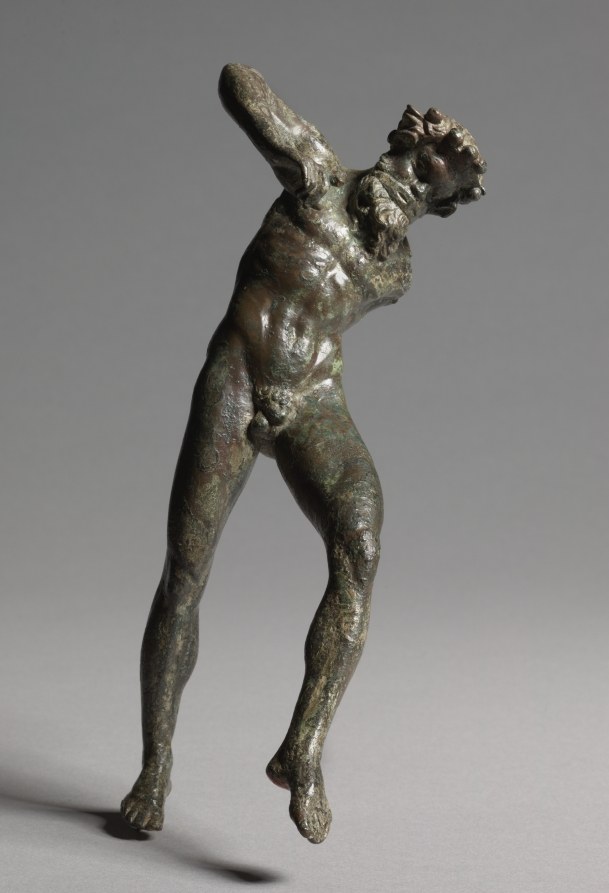
A bronze statuette of a bearded male figure in dynamic motion, captured mid-leap or exuberant gesture. The figure stands on both feet with one leg extended and the torso twisted upward in a spiraling movement. His left arm stretches overhead while his right arm bends at the elbow. His head tilts back, and his long beard flows downward. The figure appears nude or lightly draped, with defined musculature throughout the body. The bronze has a rich patina with areas of darker corrosion and lighter wear, suggesting considerable age. The figure's pose conveys uninhibited joy and abandon—a moment of ecstatic celebration rather than measured or formal dance.
The dancing
A single male figure in a state of vigorous, almost convulsive movement. His weight appears distributed across both feet, but the torso is sharply arched backward and twisted, creating a sense of upward propulsion. The raised left arm follows the line of the spine; the right elbow is bent close to the body. The head is thrown back with the face and beard lifted. The overall frame is asymmetrical and open, with no closed holds or partner contact—a solo figure in ecstatic motion rather than in a constructed dance frame.
The dance depicted
This represents a satyr—a mythological creature associated with uncontrolled revelry, wine, music, and fertility rites in ancient Greek and Roman tradition. The work depicts the satyr engaged in frenzied or orgiastic dancing, likely as part of Bacchic or Dionysian celebration, themes central to satyr iconography from antiquity onward. The sculptural tradition of satyrs playing musical instruments and dancing in states of intoxication or possession was revived extensively during the Renaissance and continued through later European art. The open, twisting posture and backward-thrown head suggest ecstatic movement rather than any codified dance form—the physical language of divine possession or wine-fueled abandon rather than learned choreography.
How it was made
This is a bronze statuette, almost certainly cast by the lost-wax process typical of Renaissance and post-Renaissance sculptural practice. The medium allowed the artist to capture dynamic pose and flowing detail—the articulation of the beard, musculature, and the torsion of the trunk—with precision. Bronze's durability and prestige made it the preferred material for such works among collectors and in court and ecclesiastical contexts. The patina visible here—dark areas and lighter wear—is consistent with age and centuries of handling, cleaning, or burial.
About this work
This bronze statuette depicts a satyr in ecstatic, bacchic dancing—a theme with roots in ancient Greek and Roman art and revived extensively during the Renaissance as artists engaged with classical antiquity. The work belongs to a continuous tradition of representing satyrs as embodiments of uninhibited movement, music, and festive liberation from social constraint. Satyrs dancing or piping appear frequently in Renaissance and Baroque decorative arts, garden sculpture, and courtly spectacle, where they symbolized the power of music and dance to move the body beyond conscious will.
The figure's frenzied posture—the arched spine, thrown-back head, and raised arms—represents movement as ecstasis rather than as learned skill or courtly decorum. For historians of dance, this image documents how Renaissance and later European artists understood ancient festival dance and how they used the satyr as a figure through which to explore movement as possession, pleasure, and release. The work is part of a visual conversation about what bodies can do when freed from social restraint.
How to look at it
Attend to the moment of peak energy the sculptor has chosen: not the beginning or end of a movement, but the instant of maximum torsion and lift. Notice how the entire body participates in the upward spiral—the legs rooted but the spine, ribs, and head all twisted and raised. The backward tilt of the head and face is crucial; it conveys loss of conscious control, abandonment to the force of music or intoxication. Compare this openness and asymmetry with the closed holds and bilateral symmetry of courtly or formal dance in Renaissance art.
The period
The satyr as a dancing, piping figure became a dominant motif in European visual culture during the Renaissance, when increased access to classical texts and artifacts prompted artists to study and reimagine ancient Greek and Roman subjects. During the 16th through 18th centuries, satyrs appeared in prints, sculptures, paintings, and decorative arts across Europe—in garden grottoes, on fountains, in woodcuts and engravings, and as marginal or supporting figures in larger mythological scenes. The figure embodied Renaissance and Baroque interest in classical learning, in the representation of the body in movement, and in the symbolic and aesthetic power of music and dance. Satyrs were also figures of transgression and license, making them useful for exploring the boundaries of decorum in visual representation.
Where it lives
The work is held in the collection of the Cleveland Museum of Art and is recorded in their database as part of the museum's holdings of dance-related art. No other details of provenance, acquisition, or previous ownership are recorded in the available catalogue entry.
Dance in this work
Questions about this work
What is a satyr and why do artists depict it dancing?
A satyr is a mythological creature from Greek and Roman tradition—part human, part animal, associated with wine, music, fertility, and wild celebration in the retinue of Dionysus (Bacchus in Roman tradition). Artists depict satyrs dancing because the combination of the figure and the movement carries symbolic meaning: the satyr represents the body's capacity for uncontrolled pleasure, ecstasy, and response to music. Dance is the perfect expression of satyr nature.
Is this a satyr or a faun? What is the difference?
The terms are often used interchangeably in post-classical European art, but strictly, a satyr is Greek and usually depicted with equine features (pointed ears, sometimes a tail), while a faun is the Roman equivalent and may appear more human. This figure's beard and human physique suggest faun, though the catalogue uses satyr. The distinction matters less for understanding the work than recognizing the classical tradition it engages.
When was this made? The catalogue says 'unknown era.'
The catalogue does not record a date or artist. The style and patina are consistent with Renaissance or later European bronze work (16th–18th century), and the subject was popular throughout that period. Without scientific analysis or documentation, the precise dating cannot be determined from the image alone.
What dance is the satyr doing?
No specific dance form is depicted. Instead, the sculptor represents ecstatic or bacchic movement—the kind of frenzied, possessed dancing imagined as part of satyr and Dionysian festivals in classical antiquity. The pose communicates abandon, pleasure, and loss of controlled form rather than steps or figures from any recognized dance system.
More dance artwork