49 works in this view — arrow keys or swipe to move between them.
Dance in Art
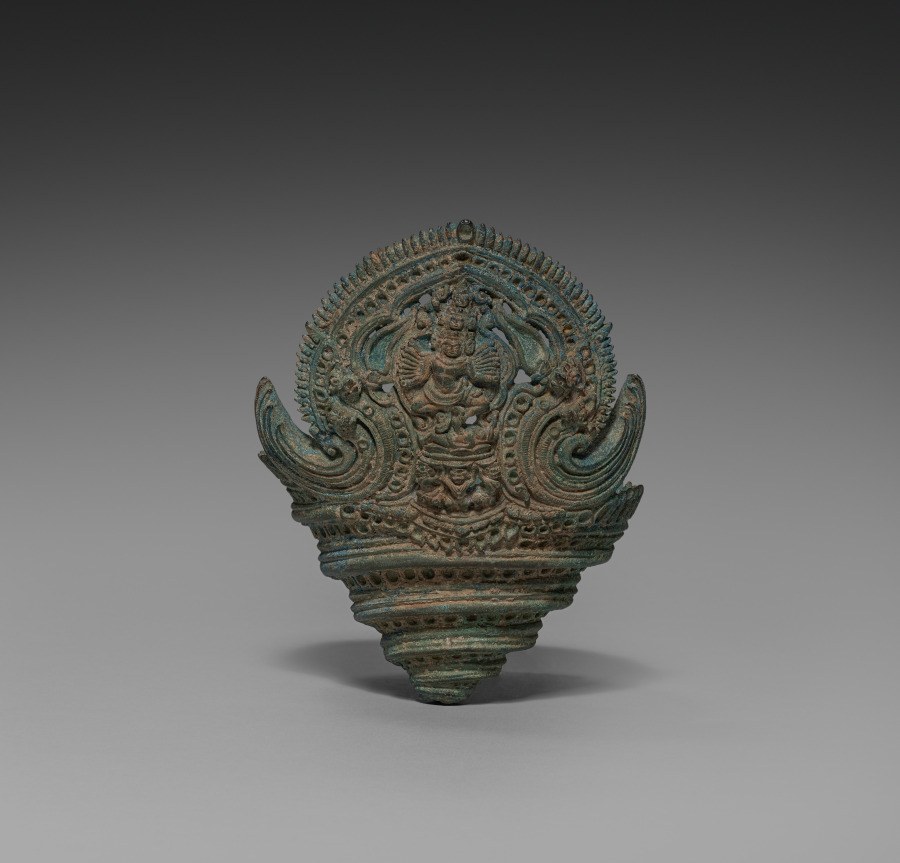
Ritual conch shell base with dancing Hevajra
Unknown artist
- Source:
- Cleveland Museum of Art
- Rights:
- Public domain — free to use, share and adapt.
- Recorded as:
- CC0 (Public Domain)
This object demonstrates that 'dance' in non-Western and sacred contexts often refers to cosmic or spiritual action rather than human-performed steps. Understanding these differing frameworks is essential for dance historians working across global and cross-cultural archives, where the same word may describe very different phenomena.
What you are looking at
This is a bronze finial or architectural ornament in the form of a richly decorated crown, likely from a Southeast Asian temple or ritual object. The base is a flared, stepped vessel form cast in bronze with a pronounced patina of green and brown oxidation. Rising from this foundation is an elaborate tiered crown composed of a broad band of repeating decorative elements—possibly stylized leaves or petals—surrounding a central narrative scene. At the apex sits a figure in high relief, identifiable by characteristic iconographic elements as Hevajra, a wrathful tantric deity from Buddhist practice. The figure is adorned with ornamental details, and flanking the deity on either side are curving, wing-like or ear-like extensions rendered in bold, organic forms. The entire piece is conceived as a three-dimensional sculptural object meant to be viewed from multiple angles, with meticulous surface detailing throughout.
The dancing
The central figure of Hevajra exhibits the formal, frontal pose typical of tantric Buddhist iconography rather than naturalistic human anatomy. The deity is seated or standing in a commanding posture, with ornamental attributes and dress indicated through raised patterns and relief work. The two curved extensions flanking the figure—possibly representing stylized ears, flames, or symbolic appendages—suggest a vertical axis and imply a contained, symmetrical composition rather than a depiction of movement or dance steps. The work does not show articulated limbs captured mid-motion, but rather a ceremonial or emblematic presentation of form.
The dance depicted
The title identifies Hevajra as dancing, but the object's function and form suggest ritual or ceremonial significance rather than the representation of actual dance movement. Hevajra is a wrathful deity in Tibetan and Himalayan Buddhist tantra, associated with enlightenment through controlled chaos and cosmic force. In tantric practice, 'dance' is often a metaphorical or symbolic concept—describing the deity's dynamic interaction with the phenomenal world rather than literal steps or partnered movement. This finial likely crowned a ritual vessel or architectural element in a temple context, where the presence of the deity and its spiritual energy were invoked through the object itself. The work depicts divine presence rather than human dancers performing a recognizable dance form.
How it was made
This is a lost-wax cast bronze object, a technique that allowed for the creation of complex three-dimensional forms with fine surface detail. The casting method enabled the artist to render both bold sculptural masses—the flared base and architectural forms—and intricate linear patterns throughout the decoration. The visible patina, ranging from green to brown oxidation, indicates age and exposure to the elements, consistent with an object that served an outdoor or exposed ritual function. The technique's widespread use across Asian metalworking traditions made such pieces accessible as votive or institutional objects rather than elite commissions alone.
About this work
This bronze crown finial represents a category of Asian ritual metalwork whose primary function was ceremonial or architectural rather than representational of dance as a performed art. The object belongs to a broader tradition of tantric Buddhist art, in which divine figures are represented through standardized iconographic conventions rather than naturalistic anatomy or captured motion. While titled as depicting 'dancing Hevajra,' the work speaks to a different concept of dance—one embedded in theological and philosophical systems where movement symbolizes cosmic force, transformation, and enlightenment rather than choreography or bodily performance.
The piece is significant for scholars of Asian material culture, ritual practices, and the visual language of tantric Buddhism. For dance historians specifically, it offers a case study in how the concept of 'dance' extends far beyond the Western theatrical tradition into sacred and metaphysical domains where it becomes a vehicle for expressing divine attributes and transcendent power.
How to look at it
Approach this object not as a study of dance movement, but as a visual invocation of divine presence. The symmetry and formality of the composition—the central figure flanked by matching extensions—create a sense of cosmic order and stability rather than the dynamism of performance. The layered decorative surface speaks to the tantric principle of complexity and multiplicity within unity. The object's material—cast bronze, enduring and precious—signals the permanence and power attributed to the deity it represents.
The period
This object reflects the sustained practice of tantric Buddhism across the Himalayan region and Southeast Asia, likely dating to a period when such ritual metalwork was central to temple practice and devotional life. Hevajra worship became particularly prominent in Tibetan Buddhism from the 11th century onward, and bronze ritual finials and vessels were produced across several centuries to furnish temples and monastic communities. The style and technique place the work within a long tradition of Asian metalworking that valued symbolic precision and spiritual efficacy over naturalistic representation.
Where it lives
The object is held by the Cleveland Museum of Art, as part of the museum's Asian art collection. No additional provenance details are recorded in the catalogue data.
Dance in this work
Questions about this work
Why is this called 'dancing Hevajra' if it does not show movement?
In tantric Buddhist theology, 'dance' describes the deity's dynamic engagement with cosmic forces and the phenomenal world—a spiritual rather than physical action. The deity's presence and power are invoked through the object itself, not through the representation of choreographed steps. Western art history traditionally associates 'dance' with recognizable human movement, but this framework does not apply to sacred iconography from non-Western traditions.
What is this object's function?
This is a finial—a crowning ornament that likely adorned the top of a ritual vessel, staff, or architectural element in a temple. Its primary purpose was to invoke the presence and blessing of Hevajra through the consecrated object, rather than to represent or commemorate a performed dance.
How do we identify Hevajra?
Hevajra is recognized through established iconographic conventions in Tibetan and Himalayan Buddhist art: the deity's formal frontal pose, ornamental attributes, and the characteristic crescent or wing-like forms flanking the central figure. These elements would have been immediately recognizable to practitioners in the tradition.
More dance artwork