49 works in this view — arrow keys or swipe to move between them.
Dance in Art
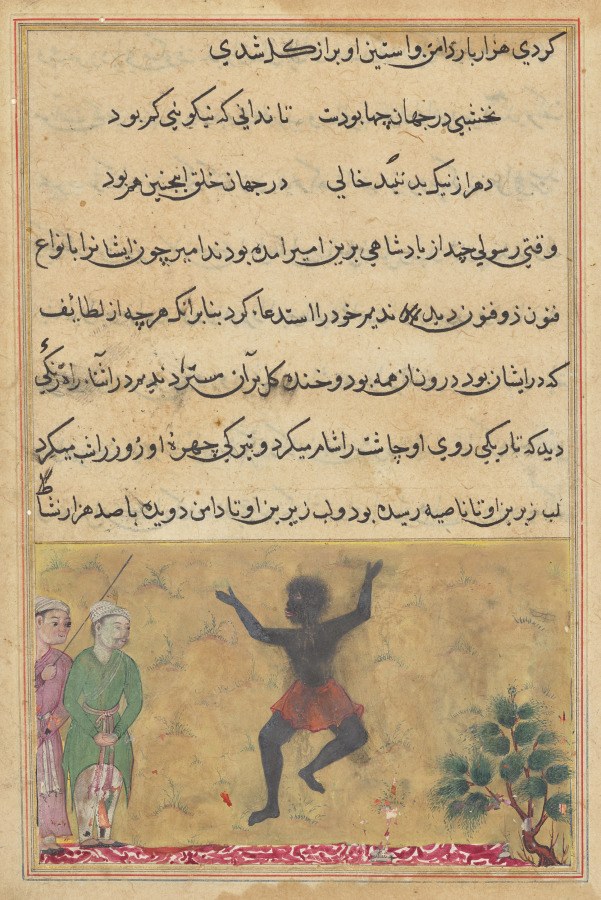
The court jester meets a Zangi dancing with joy and learns
Unknown artist
- Source:
- Cleveland Museum of Art
- Rights:
- Public domain — free to use, share and adapt.
- Recorded as:
- CC0 (Public Domain)
This image is rare evidence of how Islamic court artists depicted African performers and their movement vocabularies in the pre-modern period. It shows not a static type but a specific moment of cultural encounter and exchange—a jester learning from a dancer—and it renders the dancer's joy and physicality with genuine visual respect rather than caricature or reduction. For dance historians, it documents a real historical context (African performers in Safavid courts) and offers visual testimony to what kinds of movement were valued, remembered, and deemed worth illustrating in high-status manuscript tradition.
What you are looking at
This is a page from an illustrated Persian or Islamic manuscript, rendered in the characteristic style of Safavid-era painting. The composition divides into two distinct registers: an upper section of dense Persian calligraphy in black ink on a cream ground, and a lower figurative scene set against a pale ochre background with minimal landscape elements—a few leafy plants at the right margin.
The narrative moment shows three figures: a figure in green robes and a turban stands at left, facing rightward with one arm raised in apparent conversation or greeting; a second figure in pink or rose-toned dress stands just behind, partially obscured; and centrally, dominating the scene, is a figure with dark skin performing an exuberant dance. This central dancer wears a short red skirt or loincloth and is depicted mid-movement—arms spread wide in joy or celebration, the body in a deep squat or athletic crouch with legs bent. The pose conveys explosive energy and unrestrained happiness. A decorative border in red and gold frames the entire composition.
The dancing
The central dancer occupies most of the figural space and holds the viewer's attention entirely. The body is caught in a moment of maximum extension—arms splayed sideways at shoulder height, legs flexed beneath the torso, the spine arched and alive. This is not a formal trained posture; it reads as spontaneous, celebratory, full-bodied joy. The two standing figures are comparatively static and modestly dressed in the court robes of the era; they observe or react to the dancer with gestures that suggest surprise, delight, or instruction. The scale difference—the dancer's figure is larger and more centrally placed—suggests the artist understood this as a climactic or dominant moment in a narrative.
The dance depicted
The title indicates this scene depicts a court jester encountering a 'Zangi' dancer (a performer of Sub-Saharan African origin, a figure familiar in Safavid court contexts) and learning from the dancer's uninhibited movement. The dance shown is not a courtly or formal style, but rather something closer to what the text calls dancing 'with joy'—a vernacular or popular form emphasizing pleasure, vitality, and freedom of motion. The title suggests a didactic moment: the jester, a professional entertainer, is being schooled in spontaneity by someone outside the court hierarchy. The painting documents both a real social practice (the presence of African performers and dancers at Islamic courts) and a philosophical or artistic idea about joy and authenticity in movement.
How it was made
This is a page from an illuminated manuscript, executed in the Persian miniature tradition: opaque watercolor and gold leaf on paper. The artist worked at a very small scale (the entire page measures no more than 25 cm × 17 cm), using fine brushwork to establish the calligraphy above and build the figurative narrative below. The technique allowed for jewel-like color saturation—the reds, greens, and golds are vivid and unmuddied—and for the gold leaf to catch light in the borders and details. The flatness of the pictorial space and the absence of atmospheric perspective are conventions of the manuscript tradition; the focus is on pattern, line, and legible gesture rather than illusion. The format suggests this was created for private viewing by a royal or elite patron, and the integration of text and image was central to how medieval Islamic manuscripts conveyed meaning.
About this work
This is a page from a Persian manuscript, likely Safavid period (16th–17th century), that illustrates a narrative poem or prose text involving a court jester and an African dancer. The image documents both a social reality—the presence of Sub-Saharan African performers in Islamic court life—and an artistic interest in depicting movement and joy outside formal courtly conventions. The composition balances text and image in the manner of the Islamic manuscript tradition, where narrative is carried by word and picture together. The scene is intimate in scale but vivid and energetic in its rendering of the central figure's uninhibited motion, suggesting that the artist had observed such performance or at least understood it as a significant moment worthy of careful visual record.
How to look at it
Focus first on the central dancer's body: the artist has frozen a moment of maximum abandon—knees bent, arms wide, torso alive—that conveys kinetic joy without descent into comedy. Notice how the two standing figures, though smaller and more formally dressed, frame this moment of freedom; the composition implies a narrative of learning or exchange. Observe the use of color: the red of the dancer's garment stands out boldly against the pale ground, the greens and golds of the standing figures are cooler and more reserved. The manuscript page itself, with its border and its integration of text above, should be understood as a whole aesthetic object, not simply a transparent window onto a scene. The small scale and precise brushwork demand close looking.
The period
The Safavid dynasty (1501–1736) maintained elaborate court hierarchies that included entertainers of many origins, including African slaves and performers. Visual evidence from manuscript painting, ceramics, and other arts shows these figures were integrated into courtly life and performance contexts. By the 16th and 17th centuries, Persian poetry and prose often featured characters from diverse ethnic and social backgrounds, including African dancers and jesters, reflecting the actual cosmopolitanism of Safavid cities like Isfahan and Tabriz. In the broader history of Islamic art, the manuscript page was the premier vehicle for narrative illustration, and the integration of calligraphy and figuration was a defining aesthetic principle. The restraint and elegance of this painting—its avoidance of grotesquerie and its genuine attention to the dancer's movement—reflects the sophistication of court manuscript production.
Where it lives
This is catalogued as part of the Cleveland Museum of Art's collection and is documented in their dance-related art holdings. The record indicates it is from an Islamic manuscript tradition but does not specify the exact text, manuscript name, accession number, or current location status beyond the museum attribution.
Dance in this work
Questions about this work
What does 'Zangi' mean, and who were these dancers?
'Zangi' is an Arabic term referring to people of Sub-Saharan African origin. In the Safavid court context, Zangi dancers were enslaved or free performers of African descent who performed for royalty and the elite. They were valued for their musical and dance skills and were integrated into court life, though from a subordinate position. Visual and textual records show they were a recognized and named category of court entertainer.
Is this a real court scene or an imagined one?
It likely depicts a real social practice—encounters between court jesters and African dancers did occur in Safavid courts—but filtered through the conventions of manuscript illustration and narrative. The text indicates it is illustrating a literary narrative, so the specific scene (a jester 'learning' from a Zangi dancer) may be a didactic fiction. However, the plausibility of the encounter and the artist's attention to vivid detail suggest engagement with observed social reality rather than pure invention.
What does the dancer's posture tell us about how they actually danced?
The squat, wide-armed position conveys freedom of movement, polyrhythmic energy, and emotional expressiveness rather than formal line or restraint. It suggests a movement vocabulary that valued full-body engagement and visibility of joy, very different from the courtly composed postures of formal Persian dance. Whether this reflects an actual African performance tradition or a Safavid artist's interpretation of African dance cannot be determined from the image alone, but it shows that the artist understood joy in movement as embodied and exuberant.
Why would a manuscript illustrator spend such care on a dance scene?
In Islamic manuscript tradition, narrative scenes of human interaction and emotion were central to both literary and pictorial art. Dance, music, and festivity were valued subjects that allowed artists to display skill in depicting movement, costume, and emotion. A scene of learning or cultural encounter—implied by the title—was philosophically and artistically significant; the image serves both to illustrate the text and to validate the moment as worthy of visual record.
More dance artwork