49 works in this view — arrow keys or swipe to move between them.
Dance in Art
The Dance in the Inn
Adriaen van Ostade (Dutch, 1610–1684)
- Source:
- Cleveland Museum of Art
- Rights:
- Public domain — free to use, share and adapt.
- Recorded as:
- CC0 (Public Domain)
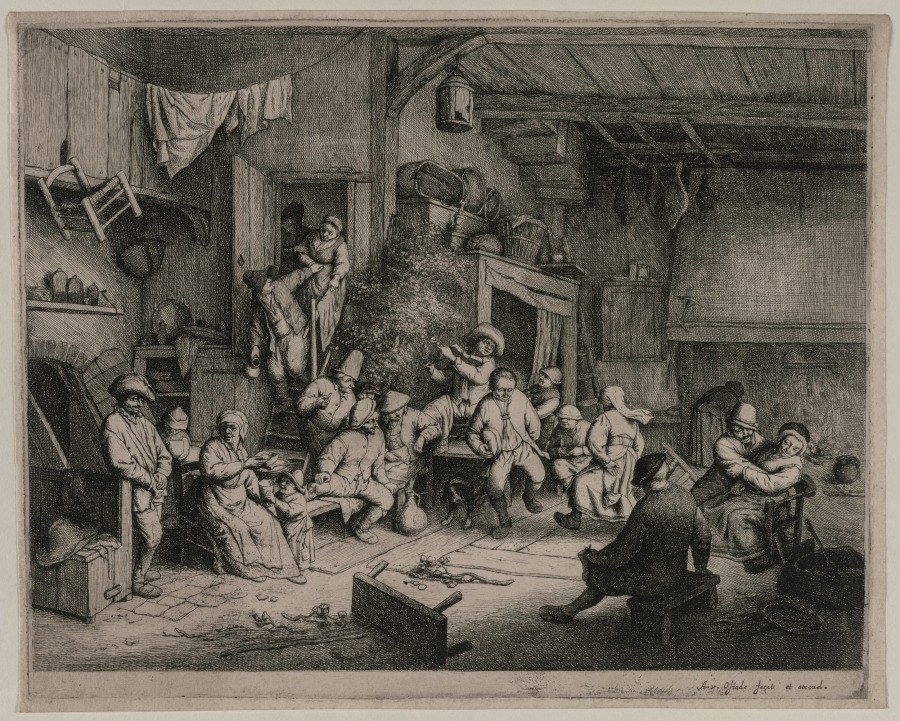
This engraving shows how artists of the early modern period visualized popular, non-courtly movement—the vocabulary of festival, celebration, and communal dancing as distinct from learned forms. For dance historians, it is evidence of how vernacular movement was valued and represented in visual culture, and what physical qualities (unleashed energy, individual expression, vertical space) artists associated with popular festivity.
What you are looking at
A crowded inn or tavern interior animated by dancing figures. The composition is densely packed with multiple nude or loosely draped putti (cherubs) and adult figures in various states of activity across a deep, timber-framed space lit from a high window. In the foreground, several cherubs dance or leap in energetic postures while adults—some seated, some standing—watch, play instruments, or participate. The setting has the disorder of a celebratory gathering: clothes hang drying from a line in the upper left, pottery and vessels clutter the lower corners, and the wooden beams and rough plaster suggest a working-class interior. The artist has rendered the scene with dramatic light and shadow through fine cross-hatching, creating a sense of movement and festive chaos. The foreground figures overlap in rapid succession, suggesting continuous action rather than a posed tableau.
The dancing
The dancers display varied, uninhibited postures: some cherubs leap vertically with arms raised, others twist or kneel. The movement is energetic and unschooled—bodies are not held in formal positions but appear caught mid-gesture with bent knees, loose limbs, and forward momentum. Several figures are partially nude, emphasizing the physical, unrestrained character of the dancing. Adult onlookers lean forward, reach, or sit at rest, creating a hierarchy of engagement. The overall impression is of folk or carnival dancing rather than court choreography: the gestures are joyous and individual rather than synchronized.
The dance depicted
This appears to be a representation of popular or festival dancing, possibly a village celebration or carnival gathering rather than formal dance. The style is vernacular and uninhibited—what would later be called folk dancing or popular revelry. The mix of nude mythological figures (putti) with clothed adults suggests this may be an allegorical or Bruegel-esque commentary on human festivity and excess. The absence of formal dance instruction, closed holds, or court protocol points toward communal celebration rather than a learned form. Without documentary evidence, the specific dance cannot be named, but the image documents the physical vocabulary of popular movement in this period.
How it was made
This is an engraving or etching, established by the fine parallel line-work (hatching and cross-hatching) that creates tone and depth without colour. The technique allowed for wide circulation via prints, reaching audiences far beyond the original artwork's location. The density of the line-work shows technical mastery—the artist has built complex spatial depth and a sense of light through controlled pressure and direction of the needle. The handling suggests a sixteenth or seventeenth-century Northern European printmaker, where such scenes of popular life and allegory were common subjects for reproductive prints.
About this work
This is a festive scene rendered as an engraving, depicting dancing and revelry in a crowded inn populated by cherubs and adults. The work belongs to a long tradition of prints and paintings representing popular celebration, human folly, and the energy of communal gathering—a tradition extending from Bruegel through to later Romantic imagery. It documents how uninhibited, joyous movement was understood and represented in popular imagery, and offers a stark visual counterpoint to the formal dance of courts and theatres documented elsewhere in the archive. The work was likely created for print circulation, making it accessible to a broad European audience interested in scenes of domestic life, allegory, and moral commentary.
How to look at it
Observe the variety of body positions and the density of overlapping figures—no two dancers occupy the same posture or hold. Notice how the artist has used the physical space of the inn to create layers of activity: the eye moves from the most energetic figures in the foreground (highest, most vertical) back to calmer, watching figures. The rendering technique (line and tone alone, no colour) focuses attention entirely on form, gesture, and the play of light—the artist is asking you to read movement through body shape and position rather than through costume or setting detail.
The period
The image dates stylistically to the sixteenth or seventeenth century, when Northern European printmakers—particularly in the Netherlands and German-speaking regions—produced thousands of scenes of popular life, moral allegory, and human folly. Bruegel and his successors had established the visual language for representing peasant celebrations, carnival, and communal dancing. In the same period, court dance was becoming increasingly formalized and codified: the contrast between this unschooled, joyous movement and the rigid geometry of court dances reflects a wider cultural divide between popular and elite movement practices.
Where it lives
The work is held in the Cleveland Museum of Art and is catalogued as part of the museum's collection of dance-related art. It is part of a widespread tradition of printed visual documentation of social and festive activity.
Dance in this work
Questions about this work
Who are the nude figures in the scene?
These are putti—cherubs or winged infant figures—a common motif in Renaissance and Northern Renaissance art, often used allegorically to represent human folly, desire, or festive abandon. Their nudity emphasizes the uninhibited nature of the celebration and the artwork's allegorical rather than documentary intent.
Is this engraving based on an observed scene, or is it imaginative?
Almost certainly imaginative: the presence of putti marks this as allegory rather than direct observation. However, the physical vocabulary of the dancing figures—the poses, energy, and lack of formal training—likely reflects real observation of popular celebration, even if the overall composition is fantastical.
What does the setting tell us about the social context of this dance?
The rough timber interior, hanging laundry, scattered vessels, and working-class figures mark this as a popular gathering space—an inn or tavern. This is not court or theatrical dance but communal celebration, suggesting these were dances of and for ordinary people rather than elite spectacle.
More dance artwork