49 works in this view — arrow keys or swipe to move between them.
Dance in Art
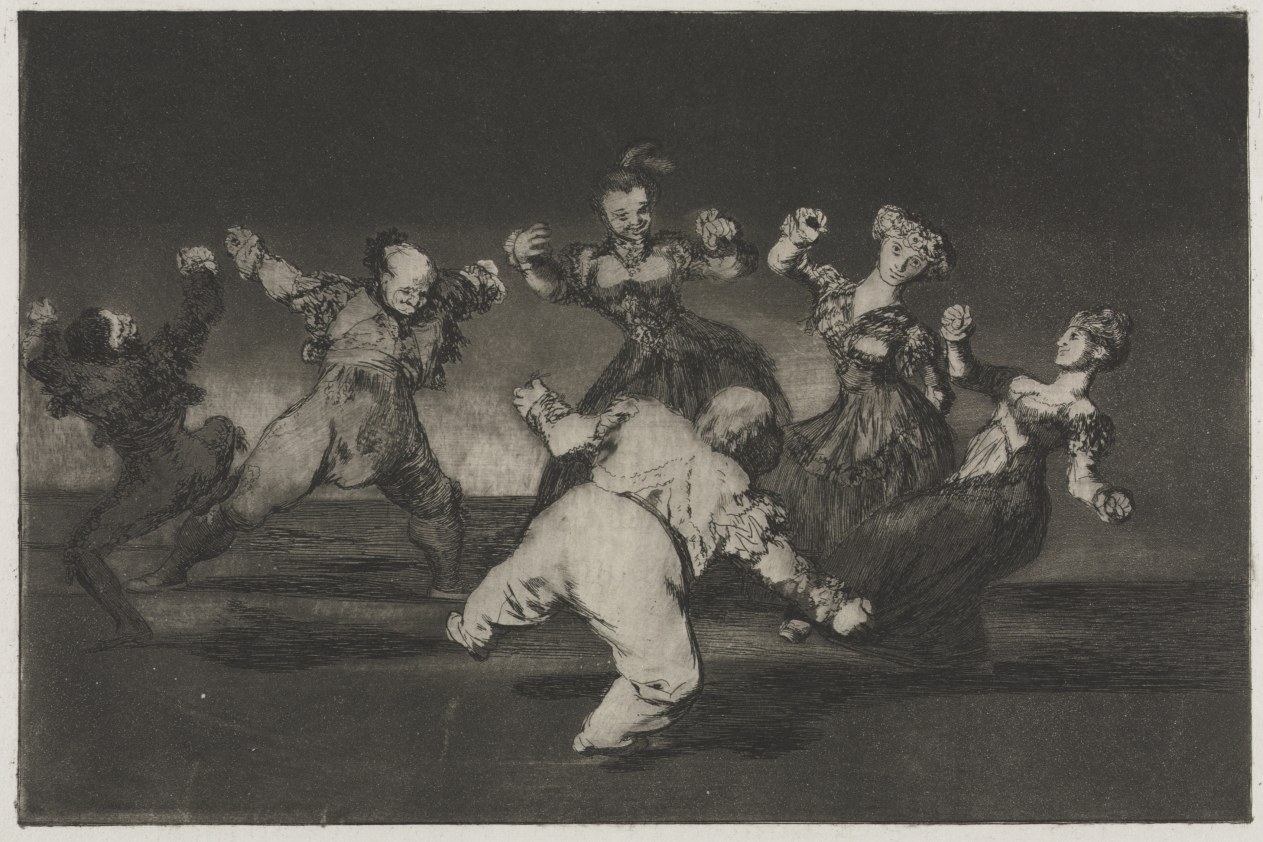
The Proverbs If Marion Will Dance Then She Has to Take th
Francisco de Goya (Spanish, 1746–1828)
- Source:
- Cleveland Museum of Art
- Rights:
- Public domain — free to use, share and adapt.
- Recorded as:
- CC0 (Public Domain)
This print reveals how dance imagery was weaponized in early modern Europe as a tool for moral censure and social satire. The title's explicit reference to Marion and dancing—and the grotesque postures and expressions the artist depicts—shows that 'dancing' and 'dancer' were coded terms for sexual promiscuity and female degradation, a semantic reality that shapes how we read historical depictions of women and dance. For anyone studying the gender politics of dance history or the role of printmaking in shaping social attitudes, this is documentary evidence of how the very act of depicting a woman dancing could be an act of vilification.
What you are looking at
A riotous nocturnal carnival or masquerade unfolds across a dark stage or floor. At least a dozen figures in elaborate costumes and masks occupy the composition—some standing, others crouched or in exaggerated postures. The costumes are richly detailed: feathered or furred garments, patterned silks, ornate headdresses. The lighting is theatrical, with figures emerging from shadow; the darkened background emphasizes the figures as if lit by candlelight or stage lamps. A central figure in the foreground crouches or bends forward in an ungainly pose, while others surround or tower over this figure. The overall mood is chaotic, satirical, and deliberately grotesque—this is not an orderly dance but a scene of revelry, mockery, or moral transgression. The composition spreads figures across the entire frame with no clear focal point, suggesting simultaneous action and disorder.
The dancing
The bodies are distorted and exaggerated, with no attention to formal dance posture or alignment. A prominent figure in the foreground is bent forward almost horizontally, buttocks prominent, in a posture of extreme debasement or lewdness. Surrounding figures lean, gesture wildly with arms raised, and adopt theatrical or mocking stances. There is no evidence of partnering in a ballroom sense; instead, figures orbit or cluster around the central degraded figure. The overall impression is of caricature and burlesque rather than trained dance—bodies are vehicles for satire, not vehicles for technical accomplishment.
The dance depicted
This is almost certainly a print illustrating a proverb or moral tale, likely a Spanish proverb about a woman named Marion who 'has to dance' (or 'pay for her dancing')—a euphemism for sexual degradation or public humiliation. The 'dance' depicted is not a social or theatrical dance but a carnivalesque spectacle of shame. The print appears to belong to a satirical tradition of depicting lower-class or disreputable social scenes. The movement is deliberately clownish and undignified, serving moral or comedic commentary rather than aesthetic display. This is dance as a vehicle for social critique, not as an art form to be admired.
How it was made
This is a dark engraving or etching, executed with fine cross-hatching and line-work that creates pronounced tonal variation and dramatic shadow. The technique is sophisticated and required considerable printmaking skill. The medium—works on paper suitable for reproduction and mass circulation—suggests this was created for a print market: viewers might encounter it in a portfolio, as a single sheet, or in a bound collection of satirical or moral engravings. The use of deep shadow and dramatic contrast is typical of Baroque-era printmaking and would have made the grotesque content viscerally striking to contemporary viewers.
About this work
This is a satirical or moralizing print depicting a scene of carnival transgression or sexual degradation disguised as dance. The title references a proverb (likely Spanish or Flemish, suggesting a northern European or Iberian context), and the composition—with its grotesque figures, theatrical lighting, and lack of any ordered movement—establishes that what is shown is not a dance in the courtly or theatrical sense but a spectacle of shame. The print belongs to a long tradition of genre engravings that used dance as a metaphor for social disorder, lust, or the degradation of women. Its presence in a dance art collection is justified by the title's explicit invocation of dance and by the fact that it represents how dance—or the appearance of dancing—functioned in early modern visual satire as a marker of moral transgression. The work documents not how people actually danced, but how printmakers used the imagery of dance to communicate social anxiety and moral judgment.
How to look at it
Attend first to the title and then to the postures: the exaggeration and disgust are intentional. The artist has chosen the moment of maximum indignity—not a moment of grace or virtuosity but of abasement. Note how the figures surrounding the central woman are not partners but an audience or a crowd, watching or egging on her degradation. The theatrical lighting and the careful rendering of costume and expression are techniques meant to make the scene vivid and memorable, more likely to lodge in the viewer's mind and shape their moral judgment. This is persuasive art, not descriptive art.
The period
This appears to be a Northern European engraving, likely from the 16th or 17th century, in the tradition of Flemish or Dutch satirical prints. The style and subject matter suggest familiarity with Bruegel-influenced scenes of peasant transgression and carnival excess. The print belongs to a rich vein of moralizing genre prints that circulated in the Netherlands, Germany, and Spain during the Renaissance and Baroque periods. Such prints often took the form of 'world upside down' imagery or proverb illustrations, in which disorder, lust, and female sexuality were depicted as threats to social order. The technical sophistication of the engraving and the circulation of prints through markets and collections meant that such imagery had wide cultural reach, reinforcing anxieties about dance, women, and social transgression.
Where it lives
The source is recorded as 'cma'—the Cleveland Museum of Art—which holds the work in its dance-related art collection. Beyond that attribution, no accession number, acquisition date, or prior provenance is recorded. The work is catalogued as being of unknown era and unknown artist, though the style and technique suggest a print-market work of the Renaissance or Baroque period.
Questions about this work
Is this actually a dance?
Not in any formal sense. The title invokes dance, and the postures are exaggerated and theatrical, but what is depicted is a carnivalesque scene of shame or transgression. The artist is using the imagery of dancing—the spectacle, the crowd, the undignified body—as a vehicle for moral satire. In early modern prints, 'dancing' often functioned as a metaphor for sexual or social disorder rather than as an actual representation of how people danced for pleasure or in courtly settings.
What does the proverb in the title mean?
The complete title seems to refer to a woman named Marion and a consequence of her dancing. The phrasing suggests that 'if Marion will dance, then she has to take th[e consequence]'—the consequence being shame, degradation, or sexual exposure. The proverb likely warned against female sexual license or public behaviour deemed improper. The print is an illustration of this moral lesson, making Marion's transgression visible and vivid.
Why is this in a dance art collection?
Because it documents a crucial historical reality: the way dance imagery functioned in early modern visual culture as a marker of transgression, especially female transgression. To understand the history of how dance has been depicted, valued, and moralized about, one must contend with images like this—images that show dance not as an aesthetic achievement but as a social threat. The print is a primary source for the gendered anxieties surrounding dance and the female body.
More dance artwork