26 works in this view — arrow keys or swipe to move between them.
Dance in Art
Hippodrome Polka.
Unknown artist
- Medium:
- Lithograph
- Dance:
- Polka
- Era:
- Late 1800s (Victorian Ballroom)
- Source:
- New York Public Library
- Rights:
- Public domain — free to use, share and adapt.
- Recorded as:
- public_domain
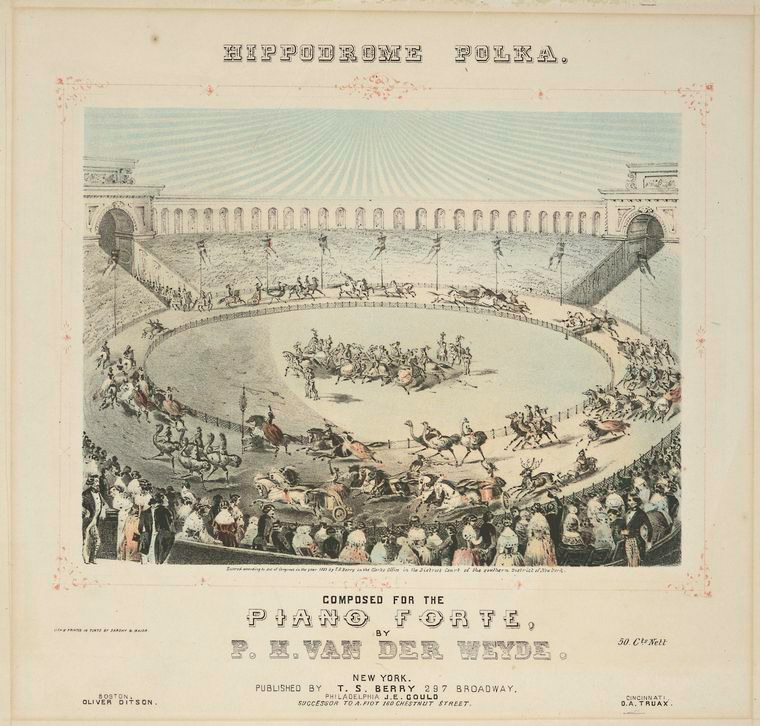
This work is vital evidence of the polka's dominance in Victorian popular culture and its migration from intimate ballroom to public spectacle. It shows dancers and viewers together, illustrating that 19th-century ballroom dance was fundamentally social and participatory, not a performance art to be watched in silence. The commercial context—as a music-cover lithograph—reveals the economic structures that made dance fashions profitable and reproducible.
What you are looking at
This lithograph depicts a densely populated hippodrome or circus arena during a polka performance, viewed from above as a bird's-eye composition. The oval arena is ringed with spectators in formal Victorian dress—men in top hats and coats, women in full skirts and bonnets—seated on tiered benches. The central performance space contains multiple groups of figures in motion: couples and individual dancers scattered across the sandy floor, some in closed ballroom positions, others standing or moving individually. A military or uniformed group occupies the center, suggesting this was a civic or ceremonial event. The architecture above shows a grand colonnade with regular arches stretching across the full width, and the sky is rendered in pale blue with radiating lines suggesting either daylight or theatrical illumination. The composition treats the entire scene as spectacle: the focus is as much on the watching crowd and the architectural frame as on the dancing itself.
The dancing
The dancers visible in the arena are generally in pairs, many in what appears to be closed ballroom position characteristic of the polka—the frame upright, partners facing one another. The movement suggested is light and springy rather than weighted; figures are shown in the quick, bouncing steps associated with polka rather than the sustained glide of a waltz. The scale of the figures relative to the huge arena makes precise foot and arm positions difficult to discern, but the silhouettes consistently show the upright carriage and quick cadence of the dance. Numerous single figures and standing groups suggest this was not a formal couple-dance competition but rather a public demonstration or carnival atmosphere.
The dance depicted
This is plainly a polka, identified in the title and confirmed by the formal Victorian-era dress, the ballroom setting, and the characteristic quick-stepping figures. The polka emerged in the 1840s and became a dominant social dance by the 1860s–1880s; this lithograph depicts it in what appears to be a public or semi-public venue—a hippodrome or large circus space—rather than a ballroom. The composition suggests this was a spectacle event, possibly a promotional performance or civic celebration. The fact that it was published as sheet music cover art (see publication details below) indicates the polka's status as a commercially exploited dance; the title "Hippodrome Polka" may commemorate a specific performance or venue.
How it was made
This is a hand-colored or tinted lithograph, a medium perfectly suited to the widest possible circulation of popular music and dance imagery in the late 19th century. Lithography allowed for rapid, inexpensive reproduction in color, making images like this affordable as sheet music covers or parlor prints. The bird's-eye perspective—a dramatic compositional choice—would have been relatively straightforward to execute in lithography, where the artist draws directly on stone. The technique allowed fine detail in the architecture and crowd while maintaining clarity in the dancing figures, suggesting an accomplished practitioner. The publication details visible at the bottom ("New York: T. S. Berry, 267 Broadway") confirm this was a commercial music publisher's product, circulated to amateur pianists and dancers across America.
About this work
The Hippodrome Polka is a lithographic record of polka-dancing in a grand public arena, probably dating to the 1860s–1880s when the polka was at the height of its popularity in the United States and Europe. It captures a moment of mass participation in a fashionable social dance, elevated to civic or theatrical spectacle by the scale of the venue and the presence of an enormous crowd. The image is as much about the polka's social meaning—a dance for public celebration, entertainment, and display—as it is about the dance technique itself. It belongs in a history of dance because it documents how ballroom dance moved beyond private drawing rooms and into the arena of mass entertainment and commercial promotion.
How to look at it
Begin with the composition: the elevated viewpoint emphasizes the crowd as much as the dance, suggesting that witnessing and participating in the polka was the point. Look at the silhouettes of the dancers—notice the upright posture and the bouncy, lightweight quality of the movement, quite different from the sustained glide of a waltz. The formal dress of every figure (no casual clothes, no exceptions) underlines that this was a respectable public event, not a street or working-class dance. Observe how the architectural frame—the colonnade, the perfect symmetry—makes the arena itself as important as the action within it; the polka has been monumentalized.
The period
The polka exploded in popularity after its emergence in Bohemia in the 1840s, reaching peak fashion in Europe and America by the 1860s–1880s. Unlike the waltz, which had provoked moral outrage for its close couple-hold, the polka was adopted enthusiastically across social classes and presented as both modern and respectable. By the time this lithograph was made, the polka was merchandise: dance instruction manuals, sheet music, and promotional imagery flooded the market. Public dance events, circus performances, and theatrical entertainments featured polka demonstrations. At the same time, lithography itself was the dominant medium for colored popular prints in America, making images like this simultaneously art objects and commodity goods. The hippodrome setting suggests a specific American context—the circus and large-venue entertainment boom of the Gilded Age.
Where it lives
This lithograph is held by the New York Public Library. It was published as sheet music cover art by T. S. Berry at 267 Broadway in New York, a major music publisher of the period. The work belongs to a vast category of 19th-century commercial dance imagery—prints, covers, and promotional materials that documented and marketed fashionable dances to a broad middle-class audience.
Dance in this work
Questions about this work
Is this a real event or a fictional scene?
Likely both. The hippodrome setting and the title "Hippodrome Polka" suggest it may commemorate or reference a specific performance, but the composition is too carefully composed and too comprehensive to be a documentary record. It is more likely an idealized or semi-fictional scene representing the polka in public spectacle, created to enhance the appeal of the sheet music. The scale and symmetry are artistic choices, not documentary accuracy.
Who danced the polka and where?
By the 1870s–1880s, the polka was danced by the middle and upper classes at balls, assemblies, theaters, and public entertainment events across Europe and America. This image suggests a civic or theatrical event in a hippodrome (a large open arena used for circuses and public spectacles). Polka was danced by both amateurs at home and by professional dancers and performers in public venues like the one depicted here.
Why is this a lithograph and not a painting?
Lithography was the fastest, cheapest way to produce colored prints in the 19th century. Because this was a music-cover design intended for sale to the public, lithography made it possible to print thousands of copies affordably. A painting would have been a unique object; this lithograph was designed from the start to be mass-produced and widely distributed.
What does the bird's-eye view tell us?
The elevated perspective emphasizes the polka as a social phenomenon—a crowd event, not an intimate pair-dance. It allows the viewer to take in the entire scene at once, appreciating both the architecture and the mass participation. This compositional choice celebrates the polka as a spectacle, fitting for an advertisement or promotional image.
More Polka artwork