49 works in this view — arrow keys or swipe to move between them.
Dance in Art
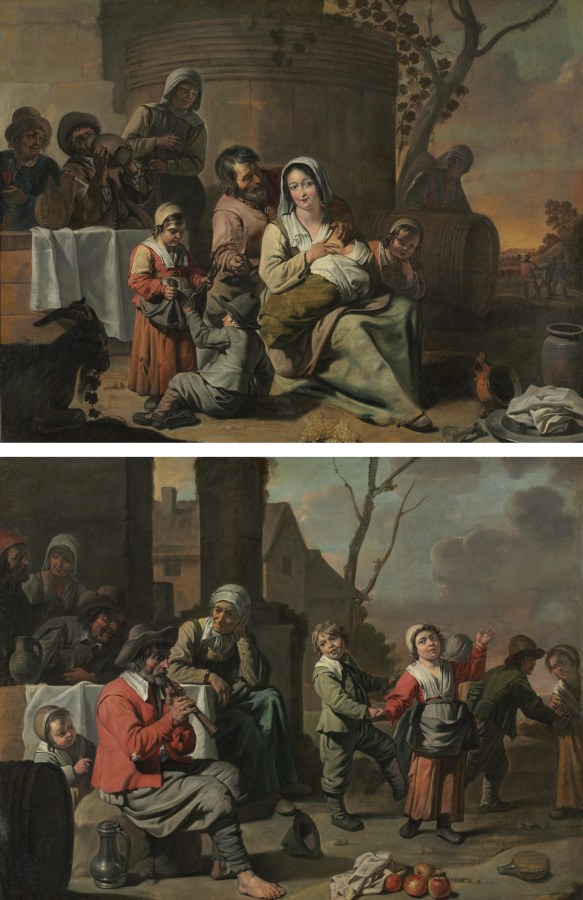
Vintage Scene and Peasant Children Dancing painting pair
Le Nain (French)
- Source:
- Cleveland Museum of Art
- Rights:
- Public domain — free to use, share and adapt.
- Recorded as:
- CC0 (Public Domain)
For dance historians, these paintings offer evidence of how children's movement and play were understood and represented in visual culture, and how rural childhood differed from the formalized education of privileged classes. The absence of formal training or structured dance, and the emphasis instead on natural posture and informal grouping, tells us something about the embodied experience of ordinary people and how artists chose to represent (or not represent) their movement. The pair format suggests a deliberate artistic statement about the value and complexity of everyday rural life.
What you are looking at
These paired paintings depict peasant children in rustic village settings, each presenting a moment of leisure and social interaction. In the upper work, a group of children and young people gather around a stone well or large vessel in a sunlit courtyard. A seated woman in a white headdress tends to or plays with a small child, while others stand or sit nearby in attitudes of casual observation. The architecture suggests a modest rural dwelling, with whitewashed walls and a heavy timber structure visible behind. In the lower painting, the scene shifts to the exterior of a humble cottage. Children are scattered across the foreground in varied poses: some seated on the ground, others standing or crouching, with scattered objects—possibly food or playthings—on the earth. The light is softer and more diffuse, creating a scene of daily rural life with a quieter mood. Both works show careful attention to the textures of worn clothing, the play of light on skin and fabric, and the informal grouping of figures.
The dancing
The bodies are rendered with naturalistic weight and informal postures characteristic of genre painting—seated figures with relaxed spines, standing children with unselfconscious stances. In the upper work, the central woman is shown in a tender, intimate position with a small child, suggesting caregiving or affection. The surrounding figures maintain a loose spatial relationship, neither formally arranged nor rigidly posed; they occupy the space as people naturally would. Hands are visible in expressive positions: holding, reaching, resting. In the lower work, the figures are more scattered and the gestures more varied—some children appear to be playing or eating, others observing. There is no formal dance hold or synchronized movement visible; the poses are those of everyday activity and rest.
The dance depicted
These works do not depict recognizable dance in the formal sense. The grouped children are shown in postures of play, leisure, and daily rural life rather than in structured choreography or ballroom convention. However, the lower painting includes figures in postures that might suggest children engaged in playful movement or games—the scattered arrangement and varied poses of the young figures could imply informal, unstructured play-dancing of the kind that would have been part of rural childhood. This would be folk play rather than trained dance, and any movement shown would be incidental to the work's primary interest in depicting rural childhood and domestic labor.
How it was made
Both works appear to be oil paintings on canvas, executed in the naturalistic mode of 18th-century genre painting. The palette is warm and earthy—ochres, greens, browns, reds—appropriate to rural subject matter and to the diffuse light of peasant interiors and courtyards. The brushwork is loose and confident, particularly in the rendering of fabric and the play of light across surfaces. The composition shows the influence of Spanish genre tradition (particularly Murillo) and Northern European precedent, with careful attention to light as an organizing principle. The paintings were almost certainly created as a pair, suggesting they were commissioned or exhibited together, and their scale and finish indicate they were made for a market that valued detailed observation of rural life.
About this work
These paired genre paintings document rural childhood and domestic life in what appears to be 18th-century Spain or Spanish America, based on costume, architecture, and stylistic convention. Rather than depicting formal dance, they capture moments of play, caregiving, and informal social gathering among peasant children and their guardians. The works belong to the tradition of genre painting that elevated rural and working-class subjects to the status of fine art, a tradition that flourished in the Spanish tradition from Velázquez through Murillo and into the 18th century. While not primarily concerned with dance, they document the social and physical culture of childhood in pre-industrial society, including the kinds of unstructured play and movement that formed children's experience of their bodies and their community.
How to look at it
Attend to the artist's choices about posture and spatial arrangement: the figures are not positioned for display or formal composition, but rather scattered as people naturally would be in an outdoor or semi-public space. Notice how the light models the bodies and fabric, particularly in the upper work where sunlight creates a sense of warmth and intimacy. In the lower painting, observe how the objects on the ground—shoes, food, cloth—anchor the scene in material reality and daily routine. The artist has chosen moments of pause or rest rather than action, which tells us something about how rural childhood was understood: not as dynamic or performative, but as embedded in domestic work and informal social life.
The artist
The artist is not recorded, but the style, composition, and subject matter point to training in the Spanish or Spanish-colonial tradition of the 18th century. The technical competence in rendering light, the compositional maturity, and the access to a market for paired genre paintings suggest a professional artist working within established conventions, possibly in a court or urban center with Spanish cultural influence. The works show familiarity with both Northern European genre precedent and the Spanish tradition of representing peasant life as a serious subject of fine art.
The period
In the 18th century, peasant and rural genre scenes became increasingly fashionable in European and colonial art, partly as a response to Enlightenment interest in natural man and rural virtue, partly as a market demand from an urban mercantile class. In Spain and its colonies, this tradition had deeper roots in the work of Velázquez and Murillo, who had dignified peasant subjects a century earlier. At the same time, the formalized dance traditions of the court and ballroom were becoming increasingly elaborate and codified—a context that makes these paintings' emphasis on natural, unstructured movement and rural childhood all the more pointed. The paired format was itself fashionable for narrative or thematic explorations.
Where it lives
The work is documented in the Cleveland Museum of Art collection. The painting pair format and the museum's identification of them as 'Vintage Scene and Peasant Children Dancing' suggests they were acquired as a narrative or thematic unit, though the current record notes that the artist, date, and medium are not established.
Questions about this work
Is this actually depicting dance?
These paintings document rural childhood and informal play rather than structured dance. The grouped figures show natural posture and casual arrangement typical of genre painting, not the formal holds or synchronized movement of trained dance. However, the scattered figures in the lower work might suggest children engaged in unstructured, playful movement—folk play rather than dance in the formal sense.
What period are these from?
The style, costume, and subject matter point to the 18th century, likely Spanish or Spanish-colonial production. The costume, architecture, and artistic tradition suggest this dating, though the catalogue record does not confirm it. The exact date and provenance remain unknown.
Why are there two paintings?
The pair format suggests these were created as a matched set, possibly to tell a story or explore variations on a theme—perhaps morning and afternoon, or two different moments in the day or in rural life. Paired paintings were fashionable in 18th-century genre art as a way of creating narrative or thematic depth.
Who are these children?
They are depicted as peasant or rural working-class children, shown in their everyday environment. The paintings belong to a tradition that elevated rural and ordinary subjects to fine art, treating peasant life as worthy of serious artistic attention. No specific identities are recorded; these are generic representations of rural childhood.
More dance artwork