49 works in this view — arrow keys or swipe to move between them.
Dance in Art
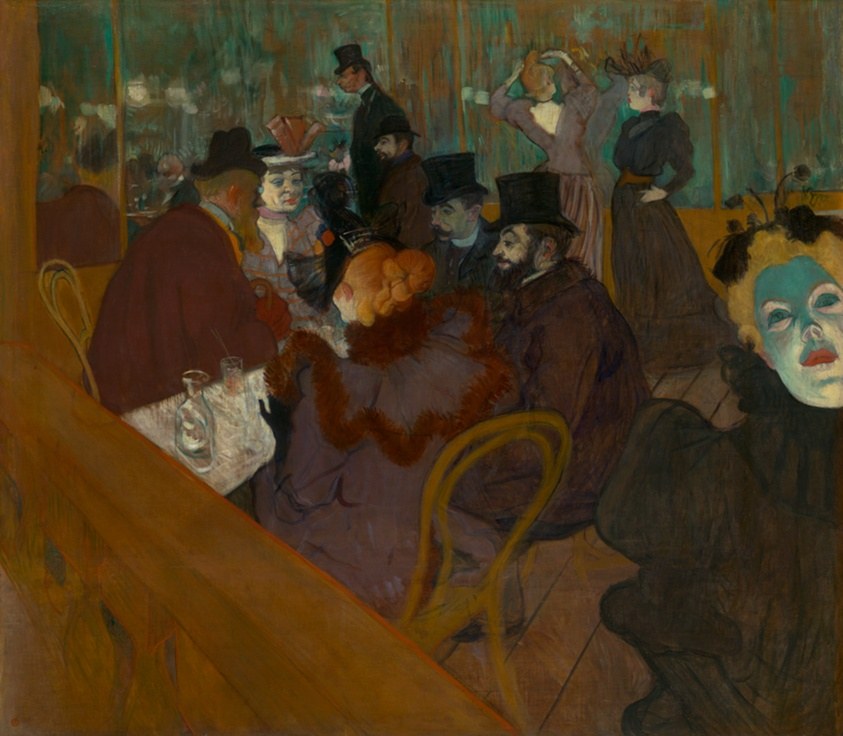
At the Moulin Rouge
Henri de Toulouse-Lautrec
- Source:
- Art Institute of Chicago
- Rights:
- Public domain — free to use, share and adapt.
- Recorded as:
- CC0 (Public Domain)
This work matters because it captures the context and social function of late 19th-century cabaret and dance halls, showing us what the Moulin Rouge looked like from inside and what bodies and dress and performance meant in that space. For dance historians, it documents the audience and venue culture that surrounded theatrical dance in Paris, revealing how dance was embedded in broader practices of social display and spectatorship.
What you are looking at
A crowded interior scene set in what appears to be a late 19th-century entertainment hall or café, the Moulin Rouge suggested by the title. The composition is dense and theatrical, with figures in formal dress—men in dark suits and top hats, women in elaborate gowns with high collars and puffed sleeves—arranged throughout the space. The palette is dominated by warm ochres and browns in the foreground, cool greens and grays in the background, creating atmospheric depth. In the immediate foreground, a woman in a rust-colored feathered garment gestures expressively, her arm raised. Behind her, men in evening dress cluster in conversation. The background shows additional figures, some standing, others seated at what may be tables, with architectural elements—walls, doorways, or mirrors—suggested in green-toned paint. The lighting is artificial and uneven, creating pools of visibility and shadow typical of gas-lit interiors. The overall effect is one of social performance and voyeurism: this is a scene of people watching and being watched.
The dancing
The bodies are positioned in social clusters rather than in partnered dance holds. The foreground figure in the rust-colored garment has her weight shifted, one arm raised in a gesture that suggests speech, animation, or performance rather than dance movement. Other figures stand or sit in conversational attitudes—some leaning in, some turned away—their postures reflecting social interaction rather than coordinated movement. The frame suggests this is about the social spectacle of the venue rather than the execution of any particular dance form.
The dance depicted
This image depicts the social world of the Moulin Rouge rather than dance itself. While the venue was famous for its cancan dancers and cabaret performances, this particular composition focuses on the clientele and atmosphere of the hall rather than on choreographed dance or a specific dance style. If dancing is occurring, it is not the central subject. The image captures the spectacle of presence and display—the way bodies, dress, and light combine to create theatrical effect—but not the mechanics or styles of dance performance.
How it was made
This appears to be a work in oil or mixed media on canvas, characterized by loose, expressive brushwork and a muted palette that builds form through color relationships rather than line. The technique is Post-Impressionist or early Modernist in approach, with visible brushstrokes and a flattened compositional space. The artist has used the fluidity of the medium to capture the haze and visual confusion of an interior lit by artificial light, where forms emerge from shadow and dissolve into background. This technique—loose, atmospheric, prioritizing mood over detail—was well suited to capturing the subjective experience of modern leisure venues.
About this work
This painting depicts an interior scene at the Moulin Rouge, a famous Parisian cabaret and dance hall of the late 19th century. Rather than illustrating a specific dance or choreography, it captures the social theater of the venue: the crowds, the fashionable dress, the play of artificial light, and the atmosphere of modern urban entertainment. The composition and style place it within the broader artistic engagement with modern leisure and nightlife that preoccupied Post-Impressionist and Modernist artists working in Paris during this period. It is a document of dance culture—the world in which dance happened—rather than a representation of dance itself.
How to look at it
Look at how the artist has used color and brushwork to suggest movement and atmosphere rather than depicting it literally. Notice the way the foreground figure's gesture—arm raised, body animated—sets a tone of social performance and display that extends through the entire composition. Observe how the background figures fade into the dim light, creating a sense of depth and the overwhelming visual experience of being in a crowded, artificially lit space. The artist has chosen not to depict a moment of choreographed dance, but rather the ambient social choreography of the venue itself.
The artist
The catalogue record does not identify the artist. From the style—loose brushwork, Post-Impressionist palette, interest in artificial light and modern leisure—the work was likely created by a painter working in Paris in the 1890s engaged with the subject matter of nightlife and entertainment venues. Several artists of that era produced such scenes.
The period
The Moulin Rouge opened in 1889 and quickly became one of Paris's most famous entertainment venues, known for its cancan dancers and spectacular productions. In the 1890s, the hall attracted artists interested in the visual and social spectacle of modern urban leisure. This was the era of Henri de Toulouse-Lautrec's iconic posters and paintings of the Moulin Rouge, and of broader artistic fascination with cabaret culture. The painting reflects the late 19th-century artistic engagement with modern city life, artificial light, and the figure of the entertainer or performer.
Where it lives
The work is recorded in the Art Institute of Chicago. It is listed only as 'Artwork from the Art Institute of Chicago' with no accession number, date, medium, or artist name provided in the catalogue record.
Questions about this work
Is this a painting of dancers performing?
No. While the image depicts the Moulin Rouge, a famous dance hall, it shows the social world of the venue—the audience, the atmosphere, and the spectacle—rather than choreographed dance performance. If dancing is occurring, it is not the primary subject of the composition.
Can you identify the artist?
The catalogue record does not identify the artist. The style—loose brushwork, Post-Impressionist color, interest in modern leisure venues—suggests a painter working in Paris in the 1890s, but without signature or documentation, attribution cannot be certain.
What dance style did the Moulin Rouge feature?
The Moulin Rouge was most famous for the cancan, a high-energy, leggy dance performed by women dancers. The hall also hosted other cabaret and variety entertainment. This particular painting does not depict cancan or any specific dance, but rather captures the venue's social atmosphere.
Why do art historians care about paintings of dance halls?
Such works document the social and visual context in which dance was performed, consumed, and understood. They show us what venues looked like, how audiences were composed, what the relationship between performers and spectators was, and how dance fit into broader leisure and entertainment cultures of the period.
More dance artwork