49 works in this view — arrow keys or swipe to move between them.
Dance in Art
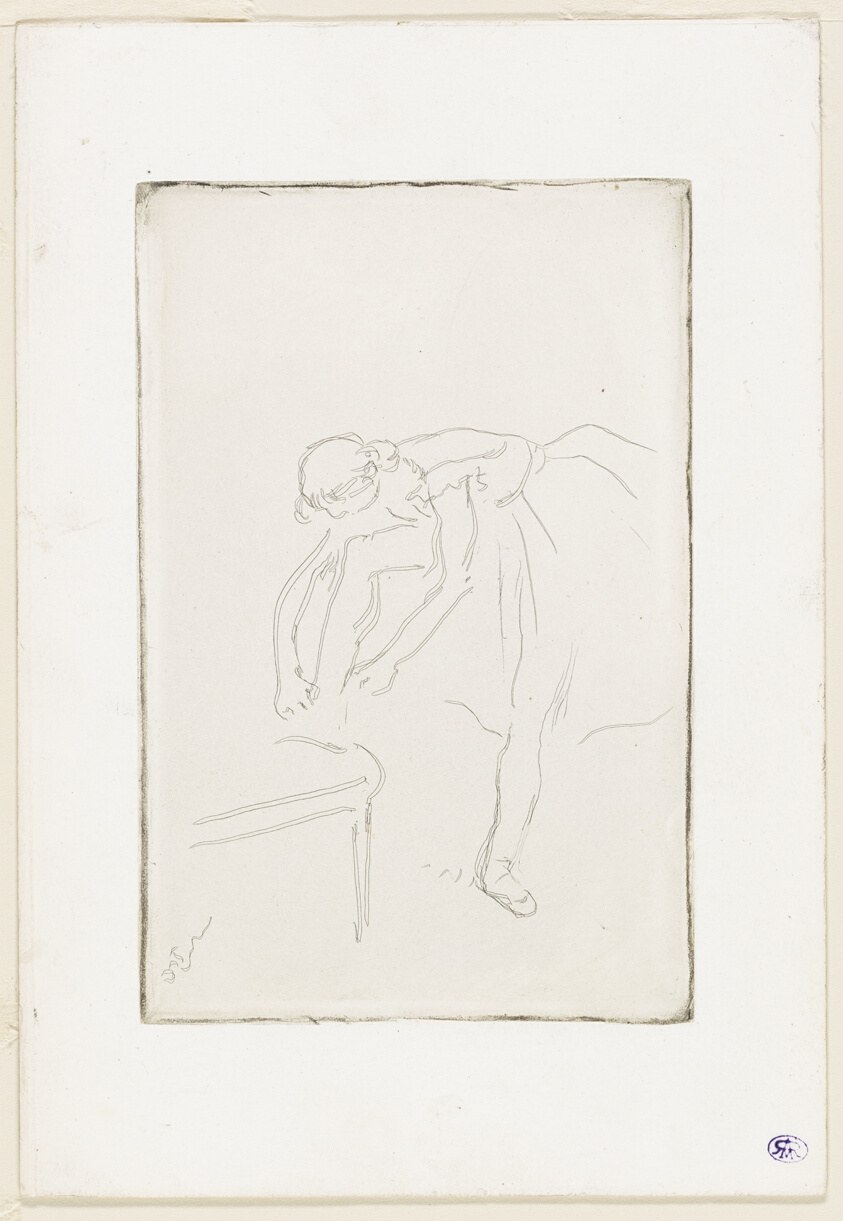
Dancer Putting on Her Shoe
Hilaire Germain Edgar Degas
- Source:
- Art Institute of Chicago
- Rights:
- Public domain — free to use, share and adapt.
- Recorded as:
- CC0 (Public Domain)
This drawing reveals the 19th-century expansion of dance as a subject beyond performance and into the realm of life study. The choice to represent not a leap or turn but the private act of dressing shows how dancers' bodies had become objects of sustained artistic attention, worthy of the same careful observation given to classical poses. For historians, it documents the aestheticization of the dancer's body in ordinary life.
What you are looking at
A single female dancer is shown in a moment of domestic intimacy—seated or crouching, engaged in the simple act of putting on her shoe. The figure is rendered in delicate pen or pencil line, with minimal shading, against an empty background. Her body is folded forward in a posture of concentration, one leg extended or bent as she attends to her footwear. The drawing captures neither a performance nor a formal dance studio, but rather a private, everyday gesture that has been treated with the careful observation usually reserved for theatrical subjects. The spare composition and intimate scale suggest this is a study from life or a preparatory sketch, the kind of drawing a dance artist or observer might make to capture the beauty of the body in an unguarded moment.
The dancing
A single figure is shown from roughly a three-quarter view, her torso bent forward at the waist in a deep fold. Her arms are engaged in the action of fastening or adjusting her shoe, with one arm reaching down toward the foot. The weight of her upper body appears to rest forward, creating a curve through the spine. Her head is lowered toward her work. The posture is asymmetrical and organic rather than balletic—this is the body at rest, attending to a practical task, not striking an attitude. There is no suggestion of turned-out legs, pointed feet, or the formal frame of classical dance.
The dance depicted
This drawing does not depict dance in any conventional sense. Instead, it captures a dancer (or a model posed as one) in a moment outside performance—the private, unglamorous business of dressing. The image belongs to a tradition of artists observing the body in quotidian states, a practice especially common in late 19th-century European art where dancers and their bodies became subjects of fascination even when stationary. The pose itself is anti-balletic: there is no lift, no turnout, no extension. It is instead a study in the natural form and in the dignity of ordinary movement.
How it was made
This is a pen or pencil drawing on paper, likely a sketch or study rather than a finished work. The line is fluid and economical, with minimal modeling or shading; the artist has used the line itself to describe form and movement rather than relying on tone. The execution suggests confidence and training—the hand moves with certainty even as it captures spontaneity. This technique allows for rapid execution and was typical of studio practice: dancers and models were observed in quick sketches that trained the eye and hand for larger compositions.
About this work
This is a single-figure study in line, showing a dancer or female model in the moment of putting on her shoe—a domestic, off-stage gesture rendered with the care usually lavished on theatrical subjects. The drawing belongs to a tradition of artists finding dignity and formal interest in the unguarded body, especially in the late 19th and early 20th centuries when dancers became paradigmatic subjects for modernist observation. It is neither a record of a choreographic moment nor a portrait, but something between: a study of the figure in motion, even at rest. The work demonstrates the artist's interest in the body's natural geometry and in the poetry of everyday gesture.
How to look at it
Attend to the curve of the spine and the weight of the upper body folded forward—this is not a pose but a genuine posture of concentration. Notice the lack of any balletic convention: no turned-out legs, no elongation, no lift. The artist has chosen a moment of vulnerability and privacy, and has rendered it with respect and attention to the natural architecture of the human form. The economy of line means that every mark counts; there is no ornament, only observation.
The period
In the late 19th century, dancers and the dancer's body became increasingly central to avant-garde art practice, especially in France. The influence of Japanese prints, the rise of photography, and the revolution in observational drawing meant that artists were finding new interest in the body in motion and at rest. Edgar Degas's many studies of dancers—both in the studio and backstage—had established the dancer as a legitimate and inexhaustible subject. By the turn of the 20th century, such studies proliferated, part of a broader interest in capturing the transient and the informal. The domestic, unglamorous view seen here reflects this climate: the body was no longer required to perform in order to be art.
Where it lives
The work is held in the Art Institute of Chicago and is documented as part of their collections. It is a drawing on paper, catalogued as an artwork from an unknown period and an unidentified artist.
Questions about this work
Is this a ballet dancer?
The subject may have been a dancer, but this drawing does not show dance. It shows a figure at rest, engaged in the practical act of dressing. The absence of any balletic positioning—turned legs, pointed feet, extended frame—suggests the artist's interest lies in the natural body rather than in the codified forms of ballet.
Why would an artist draw something so ordinary?
By the late 19th century, artists had begun to find aesthetic and formal interest in unguarded, everyday moments. Dancers' bodies, in particular, fascinated artists whether they were performing or not. This drawing reflects that shift: the private moment is treated with as much care as a theatrical tableau.
What technique was used?
This appears to be a pen or pencil line drawing, likely a study made from life or observation. The fluid, economical line and the absence of heavy shading suggest the artist worked quickly and with confidence, capturing form and movement through the line itself rather than through modeling with tone.
More dance artwork