49 works in this view — arrow keys or swipe to move between them.
Dance in Art
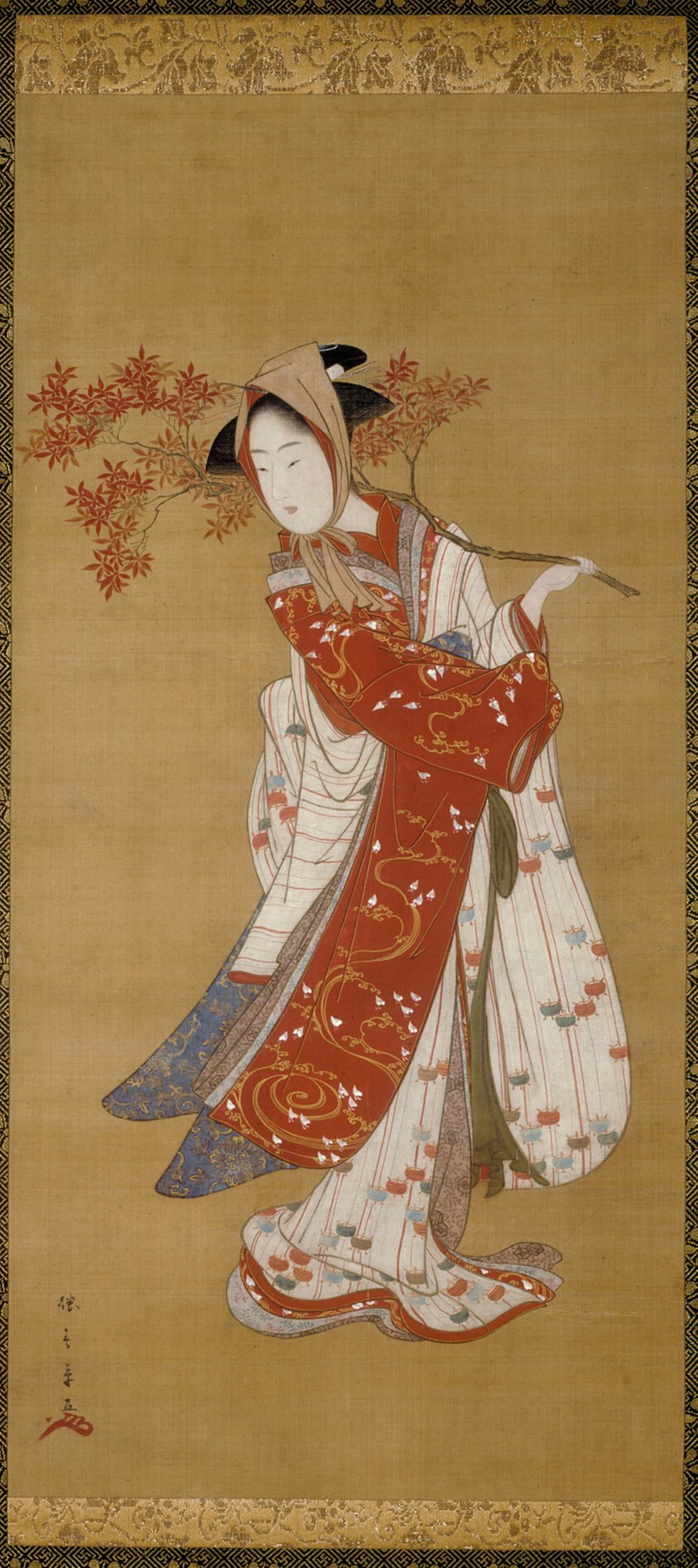
Dancer with a Maple Branch
Katsukawa Shunsho
- Source:
- Art Institute of Chicago
- Rights:
- Public domain — free to use, share and adapt.
- Recorded as:
- CC0 (Public Domain)
This print preserves evidence of Japanese theatrical dress, prop usage, and the visual conventions governing stage presentation in the Edo period. For dance historians, it illustrates how performance costumes functioned as vectors of meaning, how seasonal imagery was deployed in theatrical contexts, and the relationship between stillness and theatrical presence in Japanese performance traditions.
What you are looking at
A single female figure stands against a plain gold background, wearing an elaborate multi-layered costume in red and white with blue accents. She holds a branch of maple leaves in her right hand, extending it gracefully across her body. The figure wears a cream-colored outer robe (likely an *uwagi* or overgown) with a delicate geometric pattern, layered over a red inner robe decorated with gold scrollwork and scattered white flowers or blossoms. A decorative blue-patterned under-robe is visible at the hem. Her head is covered with a cream-colored cloth hood or *zukin*, typical of theatrical or formal dress of the Edo period. The maple branch, rendered in warm rust tones with detailed foliage, creates a diagonal compositional line that guides the eye through the figure's posed stance. The work exhibits the refined linear quality and decorative patterning characteristic of Japanese woodblock prints, with careful attention to textile design and the subtle modeling of the fabrics through line and color gradation.
The dancing
The figure's posture is upright and graceful, with the body angled slightly in three-quarter view. The left arm hangs naturally while the right arm is raised and extended, holding the maple branch at roughly shoulder height with a relaxed grip. The weight appears evenly distributed, suggesting a moment of pause or repose rather than active movement. The figure's face is rendered with the delicate idealized features typical of Edo-period *bijin-ga* (pictures of beautiful women), with a serene, downward-gazing expression. The silhouette created by the layered garments emphasizes a columnar, elegant line from shoulder to hem.
The dance depicted
This appears to be a theatrical or courtly figure rather than a depiction of active dance. The costume and pose suggest association with classical Japanese performing arts, possibly *Kabuki* or *Noh* performance contexts, where such elaborate dress and still, posed moments are fundamental. The maple branch (*momiji*) is a seasonal motif in Japanese theater and literature, often associated with autumn and melancholy. The figure's stillness and the emphasis on costume detail suggest this is a portrait of an actor or performer in character or in formal dress, captured in a moment of theatrical repose rather than choreographed movement. Without evidence of dynamic movement, multiple figures, or a clear narrative dance scene, this should be classified as depicting theatrical costume and performance context rather than dance itself.
How it was made
This is a hand-colored woodblock print (*ukiyo-e*), executed with the characteristic techniques of Japanese color woodblock printing. The composition relies on bold linear definition to structure the figure, with careful color separation creating distinct passages of crimson, cream, and blue. The delicate rendering of the maple leaves and the geometric patterns on the textiles demonstrate the refinement possible within the medium's constraints. The gold background appears to be applied pigment rather than printed color, suggesting additional hand-finishing. The scale and style indicate this was created for a commercial print market, likely intended for collectors interested in theatrical subjects or images of beautiful women.
About this work
This is a woodblock print depicting a figure in elaborate Edo-period costume, holding an autumn maple branch. The work exemplifies the *bijin-ga* tradition—pictures of beautiful women popular in Japanese printmaking—while incorporating theatrical dress and props suggestive of *Kabuki* or similar performance contexts. The figure's stillness, refined costume, and melancholic seasonal imagery place it at the intersection of performance art, textile design, and landscape poetry rather than in active dance choreography. The work documents the visual culture of Japanese theater and the aesthetic values governing stage costume and performer presentation during the Edo period.
How to look at it
Observe how the artist has frozen the figure in a moment of theatrical repose—not mid-movement but in a posed, presentational stance characteristic of actor portraiture. Notice the intense decorative focus on the layered textiles: the geometric patterns on the outer robe, the gold scrollwork on the crimson under-robe, and the contrasting blue. The maple branch functions both as a seasonal attribute and as a compositional device that breaks the vertical symmetry of the figure. The serene facial expression and the elegant line created by the drapery suggest an aesthetic valuing restraint, refinement, and the beauty of stillness over dynamic action.
The artist
The artist is not recorded in the catalogue. The style and execution are consistent with mid-to-late Edo period *ukiyo-e* printmaking, suggesting the work was produced by a printmaker specializing in actor portraits or *bijin-ga*. The refined draftsmanship and attention to costume detail indicate a skilled practitioner working within an established commercial tradition. Without a signature or colophon visible, further attribution would require comparative stylistic analysis.
The period
This work was created during the Edo period (1603–1868), when *Kabuki* theater was at its cultural apex and the woodblock print industry was producing thousands of images for an expanding urban market. The emphasis on costume, the theatrical associations, and the focus on the beautiful female figure reflect the era's fascination with performance and performers. The autumn maple motif links the image to the seasonal aesthetics and melancholic beauty (*mono no aware*) that pervaded Japanese literature and visual culture. Japanese theater of this period was highly codified, with elaborate costume systems communicating character type, rank, and narrative context to audiences familiar with theatrical convention.
Where it lives
The work is held by the Art Institute of Chicago. It is catalogued as a Japanese print from an unknown era by an unknown artist, indicating it likely entered the collection as part of a broader acquisition of Edo-period woodblock prints, a collecting focus of American museums in the late 19th and early 20th centuries.
Questions about this work
Is this person dancing?
Not actively. The figure is posed in a still, presentational stance typical of theatrical portraiture or costume documentation. The focus is on the elaborate dress and seasonal props rather than on choreographed movement. In Japanese theatrical traditions, stillness and refined posture are themselves expressions of theatrical presence and meaning.
What is the maple branch for?
In Japanese theater and literature, the maple leaf (*momiji*) is an autumn symbol associated with transience and melancholy beauty. As a theatrical prop, it identifies the character or moment and reinforces seasonal and emotional context. The branch also functions compositionally, creating a diagonal line that enlivens the otherwise vertical figure.
What kind of theater is this costume from?
The elaborate costume, the theatrical pose, and the style of the print suggest either *Kabuki* or possibly *Noh* performance contexts, though the *bijin-ga* format and the emphasis on female beauty point more toward *Kabuki*. The specific character cannot be identified without additional inscription or provenance information.
Why is the artist unknown?
Many Edo-period prints, especially those created for commercial distribution, went unsigned or were attributed to print publishers rather than individual artists. The work entered the Art Institute's collection without an attribution, and subsequent research apparently did not identify the maker.
More dance artwork